


Names and identifying details of every student below have been changed.
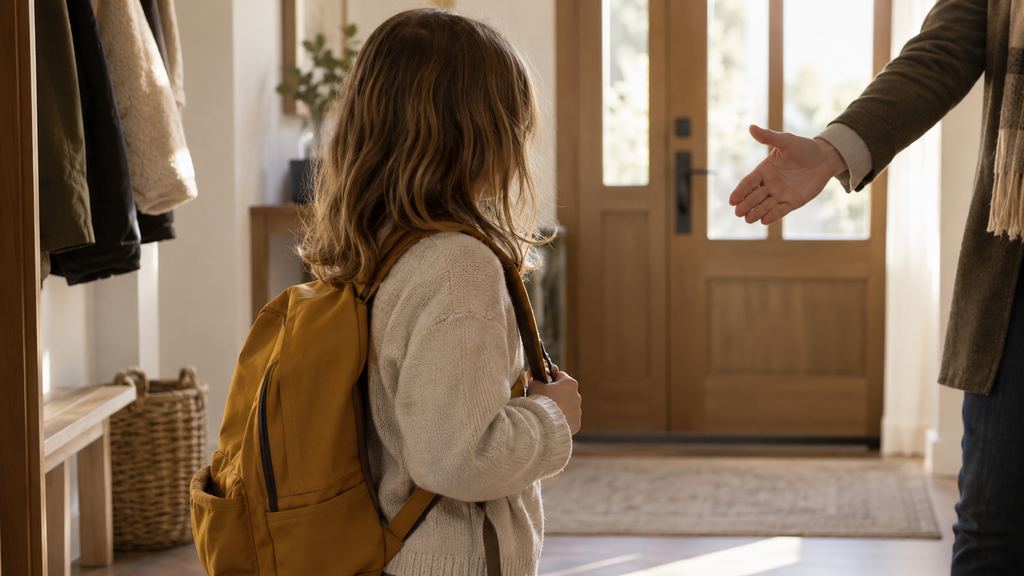
I’ve stood in a hallway telling a child to say hello, shake a hand, kiss an aunt goodbye, and not be like that. Each was reasonable alone. I never added them up. Together, repeated across a childhood, they teach one lesson: your comfort is negotiable and an adult’s feelings outrank it.
Eight years of teaching the opposite
Then the child turns eleven and we would like them to refuse things: the friend copying their homework, the group chat, the boy who keeps taking their pencil. They can’t, any of them. The skill was never taught, and worse than that, it was untaught by us over years, with the best intentions available at the time.Boundaries are a habit. Habits get practiced somewhere, or they don’t exist.
An eight-year-old needs a different word for it
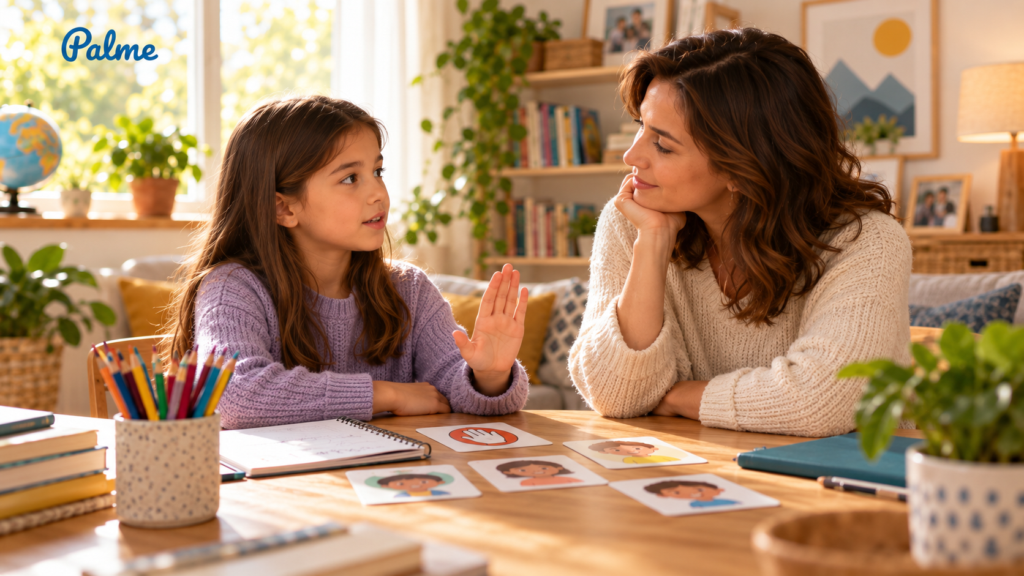
Skip the word itself. Nobody under twelve wants to hear the phrase personal boundaries, and the abstraction turns an ordinary Tuesday afternoon into a subject with a worksheet attached. What works is concrete: a boundary is the line where my business stops and your business starts. My body is my business. My things are my business. What we play is partly mine and partly yours, so that one gets negotiated.Children get this immediately, because they already run the rule the other way around. Every child alive knows the exact moment somebody has taken something of theirs, and can tell you what it was, and when.
One of these leaves a residue
Adults get this one wrong as often as children do, and the whole subject turns on it. Kindness is chosen. People-pleasing is handed over because refusing feels dangerous. From outside they look identical. From inside they feel nothing alike, and the second one leaves a residue that lasts well past the afternoon it happened in.
American schools file this area under social and emotional learning, and the meta-analytic evidence says the skills respond to being taught directly. Nadia, ten, in the Portland suburbs, let a classmate copy her homework for most of a school year. Her mother found out in April. Nadia said she hadn’t wanted to be mean, which is the answer I get most often and the one that worries me most.Nice and yes are not the same word.
She had learned the first half of a rule and never got the second half. Be nice, yes. Being nice does not mean saying yes to whatever is asked, and nobody had ever told her the two were separable. Her name and the details are changed, as they are everywhere on the blog.The scripts
Parents ask for words, so here are mine. Children should change them until they sound like themselves, because a borrowed sentence delivered flat convinces no one. The friend who asks too much gets I’m not doing that one, but I’ll sit with you while you do it. That is the shape that matters. A refusal arriving with something offered is survivable for a child who would otherwise say yes to anything at all. A game that stopped being fun gets I’m done with this, I’m going to go do something else. No justification. Children over-explain because they expect to be argued out of it, and the explanation is exactly what gives the other child something to argue with. Something already taken gets That’s mine, put it back. Notice what isn’t in it. No please, no could you, no rising note at the end. Each turns a statement into an opening bid, and bidding is what the child wanted to skip. And when no sentence is available, leaving is a boundary. It counts. A child who cannot say it yet can still walk to another table, and the walking teaches the same thing. Our piece on joining a group covers the opposite motion, and the two turn out to be siblings.The refusal that works is the one the child can actually get out of their mouth.
The part with adults
A child trained to comply with every adult is easier to manage and less safe.
Two things are worth stating flatly at home, in the voice you use for road safety. Physical affection is never owed to anybody, relatives included. A wave does the same job. And no adult gets to ask a child for a secret their parents can’t know. Surprises have end dates. Secrets don’t. That difference is the whole rule. Beyond that, keep it ordinary rather than frightening. A child who can tell you something awkward without the roof coming off has what matters, and it gets built on ordinary days.Why this is hard for the child
Saying no is not one skill but at least three running at once. You have to notice something is wrong, which means attending to your own discomfort instead of the other person’s face. You have to override the automatic yes, and inhibition is one of three core abilities, with the whole apparatus still building well into a person’s twenties. And you have to produce a sentence under social pressure, which is where most children fail, and not because they lack the words. Whether a person speaks up at all turns on their own estimate of how they are doing rather than their measured ability, an argument MacIntyre and colleagues made about second languages and carries over to a lunch table without much strain. There is a fourth thing, easy to miss. Declining in advance is the cheapest move a child has, and the first strategy in the standard model of emotion regulation, which is the model our piece on why children explode over small things runs on from beginning to end. Say no to the sleepover and you have spent nothing. Say yes, then want to leave at eleven at night, and you pay in full.What makes it harder at home
Practice with peers, the only place it costs anything, because at home you forgive the graceless refusal and the wrong tone and the bad timing, which is what parents are for and which removes the thing being learned. Small groups do this well: a refusal there has consequences, and survivable ones. The three core abilities underneath are still under construction throughout. In our lessons for bilingual kids, a child holds a turn while four others want it, and in the conversation school the whole task is producing speech under mild social pressure. Neither is a course in assertiveness. What they are is four other children who would rather you said yes.Nadia said no in May. It took four seconds and was, she reported with some disappointment, far less interesting than she had spent months expecting.
At Palme School we teach online, in groups of up to eight, two forty-minute classes a week, and the first two lessons are free. You can book those here, and there are printable materials for parents in our resource library.Frequently asked questions
With your own household rules rather than a conversation about the concept. Let refusals stand when they are inconvenient, stop requiring reasons, and drop the compulsory hug.
The lesson is carried by what happens when a child says no to you.
Pair the refusal with something offered. I’m not doing that, but I’ll do this. It keeps the relationship intact and keeps the answer.
Rudeness lives in the delivery rather than the refusal, and most children need to be told that explicitly.
This is the part that gets harder, and two rules cover it. Hugs are never owed to anybody, which is where personal boundaries for kids get tested first, and a wave does the same job. And no adult should ask a child to keep a secret from their parents, which is the line between a surprise and a secret.
Sources
- Center on the Developing Child, Harvard University. (May 20, 2012). InBrief: Executive Function. developingchild.harvard.edu
- Collaborative for Academic, Social, and Emotional Learning. (n.d.). What Is SEL? casel.org
- Diamond, A. (2013). Executive Functions. Annual Review of Psychology, 64, 135–168. doi.org
- Durlak, J. A., Weissberg, R. P., Dymnicki, A. B., Taylor, R. D., & Schellinger, K. B. (2011). The impact of enhancing students’ social and emotional learning: A meta-analysis of school-based universal interventions. Child Development, 82(1), 405–432. onlinelibrary.wiley.com
- Gross, J. J. (1998). The emerging field of emotion regulation: An integrative review. Review of General Psychology, 2(3), 271–299. doi.org
- MacIntyre, P. D., Clément, R., Dörnyei, Z., & Noels, K. A. (1998). Conceptualizing willingness to communicate in a L2: A situational model of L2 confidence and affiliation. The Modern Language Journal, 82(4), 545–562. onlinelibrary.wiley.com
Palme School: Russian for bilingual children · Conversation school · Free materials for parents
Lily Rozberg has been teaching for sixteen years, first English in Russia and now Russian to bilingual children across the US and Canada. She writes for Palme School about heritage language, reading, and the things report cards do not measure.