


Names and identifying details of every student here are changed, as they are everywhere on the blog.
Two years of one wrong word
One of my students had been buying bread in Russian for two years before anybody told him, and the person who finally did was not a cashier but his own daughter.Read this one first
The mechanisms behind everything below are explained in How to do a Russian accent
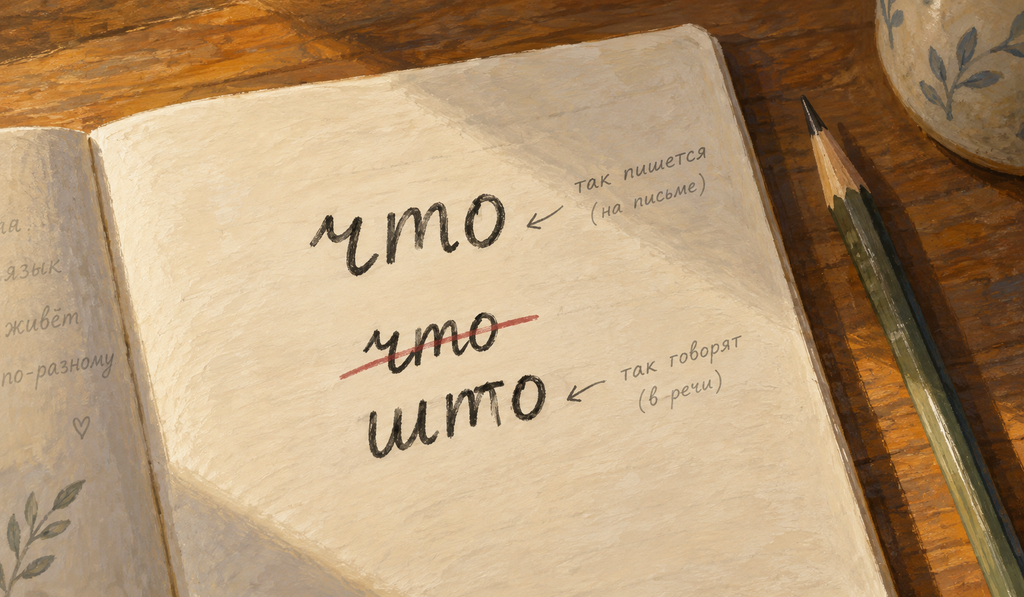
I’ve been saying it like that for two years and nobody said anything.
A student, on discovering how хлеб is pronounced
Written Russian is not a recording. Four things happen between the letters and the sound.
Where the stress lands. What the unstressed vowels do around it. Whether each consonant is hard or soft. And what happens to a voiced consonant at the end of a word. Our guide to the Russian accent explains why the first three work the way they do, and this piece does not repeat any of it. It works through actual words instead, because a rule you have read and never applied to a word you needed is not yet knowledge.The fourth thing, which nobody warns you about
Start where the bread was, because it is the one thing on this page not covered anywhere else, and because it applies to words you already know rather than words you have yet to meet.
A voiced consonant at the end of a Russian word loses its voice. Not sometimes, and not only in careless speech, but always, in every word, including in the mouths of people reading the evening news.Listen to the endings
Three words, each written with a voiced consonant and said with a voiceless one. The difference is at the very end, and it is easy to miss the first time.
хлеб
khlep
Written with *б* (b), said with *п* (p). Bread, and one of the first words anybody learns.
друг
druk
Written with *г* (g), said with *к* (k). The last sound is not the one on the page.
сад
sat
Written with *д* (d), said with *т* (t). Garden, and it rhymes with what you would write as сат.
A word can be entirely correct on paper and still announce that you learned it from a page.
English does something similar and never commits to it: the d at the end of a word loses some of its voicing without ever turning into a t. Russian commits, every time, which is why the same three letters catch every English speaker who learned the word from a shopping list.Stress, and the vowels that bend around it
Russian stress is not marked in ordinary writing, it moves between forms of the same word, and every vowel bends around wherever it lands. So the spelling is a different language from the speech, one student said, which is not quite right and close enough to be useful. The spelling records the word. The stress records how it is said, and it is the part nobody prints.Listen to the endings
Okay
kha-ra-SHO
Stress on the last syllable. The first two vowels are written *о* (o) and neither is said as one.
молоко
ma-la-KO
Same pattern, three written *о*, only the last one full. The standard demonstration.
this
E-ta
Stress on the first. The final *о* weakens toward *а* (a).
Hard and soft, priced in real words
That mechanism sits in the other article, so what follows is only the price you pay when the difference disappears from a word you meant to say.| Written | If you harden it | What it becomes |
|---|---|---|
| мать (mat’) | мат (mat) | Mother becomes a swear word |
| быть (byt’) | быт (byt) | To be becomes daily routine |
| ель (yel’) | ел (yel) | A fir tree becomes ate |
I said мат (mat) to a colleague’s mother.
A student, entirely calm about it by the time he told me
Three words that are shorter than they look
These three come up in the first month, they carry three of the four rules between them, and every one of them is shorter said than written.Listen to the endings
здравствуйте
Hello
The first *в* (v) is not said at all. Nobody pronounces every letter here, including Russians.
thank you
Spasiba
Stress in the middle, final *о* weakened. Said fully, it sounds like a word from a phrasebook.
please
PA-ZHAL-sta
Four syllables written, three said. The middle collapses in ordinary speech.
Nobody said I could skip letters.
A student, and skipping is the wrong word for it
What a dictionary gives you, and what I still get wrong
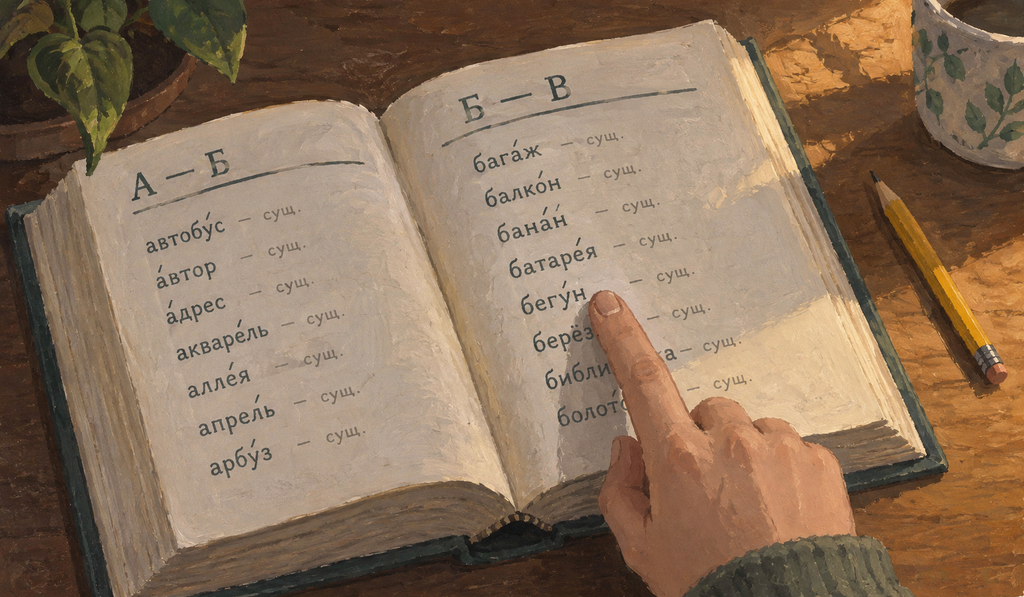
Dictionaries show the stress, which is the thing you cannot guess. They say nothing about the reduction or the devoicing, because both follow automatically once the stress is placed and nobody prints what follows automatically, and nothing about softness because the spelling has already shown you that one.
The same thing happens to me in the other direction, and sixteen years of teaching the language have not made it go away. Give me an English word I have met only in print and I will put the stress where a Russian would. I know this happens. I can’t predict which words, because by definition they are the ones I have not heard.
For years I said clothes with both consonants at the end, carefully, the way it is written, and nobody mentioned that either. A colleague eventually said it back to me the ordinary way in the middle of a sentence, not correcting me, just saying it, and I heard the difference and stopped.You cannot reason your way to how a word sounds. You can only have heard it.
Related reading at Palme School
How to do a Russian accent
The mechanisms behind everything on this page, including why soft consonants exist at all
Best apps for learning Russian
Which parts of pronunciation software can genuinely check and which it cannot hear
Speaking Russian with confidence
If worrying about getting words wrong is what keeps you quiet
Somebody has to hear you say it
Pronunciation is the one thing you cannot check on your own. Two free lessons to start.
Start with a free lessonNothing charged, nothing renews.
Frequently asked questions
You look it up or you hear it. Dictionaries show it, and after a few hundred words the common patterns start doing some of the work for you.
Because a voiced consonant at the end of a Russian word always loses its voice. The б (b) is written and a п (p) is said, and the same happens to г (g) and D (d) in that position.
Yes, and it is the difference between sounding careful and sounding Russian. An unstressed о (o) moves toward а (a), and the further it sits from the stress the weaker it becomes.
You can learn the rules alone. What you cannot do alone is find out which words you are getting wrong, because the mistakes that matter are the ones you cannot hear yourself making.
Palme School: Russian for bilingual children · Conversation school · Free materials
Lily Rozberg has been teaching for sixteen years, first English in Russia and now Russian to bilingual children across the US and Canada. She writes for Palme School about heritage language, reading, and the things report cards do not measure.