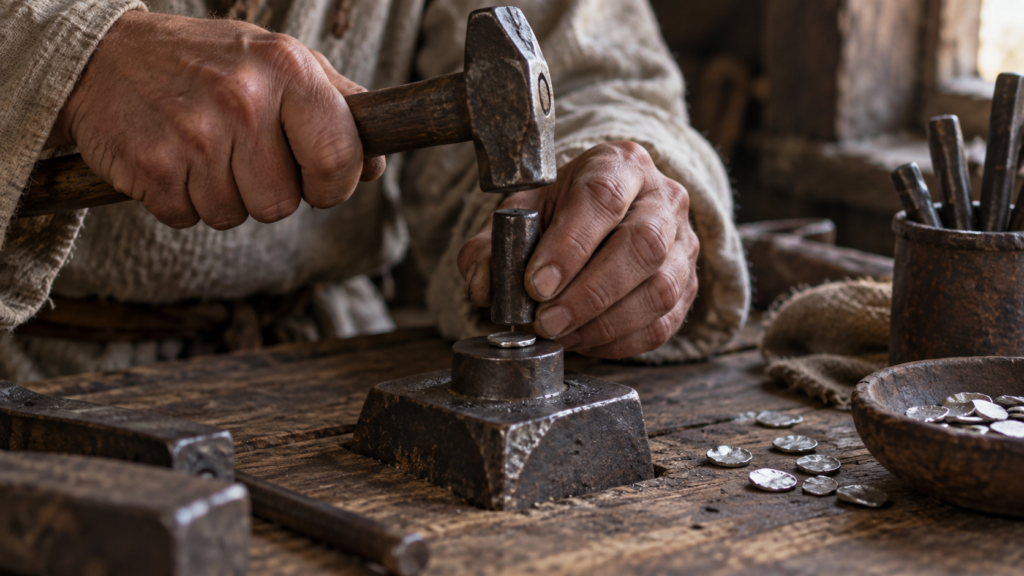

A coin the size of a thumbnail, curved, silver. On one side is a Russian princely inscription. On the other is an Arabic inscription. In the 1834 edition of «The Description of Ancient Russian Coins,» Alexander Chertkov quotes a reading by the orientalist Christian Frent: on the coins attributed to Dmitry Donskoy and his son Vasily, he discerned the name of Khan Tokhtamysh and a wish for long life.
Such coins (numismatists write «denga») were minted in Moscow in the late 14th century.
That is, the name of the khan is worth the money of the prince who defeated Mamai on the Kulikovo field.
Mamiy and Tokhtamish
The strangeness disappears if you take a closer look at who exactly was defeated in 1380.
Mamy was not a khan. He was a powerful military commander who appointed people convenient to him to the Orda throne and ruled in their name. The Orda was divided between rivals during those years, and Dmitry fought against Mamy's army, one of those who fought for power in it. After Mamy's defeat, Tokhtamish crushed his remaining forces and established his rule over the part of the Orda that he controlled.
The Kulikovo victory did not end the dependence of the Horde. In 1382, Tokhtamish came to Moscow on his own; the city was burned down, and after the devastation, the payments resumed. The name of the Horde Khan on the Moscow silver coin is quite appropriate in this context.
This dependence began a half-century and a half before, with the campaigns of Batu in 1237–1240. After that, the princes ruled according to the khan’s regulations and sent a tribute of silver to the Horde on a regular basis. Over time, the Moscow princes acquired the right to collect it from other principalities, and Vasily Klyuchevsky considered these powers as one of the tools for strengthening Moscow. They paid with the same metal from which the Moscow denge was later minted.
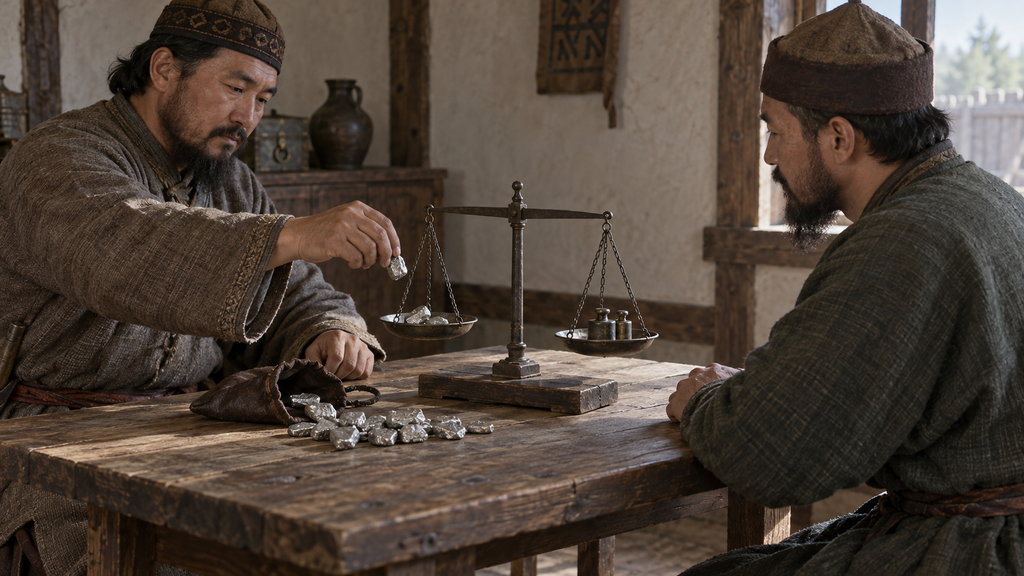
The princely side appears on the Moscow coin, but the Khanic legend remains alongside it. Even the small denaga shows how independent Moscow already was and how much it still remained within the Oiridian political system.
Connection with the name of the Moscow prince
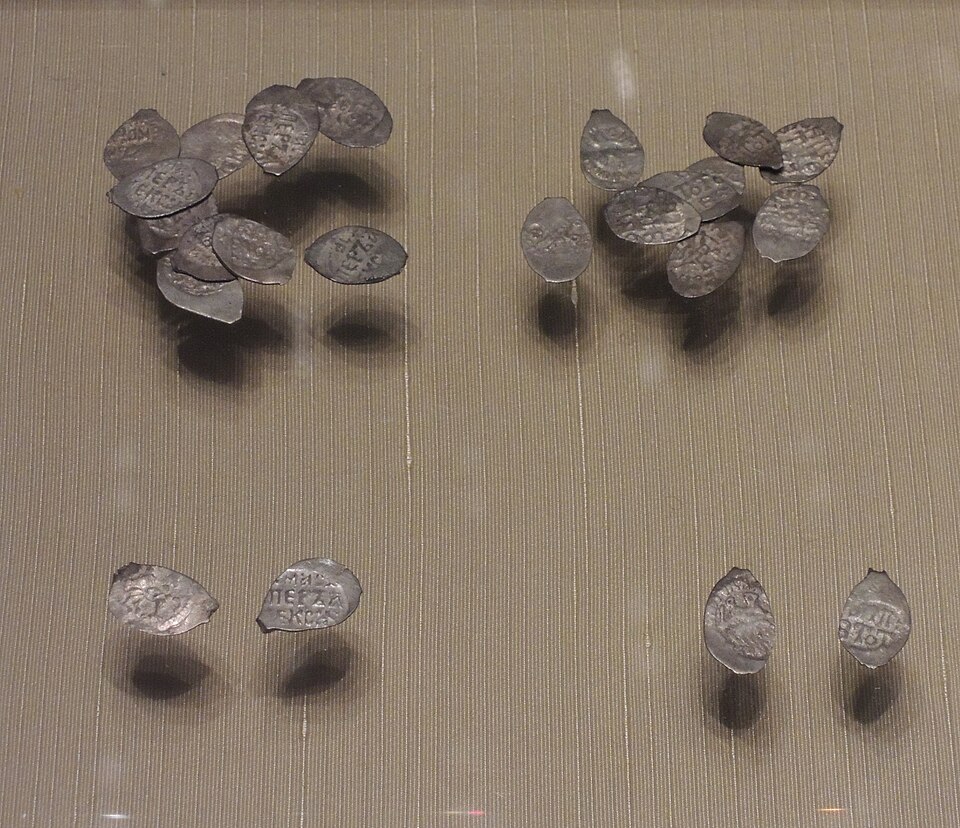
The origins of the Moscow mint remain a subject of debate. Researchers associate it with the time around the Battle of Kulikovo, but they disagree on whether Moscow had its own money shortly before or after the battle. The dispute over the date here largely concerns when Moscow decided to mint its own silver coins.
There is also debate over the meaning of the khan's name. Some see it as a sign of tribute levied at the very sight of the coin. Others point out that Moscow traded with the Volga region and the East, where the Orda coin was a common standard. As early as 1910, numismatist Ivan Tolstoy warned that the khan's name on a Russian coin did not always mean submission; the engraver could simply copy the coin circulating in circulation.
The dependence itself is more clearly evident. In 1408, already under the son of Dmitry Vasily I, Yeyegey arrived in Moscow. Dmitry's grandson, Vasily the Dark, also received the khan's confirmation of the grand prince title. The victory over Mamai remained the most important event, but relations with the Horde continued to determine the lives of the Moscow princes for several generations.
By the end of the 15th century, the Horde had broken up into separate khanates. Under Dmitry's grandson, Ivan III, The withdrawal payments ceased, and in 1480 Khan of the Great Horde Akhmat marched on Moscow. His army attempted to cross the Urga River, but attacks repelled it, and after several weeks of confrontation Akhmat retreated. This year is considered the end of dependence.
And the story didn’t end there. On the Novgorod daguerreotype of Ivan III, which is dated 1478–1490, the Russian title «lord of all Rus»” is inscribed around the image, and in the center the Arabic script indicates the name of the prince himself. The letter that once used to be written in the khan’s name has now become the name of the Moscow grand prince.
What's left in the wallet

The very name of the coin comes from there. According to Fsamer’s dictionary, the word «denge» comes from the Turkic name for a silver coin; from it, the word «denge» was also formed. The word has proven to be more enduring than both the Horde and the denge itself, and now it is used to refer to any money, even the ones that are on the map.
Other words are from the same root. «Customs» is related to tamgo, that is, a stamp, a seal, and also to customs duty. «Jamsik» also comes from Turkic languages and is related to a jam, a post office where horses were exchanged. «Yarlik» is of Turkic origin, and from the khan’s decree it became a paper on the goods. All four words are related to Turkic languages, so calling them Mongolian is not entirely accurate.
How historical events changed the vocabulary, we told in an article about the history of the development of the Russian language. And there is also the question of how Russian words, on the contrary, migrated to English. separate article.
The Horde that didn't exist then
The name «Golden Horde» appears in Russian written sources only in the XVI century, after the death of Dmitry Donskoy. Contemporaries wrote about the Horde and the Tatars, and the name "Ulus Djuchi" is also used in historical literature.
With the «icth» there is a similar story. The word became associated with this era much later in books. The English terms "golden horde" and "mongol yoke," which are used to refer to this topic abroad, translate to the latter names.
So the main words of this story have no era signature. Instead, inscriptions from the era itself have survived on the coins.
With a child, this makes for a good riddle. What do money, customs, a tax inspector and a stamp have in common? The answer lies in Orde, and after that the most ordinary words begin to sound like small finds from a treasure trove. At Palme School, children aged four to seventeen learn Russian online in small groups, and you can get to know the school by watching the video below. two free lessons. First, the child will meet with a methodologist, who will determine the level, and then they will attend a trial class in the selected group.
Frequently Asked Questions about the Golden Horde and the Mongol Empire
What is the Golden Horde?
The state that grew out of the western part of the Mongol Empire, from the possessions of Genghis Khan's eldest son, Juchi. In the sources he was called by different names, for example Ulus Juchi or Olgul Ulus; Russian chronicles most often simply called him Orda; the name «Golden Horde» appeared in Russian texts only after his disintegration. Its capital was Sarai on the Lower Volga.
What is the Mongol yoke and how long did it last?
This is how the dependence of the Russian principalities on the Horde is traditionally referred to, in which the princes received a title from the khan for their rule and paid a tribute. The period is counted from the invasion of Batu in 1237–1240 to the siege of Urgench in 1480, which is approximately two and a half centuries. In English-language literature, it is called the Mongol yoke.
Has the addiction ended after the Kulikovo battle?
No. Ma'may, who fell in 1380, was only one of the contenders for power in the Horde. Dependence persisted, and in 1408 Edeigey approached Moscow, who was actually ruling the Horde under the Khan-Emirs.
Who freed Rus from the influence of the Horde?
The end is associated with Ivan III and the siege of the Urga in 1480. At that time, Moscow was dealing with one of the heirs of the disintegrated state, the Great Horde.
What Russian words are associated with the Horde era?
Among the most famous are «dengi», «tamyshna», «yamshik», and «yarlik». All of them are related to the Turkic languages. «Dengi» comes from the name of the coin «denge», «tamyshna» from «tamge», «yamshik» from «yamy», and «yarlik» is entirely borrowed.