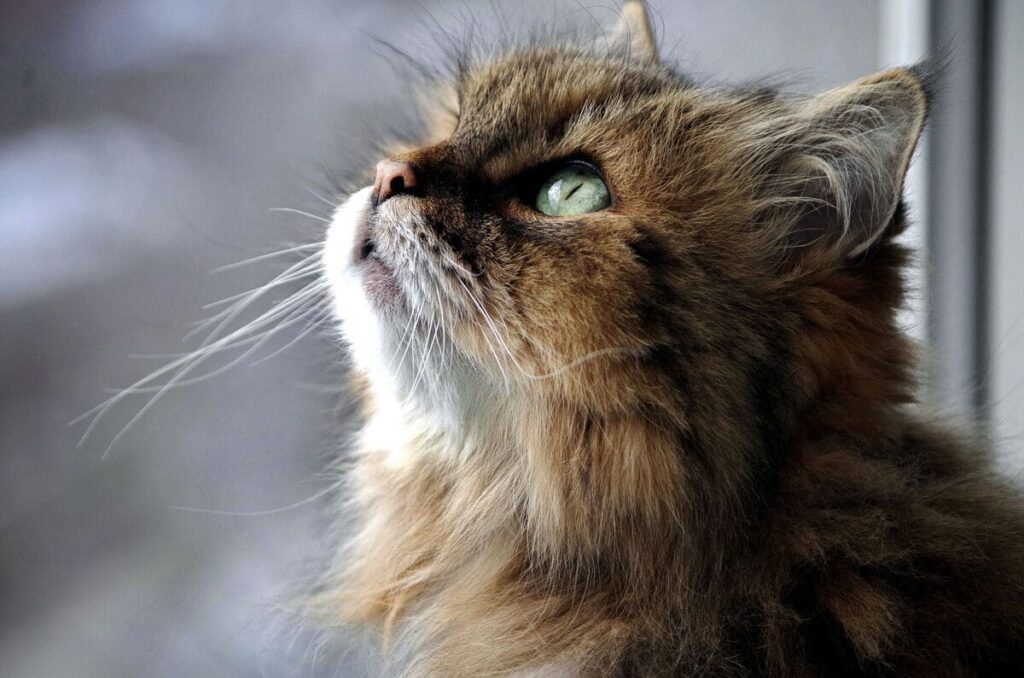
Ask people what they want to know about the Siberian cat and two questions come up again and again: how big does it get, and can someone with allergies live with one? Fair enough, both matters. The Siberian is a big, fluffy cat from Russia with a round face, a thick fur coat and a coat that seems to come in three layers. Russians often call it their national cat. In the US it went from a rare import in 1990 to a championship breed in TICA by 1996, which is quick. You’ll sometimes see it called the Russian Siberian cat, and that makes sense, since the roots are Russian.
People come to the breed for different reasons. Some just love the look. Some have heard that Siberians are friendly and playful, almost like small dogs. And plenty are really asking whether they can live with a cat when they’re allergic. We take that one seriously, so there’s a careful answer below, with the research and no promises.
This guide covers where the Siberian forest cat comes from, what the TICA and CFA breed standards say, what living with one is like, and how to groom it. At the end there’s a short block of cat words in Russian, because a cat from Russia deserves its Russian name.
Siberian Forest Cat: History and Origin in Russia
Where does the Siberian cat breed come from? Russia, and a very long time ago. The Cat Fanciers’ Association (CFA) calls it the national cat of Russia and, in its own account of the breed, says the cat’s history there goes back to about the year 1000. Wikipedia points to forest cats in old Slavic folktales and village stories, which may be why so many people say Siberian forest cat. Whether those cats looked like today’s Siberian, nobody can say. What Vetstreet tells us is that they were working animals, mostly mousers on farms and in shops.
The name is a bit of a puzzle too, since these cats were never only from Siberia. In Russian it’s Сибирская кошка (Sibirskaya koshka), and Wikipedia says it was once called the Moscow Semi-Longhair or the Russian Longhair.
How does a Russian barn cat end up on a show bench in the US? Slowly, and in two steps. A few Siberians went west a long time ago. Cat shows in the 1890s brought the breed some attention, the CFA notes, but the early imports were crossed with other longhaired cats and, according to Wikipedia, the Siberian’s separate identity got lost. The second step came in the late 1980s, when breeding started again in Russia and Germany. Wikipedia says a young pair traveled from St. Petersburg to Berlin in 1987, and that same year the Kotofei Cat Club in St. Petersburg wrote down one of the first standards.
The American chapter is short. The first breeding Siberians arrived in 1990, says the CFA, imported by Elizabeth Terrell for her Starpoint cattery, and Vetstreet adds that she got them by trading Himalayan cats. TICA accepted the breed in 1992 and gave it championship status in 1996, according to Wikipedia. The CFA began registering Siberians in 2000, and by its own breed page the championship followed in 2007.
Is there a link to Russia’s famous museum cats? Not that we could find. Wikipedia traces the Hermitage cats of St. Petersburg to Empress Elizabeth, who in 1745 ordered cats into the Winter Palace to keep mice away, but nothing we read says they are Siberians. If wild Russian cats interest you more, we have a post about the manul and another about the Amur tiger, both of them cats you should not try to keep at home.
Siberian Cat Breed Standard: Size, Coat and Colors (Including White Siberian Cats)
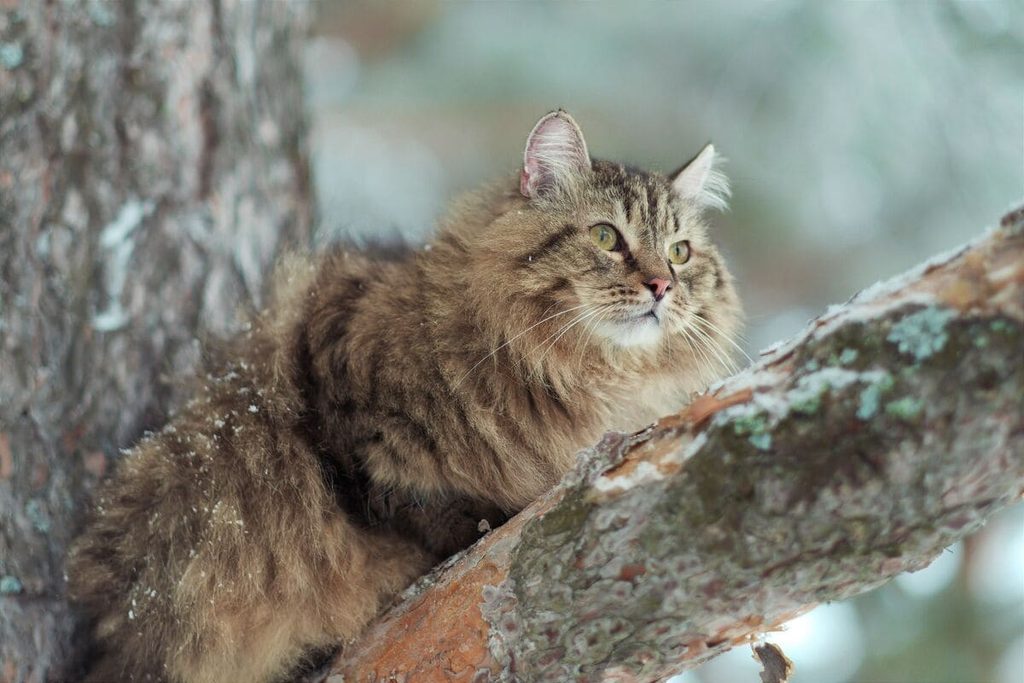
Breed standards can read dry, but they show what a breeder is aiming for. Two matter in the US, TICA’s and the CFA’s, so here they are in plain English.
Both describe a medium to medium-large cat. The CFA says it has “surprising heft for its size” and wants a general impression of roundness and circles, not angles. TICA agrees that females are considerably smaller than males, and adds a line we like: size is secondary to type. On the CFA’s breed page, mature males run about 12 to 18 pounds and females about 8 to 12. It’s slow to grow up too. Both standards say it can take as long as five years to mature, so a Siberian that looks a bit gangly at two may just not be finished.
The head is a modified wedge with rounded lines, wider at the top of the skull and narrowing to a full, rounded muzzle. The ears are medium to large and tilt slightly forward, the eyes are large and nearly round, and the profile slopes gently from forehead to nose. Put it all together and you get that sweet, slightly surprised Siberian expression.
It’s the coat that everyone notices. Both TICA and the CFA require a moderately long to long triple coat with an abundant ruff, plus a tight undercoat in mature cats that thickens in cold weather. Texture ranges from coarse to soft depending on color, the CFA says, and TICA says a wavy coat isn’t what the breed should have.
The colors are about as open as they get. TICA allows all traditional and pointed colors and combinations, with or without white, and the CFA says much the same. The CFA lists the point colors (seal, blue, flame, cream, tortie and blue-cream) plus lynx point variants, and says every pointed Siberian has blue eyes.
You may hear pointed cats called Neva Masquerades. According to Wikipedia, TICA and the CFA accept point coloring within the Siberian breed, while FIFe and WCF treat the Neva Masquerade as a separate breed. For cats that aren’t pointed, the CFA allows green, gold, green-gold or copper eyes and gives no points for eye color, and TICA says there is no relationship between eye color and coat color or pattern.
And what about the white Siberian cat? Yes, they exist, and they’re lovely. The CFA allows white in any amount and in all areas, and says a solid white should be “pure glistening white,” with pink nose leather and paw pads. White cats may have blue or odd eyes. TICA also allows white: for tabbies its standard names are the chin, breast, and stomach, and for other cats it says white is allowed in most areas.
One caution, and we’d rather you hear it from us: white cats with blue eyes are more likely to be born deaf. The Louisiana State University veterinary school lists the Siberian among the breeds that carry the white gene and are “at risk for congenital deafness,” though the same page says there is no prevalence data for Siberians. Wikipedia says hearing tests (BAER or OAE) are recommended for white cats, and some registries require them before breeding. So if you’re looking at a white Siberian kitten, it’s fair to ask the breeder about hearing.
Temperament: What Living with Siberian Cats Is Like
So what is a Siberian like at home? The CFA calls the breed extremely intelligent and curious about everything around it, and quotes owners who say their cats are “90% placid and 10% mischievous.” That sounds about right. It also says Siberians are sociable and easygoing, usually bond closely with their owners, and get along well with children and other pets. TICA’s standard only asks that the temperament be “unchallenging,” which is short and doesn’t tell you much on its own.
Vetstreet has more fun with it. Its Siberian is a “madcap adventurer” that climbs, leaps and will find a way to the toy you thought you’d hidden. He loves his family without demanding constant attention, it says, and may be wary of guests at first. Wikipedia adds that many Siberians are fascinated by water and chirp more than they meow.
Boredom is the main risk for a cat this clever and athletic. Vetstreet suggests puzzle toys and teaching tricks, and a tall cat tree isn’t really a luxury here.
Health deserves a word too, because it decides how long you get to keep your cat. Cornell’s Feline Health Center calls hypertrophic cardiomyopathy (HCM) the most common heart disease in cats and says some breeds get it more often. The New Zealand Cat Fancy’s health policy says it’s hereditary and does occur in Siberians. Back in 2022, when that policy was issued, the breed had no commercial DNA test for it, so screening meant a cardiac ultrasound by a qualified vet. And even the tests that exist aren’t perfect, Cornell says. That’s why a breeder who swears a cat will never develop HCM should make you a little nervous. Ask about the parents’ screening instead. These are big cats too, so watch the weight.
Are Siberian Cats Hypoallergenic? What the Research Says
Most people reading this section came for one answer, so here it is up front: nobody has proven that any cat breed is truly hypoallergenic, and the Siberian is no exception. So how did the idea get so popular? Let’s walk through it.
Start with what actually causes the sneezing. It’s a protein called Fel d 1. The Animal Medical Center in New York says two genes, Ch1 and Ch2, control how much a cat makes, and an article from the University of Southern Queensland adds that it comes from saliva and skin glands. So it’s not really the hair. Even hairless Sphynx cats make it, according to the same article, and from there it travels on dander and settles into clothes and couches.
The “hypoallergenic Siberian” story seems to come mostly from breeders and owners, people who say their allergic relatives cope better with one. Dr. Ann Hohenhaus, a vet at the Animal Medical Center, puts it bluntly: Siberians are named as a possibly hypoallergenic breed “based on breeder anecdotes.” She also mentions that Burmese cats, which set off her own symptoms, appear on other lists of hypoallergenic breeds. You can see how loose these lists are. Her bottom line is that there is no non-allergenic cat breed.
Is there any real science behind it? A little, and it points in two directions. In 2017 a team of Italian researchers led by Stefano Sartore looked at the Ch1 and Ch2 genes in Siberians for the first time, and published the results in Veterinary Sciences. They found a lot of mutations, and a few might change how allergenic Fel d 1 is. But the authors are careful. No one yet knows whether those mutations actually lower the allergen, they say, so the breeders’ claim is still unproven. Wikipedia also describes testing of hundreds of Siberians by a breeders’ association, which found Fel d 1 levels all over the place from one cat to the next, with about half lower than other breeds. Remember who ran that, though: breeders, not an independent lab.
Zoom out, and the picture gets less hopeful for anyone wanting a safe breed. A 2024 review by researchers at the Luxembourg Institute of Health, in Allergology Select, found that every known breed still makes Fel d 1, and that the attempt to breed cats without it has been dropped. Most allergic people also react to more than one cat allergen, the review adds, so cutting one protein might not solve much. The Southern Queensland article sums up the rest: coat length and color don’t seem to matter, individual cats vary a lot, and unneutered males tend to make more Fel d 1 than females or neutered males.
So what should you do if you’re hunting for Siberian hypoallergenic kittens? Nothing here is a guarantee, but a few steps make sense. First see an allergist, especially if you have asthma, because a cat is a long commitment. Then spend real time with the cat you’re considering, more than once and for longer than a few minutes, because reactions differ from cat to cat as much as from breed to breed.
Be careful with a kitten, since it’s a less reliable test. Wikipedia says kittens make less Fel d 1 than adults, though it cites no study, while a 2019 study of adult cats found older ones tended to have lower levels in their saliva, and mentioned another study that saw no age difference at all. The picture isn’t settled. Time with an adult cat from the same breeder, or with the kitten’s parents, will tell you more. And if a breeder promises you won’t react, walk away, because no one can promise that.
Cleaning helps a bit. The Southern Queensland article cites research suggesting that regular cleaning substantially reduces cat allergens at home. Vetstreet says regular baths can help if someone in the house is allergic, but don’t expect much from them: one explainer notes the protein comes back within a couple of days.
So, are Siberian cats hypoallergenic? Some allergic people seem to do better with them, and the genetics are interesting. Today, though, the honest answer is that nobody has shown a Siberian to be safe for a person with a cat allergy.
Grooming Siberian Cats and Everyday Care
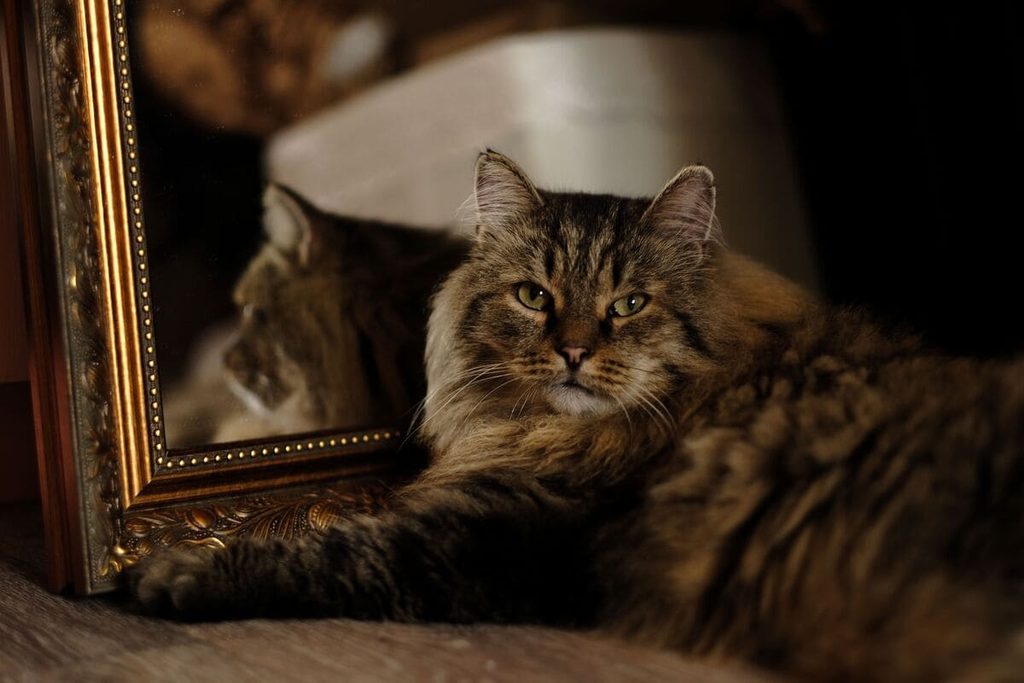
The good news about grooming Siberian cats is that it’s easier than that coat makes you think. The CFA says needs vary a lot: some Siberians want a weekly session to keep mats away, and others go weeks without one. Vetstreet agrees that weekly brushing is usually enough, then adds the catch. In spring and fall, when the coat comes out in clumps, a Siberian needs daily brushing. Wikipedia notes that young cats can take years to grow their full coat, so don’t judge the fluff at one year old.
Where do mats show up? The CFA suggests checking the belly, the tail, and the “britches” (the long fur on the hind legs) a few times a week, because that’s where tangles usually start. If you find one, work it apart gently with your fingers or a steel-toothed comb. Don’t snip it out with scissors close to the skin.
Baths are rarely needed, Vetstreet says, unless you’re planning to show the cat, and plenty of Siberians don’t mind water anyway. Aside from the coat, it’s the usual routine of nails, ears and teeth. And feed for the size of the cat, not the size of the fur. A little extra weight can hide under all that hair, so feel for the ribs now and then.
Siberian Cat vs Russian Blue vs Maine Coon
People often put these three together: the Siberian, the Russian Blue, and the big cat from Maine. The Russian Blue is a very different animal from the other two, and we cover it in detail in this article. our Russian Blue guide. Here’s a quick comparison, based on the CFA’s breed pages.
| Siberian | Russian Blue | Maine Coon | |
| Origin | Russia | Believed to be northern Russia (Archangel) | New England, USA |
| Size (CFA) | Males about 12–18 lb, females about 8–12 lb | Males rarely weigh over 10 lb, females 5–8 lb | Mature males often reach or exceed 20 lb |
| Coat | Dense triple coat, moderately long to long, thick ruff | Short, dense, plush, silver-tipped, blue only | Thick, heavy, silky, with shorter fur on the shoulders and longer on the sides |
| Grooming | Weekly brushing; daily during molts | Brushing a few times a month | Comb twice or three times a week |
| Temperament | Clever, playful, sociable, “90% placid and 10% mischievous” | Clever, affectionate, may be shy at first | Friendly, sweet-tempered, easy to train |
| Time to mature | As long as 5 years | Not stated on the CFA page | Up to 3 years |
| Allergies | No breed is proven to be hypoallergenic | No breed is proven to be hypoallergenic | No breed is proven to be hypoallergenic |
If you want a big, fluffy, playful cat from Russia, the Siberian is the one. If you’d rather have something sleek and quiet, the Russian Blue fits better, and our guide describes it as devoted to one chosen person. And if you want the biggest cat you can find, there’s the Maine Coon. The CFA says that in a Maine Coon “it is not unusual for a mature male’s weight to reach or exceed 20 pounds,” which is quite a bit heavier than the Siberian’s range.
Cat Words in Russian
If you bring a Siberian home, you may want to speak to it in its own language. Here are the everyday words you’ll hear Russian speakers use for cats.
| Russian | Transliteration | English |
| cat | koshka | cat, the female cat (the counterpart of кот) |
| cat | goat | male cat, tomcat |
| A kitten | kotyonok | kitten (plural: котята, kotyata) |
| chirp | murlykat’ | to purr |
| sour-sour | bit by bit | the sound Russians make when calling a cat |
| Siberian cat | Siberian koshka | Siberian cat |
Wiktionary lists кошка as the feminine counterpart of кот, which is why you’ll see both in the table. And if you want a cuddly nickname for your cat, terms of endearment are a good place to look, and we cover them in our post about Russian terms of endearment.
Try it at home. Call “Kys-Kys!” and see what happens. A Siberian will probably look up from the couch and decide whether it’s worth getting off.
Frequently Asked Questions About Siberian Cats
Are Siberian cats hypoallergenic?
Not in a way that has been proven. All known cat breeds produce Fel d 1, according to a 2024 review by the Luxembourg Institute of Health, and the Animal Medical Center says there is no non-allergenic cat breed. Some people with allergies do feel better around Siberians, but that is based mostly on breeder reports. Spend time with the cat and talk to an allergist before you decide.
How big do Siberian cats get?
According to the CFA, mature males weigh about 12 to 18 pounds and females about 8 to 12. Both the CFA and TICA say a Siberian can take up to five years to reach full maturity.
Is there a white Siberian cat?
Yes. The CFA allows white in any amount, and TICA also allows white. White cats with blue eyes can be more often deaf, so ask the breeder about hearing tests for a white kitten.
Are Siberian cats good with children and other pets?
The CFA says Siberians get along well with children and other pets, and Vetstreet agrees, though it adds that they may be wary of guests at first.
What is the difference between a Siberian cat and a Neva Masquerade?
This is the name used for pointed Siberians. According to Wikipedia, TICA and the CFA accept pointed cats as part of the Siberian breed, while FIFe and WCF register the Neva Masquerade as a separate breed.
What to Do Next
A cat is a good way to learn a language, too. Children pick up кошка and мурлыкать fast, and soon they ask for the words for everything else in the house. At Palme School we teach Russian online. Our Russian as a foreign language course is for children who are starting from zero, and adults can look at Russian for adults. For kids who love animals, there’s also our Biology course if you’d like to see what else we teach.
Here is how a trial works. Palme School offers two free lessons: an intro session with a curriculum specialist and a trial lesson in a group. Everything is online. Lessons run 40 minutes, groups stay small, and the ages range from 4 to 17.
And if a Siberian does come to live with you, make sure it gets a good Russian name.