

The child who can name every feeling and still gets it wrong
Sasha is nine, lives in the Minneapolis suburbs, and can tell you the difference between frustrated and disappointed without pausing to think about it. A feelings chart hangs on her wall. She uses it. Her mother did everything the parenting books suggested, and every bit of it worked. Her details are changed, as they are everywhere on the blog.

She also told a friend that her drawing looked like a potato, watched the friend’s face change, and carried on talking.
Naming an emotion and using the information are two separate skills, and only the first one gets taught.
What emotional intelligence actually means, and who says so
Something worth knowing before you read anything else on this subject. Two competing definitions are in circulation, and most articles blend them without saying so. One comes from Daniel Goleman’s 1995 book and has five components. Self-awareness, self-regulation, motivation, empathy, and social skills. If you have seen a list of five, this is where it came from.
Another comes from John Mayer and Peter Salovey, and it has four branches. Perceiving emotions, using emotions to help you think, understanding emotions, and managing them. It is measured with performance tasks instead of a questionnaire, which matters, because you cannot flatter yourself into a good score. These are not variations on a theme. Mayer, Salovey, and Caruso have argued at length that piling positive traits together and calling the pile emotional intelligence stretches the concept until it stops being distinguishable from personality, and they have a point about motivation in particular. Being driven is a fine quality. It is not a skill for handling emotions.I use the four branches with parents, because each one maps onto something you can watch a child do or fail to do on an ordinary afternoon.
First, noticing that anything is happening
Noticing an emotion is present comes first, in yourself or somebody else, before anything else can happen. I lost this ability for about a year, as an adult, and it was instructive. My first winter here I couldn’t read faces. Not because the faces were unreadable, but because all my practice had been on a different set and none of it on this one. A colleague was annoyed with me for two weeks before I figured it out. When somebody finally said so out loud, I could see it at once in the memory of her face. The information had been arriving the whole time, in full, on schedule, and I had no idea what any of it meant.
This was the same winter I sat through the staff meeting I described elsewhere, knowing the answer at minute four and saying nothing until the corridor. The two problems turned out to be one problem. Children vary enormously here, and the variation has nothing to do with intelligence. Some nine-year-olds read a room instantly. Others miss a friend’s face falling from three feet away, and the missing is genuine rather than callous, a distinction adults find surprisingly hard to make about a child they are already annoyed with.
Narration helps, done out loud, about other people, in the ordinary run of a day. Look at that man, he’s been waiting for the bus a while and he keeps checking his phone. Not a lesson. Just attention, aimed outward, in a voice that does not sound like teaching.
Books beat conversation here. A paused page is easier to talk about than a real face that is still moving. What do you think she’s feeling right now? What’s her brother about to do?
Second, and nobody teaches this one

This branch is the strangest of the four and gets left out of nearly every parenting article, which is a shame, because it explains something families argue about constantly.
Emotions carry information about what to do next. A slightly anxious mood is genuinely better for proofreading, a good mood better for generating ideas, and most adults act on this without ever putting it into words, which is why they save the difficult email for a particular kind of afternoon. Nobody taught them that.
Children can learn it. The lesson is startlingly practical. You’re wound up. That’s a bad hour for the essay and a good hour for the sports drills, so do those first and come back.
You are teaching that a feeling is data rather than an obstacle, and that the answer to being in a mood is sometimes to pick a different task instead of fixing the mood.
Third, where the feeling came from
Branch three is knowing where feelings come from, what they turn into, and how they mix. That disappointment can arrive dressed as anger. That most eight-year-olds hitting a sibling are not primarily angry at the sibling. That feelings have causes located in time, usually earlier than the incident.
A chart teaches the word. It cannot teach the reading of a face.
Vocabulary matters here more than anywhere else, and this is the part the feelings charts get right. A child with three words for unpleasant states experiences three unpleasant states. A child with twelve has a finer instrument, and will notice differences the first child cannot register at all, and that is the entire argument for the vocabulary, as well as the limit of it.
But charts alone produce children like Sasha, who can label a feeling accurately and cannot do anything with the label. The vocabulary needs a story attached. You went quiet after lunch. Something happened at lunch, or you were already tired going into it?
Branch four is a different article
Managing the emotion once it has arrived is the fourth branch, and it’s the one everybody means when they say emotional intelligence. It’s also the one where nearly all the practical advice lives, and where nearly all of it is aimed too late. We wrote about that separately, and I won’t repeat it here except for the one sentence that matters. The useful moments are almost all before the explosion, not during it.
Three branches happen quietly for years. The fourth is the only one you notice.
That asymmetry is why so much parental effort goes into the wrong place, and why it arrives there at the wrong moment too.
Does any of this actually predict anything
Some of it. Moderately. What is reasonably established is that school programs teaching these skills directly show gains in behavior, attitudes, and academic results, which a large meta-analysis of more than two hundred programs found. American schools file the whole area under social and emotional learning, and the five competencies you may have met at back-to-school night, which CASEL calls the CASEL 5, are a third framework again, and a second list of five, and that is exactly why these get confused.What is not established is the strong version you meet in business books, where emotional intelligence explains most of the difference between successful and unsuccessful people. Mayer, Salovey, and Caruso point out that Goleman himself later wrote that readers who took his book that way had misread it. That is worth knowing before anybody buys a program on the strength of the claim.
Worth holding both of those at once. The skills respond to being taught. They are not a master key to a life.
By age, and what to actually do

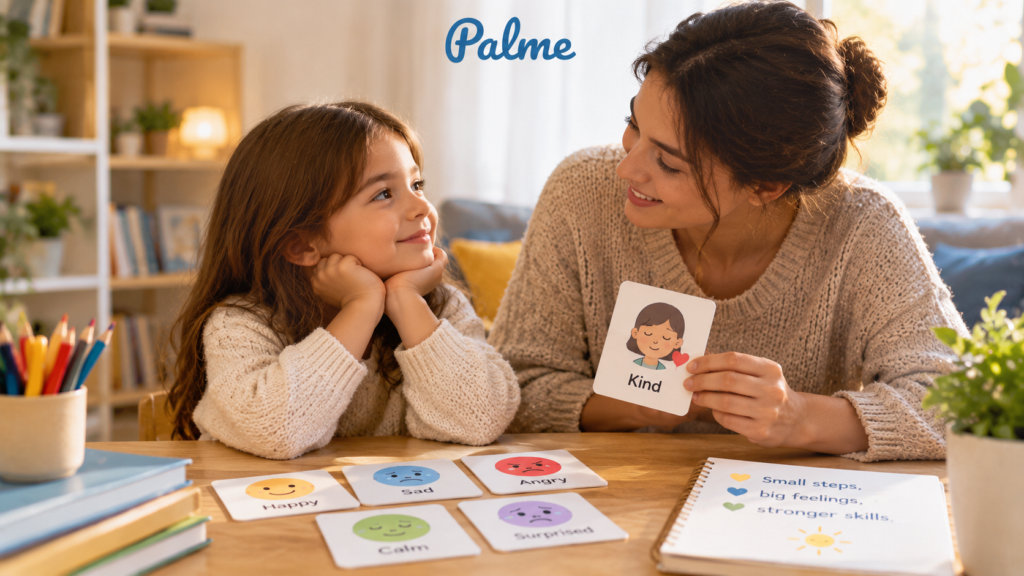
My classroom shorthand follows, and it is not a developmental norm. At four to six everything is naming, and you do the naming, out loud, for years before the child manages it alone. Face-matching games work here precisely because they are stupidly simple. Look at a picture, say what the person feels, say how you know. That last part is the whole exercise.
By seven or so, add causes. Books and movies make better material than the child’s own day, because a character’s bad afternoon can be discussed without anybody getting defensive. This is also the age for the second branch, the one nobody teaches: notice your mood, then choose your task to match it. Somewhere around ten the mixed feelings arrive, and that is the interesting part. A child who can say they were relieved and also disappointed about the same thing has crossed a real line. Ask about characters who feel two things at once, because those are the ones children under ten cannot read at all.
From thirteen you mostly stop instructing and start modeling, which is harder work and less satisfying. A teenager watching a parent handle a bad day badly, and say so afterward, learns more than any exercise will teach them.
What makes it worse
Naming the feeling for them. Every time. Forever. You’re frustrated because your tower fell. Correct at four, and by nine it means the child never has to produce the word themselves. Treating the chart as the goal. Vocabulary is instrumentation. Instrumentation is not the same as skill, and a child who can label precisely and act badly has learned only the easy half.
Rushing to fix it. A child who reports a feeling and is immediately handed a solution learns that reporting feelings triggers management, and quietly stops reporting them.
And insisting on the account in the moment. Tell me why you’re upset is a fair question at the wrong time, and the right time is usually several hours later.
What actually builds it
Other children, mostly.
The least convenient answer available, and the one nobody wants after buying the chart. Branches one through three get practiced on faces under no obligation to be kind. A parent forgives the missed cue. A parent explains the joke, waits out the silence, and supplies the word that was taking too long. Every one of those kindnesses quietly removes a repetition the child needed. It’s the same mechanism we described in the piece on how children join a group, and it’s why the room matters more than the exercise. In our lessons for bilingual kids there are four other children with visible faces and limited patience, and a child who misreads the room finds out immediately. The conversation school works the same way with speaking as the whole task.Sasha apologized to her friend eventually, about a week later, after her mother stopped explaining what she had done wrong and started asking what she thought the friend’s face had meant.
At Palme School we teach online, in groups of up to eight, two forty-minute classes a week, and the first two lessons are free. You can book those here, and there are printable materials for parents in our resource library.Frequently asked questions
The ability to notice emotions, use them as information, understand where they come from, and manage them. That is the four-branch model from Mayer and Salovey, and it is the one with performance-based measurement behind it.
The five-component version people quote comes from Daniel Goleman’s book and mixes emotional skills with personality traits.
Narrate other people’s feelings out loud, use books and movies as material, and build vocabulary with causes attached rather than labels alone.
Then put the child somewhere their misreadings have consequences, because the first three branches are practiced on people who are not obliged to be patient.
Around four, with naming and face-matching. Causes come in around seven, mixed feelings around ten, and by the teens most of the teaching is modeling rather than instruction.
For vocabulary, yes. Vocabulary is genuinely useful and genuinely not the whole thing.
A chart teaches labeling. What it cannot teach is reading a face that has just changed, which is the skill most children actually need.
Sources
- Collaborative for Academic, Social, and Emotional Learning. (n.d.). What Is SEL? Retrieved September 4, 2026. casel.org
- Durlak, J. A., Weissberg, R. P., Dymnicki, A. B., Taylor, R. D., & Schellinger, K. B. (2011). The impact of enhancing students’ social and emotional learning: A meta-analysis of school-based universal interventions. Child Development, 82(1), 405–432. onlinelibrary.wiley.com
- Explore SEL, Harvard Graduate School of Education. (n.d.). Four Branch Model of Emotional Intelligence. Retrieved September 4, 2026. exploresel.gse.harvard.edu
- Goleman, D. (1995). Emotional Intelligence: Why It Can Matter More Than IQ. Bantam Books.
- Mayer, J. D., Salovey, P., & Caruso, D. R. (2008). Emotional intelligence: New ability or eclectic traits? American Psychologist, 63(6), 503–517. doi.org
Palme School: Russian for bilingual children · Conversation school · Free materials for parents