

Names and identifying details of every student here are changed, as they are everywhere on the blog.
What should my child do differently. That’s the question almost every parent brings me, and I understand it completely, because it’s the only question you can act on at eleven at night. It’s also the wrong one, and I want to explain why carefully rather than quickly.
Start with the wrong question
Bullying is not a fight between two children. It is a performance with an audience, and the audience decides how long it runs, which is why the same child can be tormented in one classroom and left alone in another with the same set of personal qualities.The child being hurt is the one person in the room with the least power to stop it.
What actually stops it
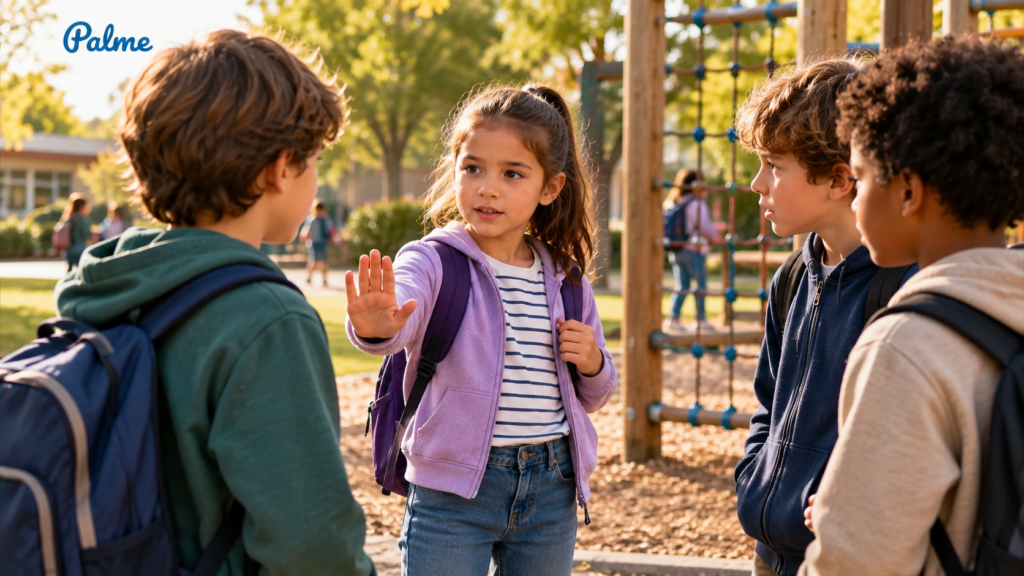
Here is the finding that ought to be on every school noticeboard. Researchers recorded playground interactions and watched what happened when another child stepped in. Bullying stopped within about ten seconds in more than half of those episodes. Not after a conversation. Not after adult mediation. Within seconds, because one other child made the audience stop being unanimous. Now the second number, which is harder to read. Roughly one child in five or six actually steps in, and the rest either watch or drift off to the edge of it.An intervention that works in ten seconds, and a supply problem.
That is what those two numbers describe together. That is a completely different situation from the one implied by teach your child to stand up for themselves, and it points at different work.Why the standard advice misfires
Tell a child to be more confident and you have told them the problem is their manner. Tell them to ignore it and you have told them their read on the situation is wrong. Tell them to hit back and you have handed a smaller person a plan that requires them to win.
None of these are cruel. All of them put the job on the person carrying the least leverage, and children hear the transfer even when parents do not intend it.Your child does not need to become braver. Your child needs one ally and an adult who acts.
There is a harder thing underneath, and it deserves saying plainly. A child who is being bullied usually already knows that standing up to it would help. What they lack is not insight or nerve. It is a second person.What to watch for
Children conceal this, and they conceal it longest from the people most likely to intervene, because intervention has a history of making things worse before it makes them better. Signals worth taking seriously, particularly in combination: property that keeps getting lost or broken, reluctance about specific days or specific routes, appetite or sleep changing without another explanation, a friendship group that shrinks quietly over weeks, and a child who stops mentioning school at all. That last one is the easiest to miss, because silence looks like nothing being wrong.
None of these proves anything on its own. Several together, over a month, is a pattern worth acting on, not watching.
What to do, and in what order
Order matters here more than content, and the first step is the one families skip, usually because it feels like something you do after checking rather than before.| Step | What it looks like |
|---|---|
| Believe it, completely | Before you verify anything, before you ask what they did |
| Write it down | Dates, times, locations, names. Four lines, not a feeling |
| Go to the school as a partner | Ask what will be done, by when, and who tells you it changed |
| Escalate in writing | Email, not a corridor conversation. The record is the leverage |
| Go outside the school | Threats, harm, or anything continuing after two reports |
Believe it first. Everything after that depends on the child not regretting having told you.
The written record deserves a word of its own. Schools respond differently to he has been having a hard time and to a list of four incidents with times and locations attached, and this isn’t adversarial. It is what lets a teacher act. Most jurisdictions require schools to respond, and it is the record that makes the requirement real rather than aspirational; the federal StopBullying resource sets out what they are obliged to do. That last row is not an overreaction. It is the point where the process has failed and a different one is needed, and no parent should feel they need permission to reach it.The part about standing
Social standing does help, and pretending otherwise would be dishonest. A child with two solid friendships is a harder target than a child with none. This is not because bullies are cowards. It is because bullying is a public act, and public acts need an audience that will not object.
So the useful work runs sideways, and most of what parents are advised to try runs straight at the problem instead
| The direct approach | What it actually does |
|---|---|
| Be more confident | Names your child’s manner as the problem |
| Just ignore them | Tells them their read of the room is wrong |
| Hit back | Hands a smaller person a plan requiring them to win |
| Make more friends at school | Sends them back into the room where standing is lowest |
What builds it, slowly
Rooms where your child is known by somebody who is not obliged to like them. A second friendship group outside school changes the arithmetic more than any conversation about confidence, and it does it without asking the child to perform courage. Our conversation school is one such room, and there are dozens of others that have nothing to do with us. Our piece on peer pressure covers the mechanism: groups look unanimous from inside and almost never are. Timur was twelve when his year went badly, and what changed it was not anything he did differently at school. It was a Tuesday group where he was funny, which he had not been at school for months, and a boy in that group who eventually turned up in his class.He didn’t stand up for himself.
Somebody stood next to him, and the audience stopped being unanimous. At Palme School we teach online, in groups of up to eight, two forty-minute classes a week, and the first two lessons are free. You can book those here, and there are printable materials for parents in our resource library.Frequently asked questions
Believe them completely, then write down what happened with dates and locations. Take that record to the school and ask for specific actions with a timeline attached.
Do not ask your child to handle it alone, and do not advise hitting back.
Partly by accepting that this is not mainly their job. What ends bullying quickest is another child stepping in, and what you can build is the friendship that produces one.
Do not contact the other child’s parents directly, do not tell your child to ignore it, and do not let the school reassure you without saying what they will actually do.
Put it in writing and escalate through the district. Schools have obligations, and written records are what make those obligations enforceable.
Sources
- Hawkins, D. L., Pepler, D. J., & Craig, W. M. (2001). Naturalistic observations of peer interventions in bullying. Social Development, 10(4), 512–527. doi.org
- Malamut, S. T., Garandeau, C. F., & Salmivalli, C. (2025). Defending behavior and victimization: Between- and within-person associations. Journal of Youth and Adolescence. doi.org
- StopBullying.gov, U.S. Department of Health and Human Services. (n.d.). Retrieved September 4, 2026. stopbullying.gov
Palme School: Russian for bilingual children · Conversation school · Free materials for parents
Lily Rozberg has been teaching for sixteen years, first English in Russia and now Russian to bilingual children across the US and Canada. She writes for Palme School about heritage language, reading, and the things report cards do not measure.