Palme School

Online Russian Language School in the USA and Canada
Online school in Russian for bilingual children and teenagers
💡 Get bonuses with us! Referral program

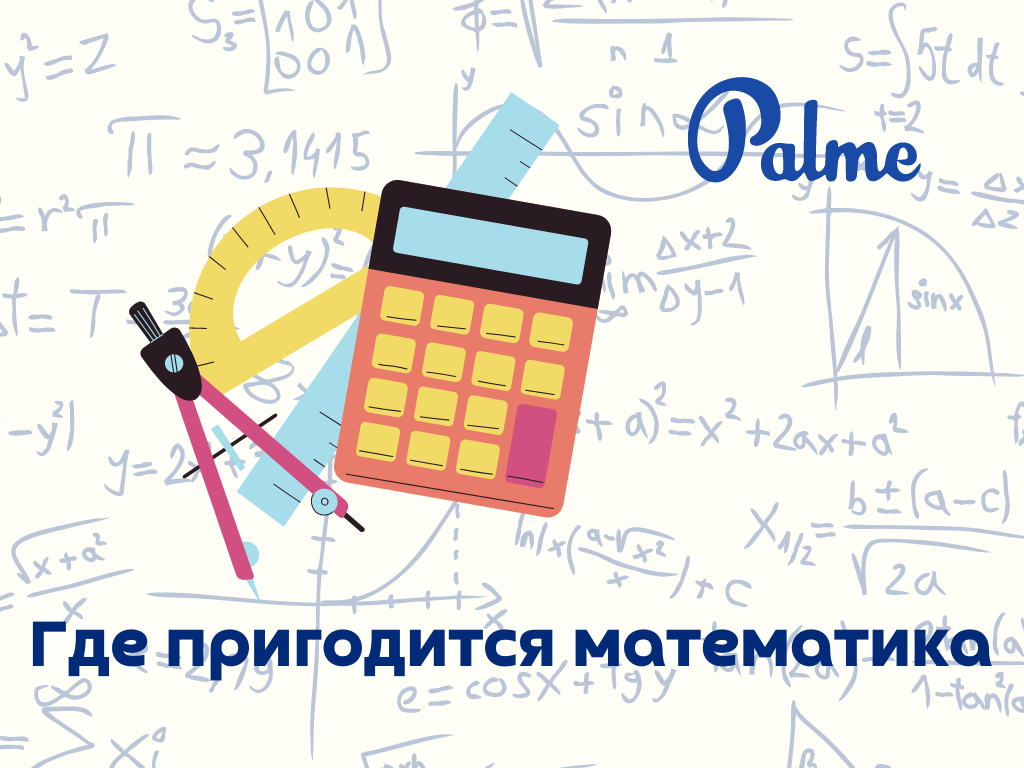
Where math will be needed. How to motivate your child to learn.

Hi! Palme School is here. Today we're discussing where math can come in handy.

The short answer is everywhere. 


  1. The best-paying professions in the U.S. are held by math.
  2. What are the "soft" skills that math develops.
  3. 3 Lifehacks that will motivate your child to do math.


Indeed - has come up with a list of the 100 highest paying occupations across the United States.

How do they use math?

  1. Doctors (from 150.000$ per year). The most important fields are physics, chemistry and biology, but even basic knowledge in these subjects is kept to formulas, figures and calculations. 
  2. IT specialists (from 130.000$ per year). Everything from writing code to building a product design is based on math.
  3. Marketers (from 120,000$ per year). Calculations, formulas and analysis of customer behavior should be based on numbers, not hypotheses. And any hypothesis is supported by numerical indicators.
  4. Analysts and finance professionals (from 80,000$ per year). Their work literally consists of numbers.
  5. Lawyers (from 70.000$ per year). In addition to knowledge of laws and logical thinking, people in this profession often have to deal with basic mathematics: calculate the ratio of cases and pre-trial settlements, gather statistics, analyze the amount of information.

What are the "soft" skills that math develops?

In addition to the direct purpose of math is excellent for training skills that will be needed not only in work, but also in everyday life absolutely any person.


  • Logic. Leading discussions and making logical connections is an advantage in society.
  • Critical thinking. Separate the grain from the chaff. Find the right sources of information, analyze and propose solutions.
  • Concentration. In this article. we talked about concentration and other important skills for a child.
  • Spatial reasoning. Orient yourself in a new city, assemble a Rubik's cube and park the car.
  • Memory. The more we train our memory, the longer our brain retains its integrity.

The top 3 lifehacks on how to motivate your child to learn math.

We talked about motivation in general in this article: "The biggest mistake in praising a child"

Remember that any motivation must work with positive reinforcement.

Lifehack 1. Incorporate math into a child's everyday life.


"Do you think this garage will fit in our bedroom suite?"

"Who's faster, the cheetah or the hare?"

Or even "Is a trunk a nose or a hand?"


Ask any questions that prompt your child to calculate or reason logically.

Lifehack 2. Don't program your child to fail.


In Part 1 and this article you can read more about the myth of the humanitarian and technical brain, and also a bit about the different workings of the left and right hemispheres.

But to summarize: neuroscientists have yet to find evidence that some groups of people are more successful in technical science than others. Not by gender, dominant gene, or other phenomena.


So the phrases "Girls have a harder time with math", "You'll hate math in school" or "Everyone in our family is a humanities major" do not carry any truth, but only a value judgment and an imposed stereotype.

Lifehack 3. Use tricks.


Formulas and multiplication tables just have to be memorized. It's frustrating, hard to motivate. 


  • Divide large tasks into smaller tasks.
  • Tell me about the secret way to multiply by 9 or divide by 3 (the sum of the digits of a number is a multiple of 3)
  • Use verse definitions, finger method, etc.

It is still useful and proper to learn math from Palme School.

And sign up for a free trial lesson here

Do you want to support child's successes In studies?
Helping to develop knowledge, confidence, and a love for learning through modern Russian language classes and beyond.
Ordinal numerals in Russian are formed by taking the root of the cardinal numeral and adding the appropriate ordinal suffix. These suffixes agree in gender, number, and case with the noun they modify. Here's a breakdown: **1. Basic Structure:** * **Cardinal Numeral + Ordinal Suffix** **2. Ordinal Suffixes:** The suffixes are generally based on the endings of adjectives. * **Masculine:** -ый (e.g., первый - first) * **Feminine:** -ая (e.g., первая - first) * **Neuter:** -ое (e.g., первое - first) * **Plural:** -ые (e.g., первые - first) **3. Examples:** Let's look at the first few numbers: * **Один (one):** * Masculine: первый (pervyy) * Feminine: первая (pervaya) * Neuter: первое (pervoye) * Plural: первые (pervyye) * **Два (two):** * Masculine: второй (vtoroy) * Feminine: вторая (vtoraya) * Neuter: второе (vtoroye) * Plural: вторые (vtoryye) * **Три (three):** * Masculine: третий (tretiy) * Feminine: третья (tret'ya) * Neuter: третье (tret'ye) * Plural: третьи (tret'i) * **Четыре (four):** * Masculine: четвёртый (chetvyortyy) * Feminine: четвёртая (chetvyortaya) * Neuter: четвёртое (chetvyortoye) * Plural: четвёртые (chetvyortyye) **4. Numbers 5 and above:** For numbers five and higher, the formation is more straightforward. You take the root of the cardinal numeral and add the standard adjectival endings. * **Пять (five):** * Masculine: пятый (pyatyy) * Feminine: пятая (pyataya) * Neuter: пятое (pyatoye) * Plural: пятые (pyatyye) * **Десять (ten):** * Masculine: десятый (desyatyy) * Feminine: десятая (desyataya) * Neuter: десятое (desyatoye) * Plural: десятые (desjatyye) * **Сто (one hundred):** * Masculine: сотый (sotyy) * Feminine: сотая (sotaya) * Neuter: сотое (sotoye) * Plural: сотые (sotyye) **5. Compound Numbers:** When forming ordinal numerals for compound numbers (e.g., twenty-first), only the last part of the cardinal number changes to an ordinal. * **Двадцать один (twenty-one):** * Masculine: двадцать первый (dvadtsat' pervyy) * Feminine: двадцать первая (dvadtsat' pervaya) * **Сто двадцать три (one hundred twenty-three):** * Masculine: сто двадцать третий (sto dvadtsat' tretiy) * Feminine: сто двадцать третья (sto dvadtsat' tret'ya) **6. Pronunciation and Spelling Changes:** You might notice some spelling and pronunciation shifts, especially with the softer vowels and consonant changes in the first few numbers. These are typical sound changes in Russian. **7. Case Agreement:** Like all adjectives, ordinal numerals must agree with the noun they modify in case. * **Nominative:** первая страница (the first page) * **Genitive:** первой страницы (of the first page) * **Dative:** первой странице (to the first page) * **Accusative:** первую страницу (the first page - direct object) * **Instrumental:** первой страницей (by the first page) * **Prepositional:** о первой странице (about the first page) **Key Takeaways:** * Ordinals are formed from cardinals with specific suffixes. * They agree in gender, number, and case with the noun. * The first few ordinals (первый, второй, третий) are irregular and have unique forms. * For compound numbers, only the last numeral becomes ordinal.

Do you want your child to love learning?

At Palme School, classes are held online in live groups with experienced teachers. Choose a subject and sign up for a free first lesson.

Sign up for the newsletter
We at Palme Online School fall in love with the Russian language and Russian culture

Leave a request for a free call

Sign up for a free lesson.
Apply for a free introductory lesson to get acquainted, determine your goals, and find a suitable group.
Sign up for a free lesson
Submit a request for a free first session with a guidance counselor to get to know each other, determine your goals, and match your child with an educator
Sign up for a free lesson
Submit a request for a free first session with a guidance counselor to get to know each other, determine your goals, and match your child with an educator
Sign up for Russian Dictation
Sign up for a free lesson
Submit a request for a free first session with a guidance counselor to get to know each other, determine your goals, and match your child with an educator
Sign up for a free lesson
Submit a request for a free first session with a guidance counselor to get to know each other, determine your goals, and match your child with an educator
Sign up for a free lesson
Submit a request for a free first session with a guidance counselor to get to know each other, determine your goals, and match your child with an educator
Sign up for a free lesson
Submit a request for a free first session with a guidance counselor to get to know each other, determine your goals, and match your child with an educator
Sign up for a free lesson
Submit a request for a free first session with a guidance counselor to get to know each other, determine your goals, and match your child with an educator
Sign up for a free lesson
Submit a request for a free first session with a guidance counselor to get to know each other, determine your goals, and match your child with an educator
Sign up for a free lesson
Submit a request for a free first session with a guidance counselor to get to know each other, determine your goals, and match your child with an educator
Sign up for a free lesson
Submit a request for a free first session with a guidance counselor to get to know each other, determine your goals, and match your child with an educator
Sign up for a free lesson
Submit a request for a free first session with a guidance counselor to get to know each other, determine your goals, and match your child with an educator