


Names and identifying details of every student here are changed, as they are everywhere on the blog.

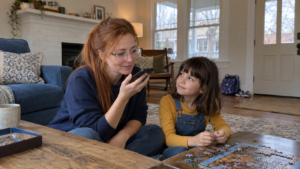
Liliya’s daughter is 2 years and 7 months, and she speaks in sentences that have both languages in them, sometimes both inside one word. Her mother-in-law has a theory about this, delivered weekly, and the theory is that the child is confused and the family should pick one language and stop torturing her.
Liliya came in with the question underneath that, which was not about grammar. She wanted to know whether she is harming her daughter. I am not a speech therapist, so the useful part of this is what the specialists publish, and on this particular question they are unusually direct.
Mixing is not confusion
Speech therapists have a word for it, code-switching, and their professional association calls it an ordinary part of growing up with two languages. Not a warning sign. A word. Kids who do it are not stranded between two systems; they are grabbing whatever gets the sentence out, which is the job.
That idea, the one about two languages confusing a child, is the most repeated sentence on this subject anywhere. Research does not back it up. Two languages do not cause a speech or language disorder.
Two vocabularies, added up
So we counted. Not the English words, which is what she had been doing in her head for a month, but all of them. Dog in Russian. Truck in English. Cat twice, because the girl learned it twice. Liliya stopped writing somewhere past sixty. According to the specialists, bilingual children sit about where their peers sit. This makes the first question not how much English she has, but how many words she has at all. What she had been doing before that, and what half the mothers in my chair do, was keeping two separate scores in her head and panicking at the lower one. The paper fixed that in four minutes. She took it home and put it on the fridge, and her husband added eight words she had forgotten by the time he read it.Real language disorders appear in both languages. One language is easy and the other difficult. It is about what a child hears all day long. It is not a diagnosis.
Silent months after a move
Then the second scare, the silent period. The daycare teacher had already seen it, she told Liliya, months of nothing in English from a kid who talks all evening at home.
Being quiet like that is not regression. Ask about the one who goes quiet in both at once, including at home, with the people she has always talked to.
Signs that actually matter
Specialists put the markers in both languages, not in English alone, and they are the same markers used for any child.- No babbling by about 12 months.
- No words by about 18 months, counting both languages.
- No two-word combinations by about 24 months, again counting both.
- Having difficulty understanding simple requests in either language.
- It becomes quiet in both languages at once, including at home.
- Frustration with her own speech, or giving up on trying to say things.
Why dropping the home language backfires
Pick one language. That is the grandmother’s line, and plenty of professionals say it too. But nothing about a delay comes from the second language, so losing it changes nothing about the delay. What it changes is that the grandparents stop being understood.
There is a practical side as well. A parent speaking a thinner, more careful version of English gives a child a thinner, more careful model, and that is a worse trade than it sounds.
Proper evaluation, and where it happens
One question does most of the work here, and that is who tests the Russian. Nobody, and you ask for an interpreter. Measure a child in her weaker language alone and the result looks like a disorder when the real answer is less exposure, an error specialists have been writing about for years.
Where the evaluation happens depends on age. For the youngest children it goes through the early intervention system, and from age three it runs through the school district, which is a different door and the same question.
And one thing worth keeping apart. Schools call it English learner status, which is an educational classification and not a speech diagnosis, and families constantly confuse the two.
My own mixing, for the record
I do it myself. Hands full, two clients waiting, and out comes dame un segundo at a woman from Kyiv who has never heard a word of Spanish. Nobody has ever called that confusion. At 3, with my niece, the same thing gets a different name, and the name depends on who is talking.
How it went for Liliya
Four questions from the pediatrician, who then said the girl is fine, which is the most common outcome of this conversation. Liliya still asked for the referral, because she wanted it on paper, and the specialist agreed with the pediatrician. Now the mother-in-law says she always knew the girl was fine. Also the most common outcome of this conversation. Her voice message came a couple of weeks later, in Russian, with the girl shouting something in the background that had an English verb in the middle of it. She wrote underneath, in English, that she had stopped counting. That is the whole arc of this subject in one notification.Courses at Palme School
Russian for bilingual children
When a kid understands Russian and answers in English
School of reading
Reading and writing for kids who already speak Russian
Free materials
Things to print and do at the kitchen table
Frequently asked questions
Yes. Speech-language professionals describe mixing, known as code-switching, as a normal feature of bilingual development rather than a sign of confusion or delay.
No. Learning two languages does not cause a speech or language disorder. A bilingual child can have one, as any child can, but the cause is not the second language.
Across both languages together. Counting only one language underestimates what the child knows, and the combined total is what is compared with peers.
Signs worth raising with a pediatrician include no babbling by around 12 months, no words by around 18 months, no two-word combinations by around 24 months counting both languages, difficulty understanding simple requests in either language, a child going quiet in both languages at once, or visible frustration with her own speech.
Dropping the home language does not remove a delay, because two languages do not cause one, and it removes the language the child shares with her family. Evaluations should assess both languages, with an interpreter if needed.
Palme School: Russian for bilingual children · School of reading · Free materials for families
Monica Perez is from Rosario, Argentina. These days she does nails in Los Angeles, and her regulars are mostly Russian-speaking, which is how these stories reach her before they reach anyone else.