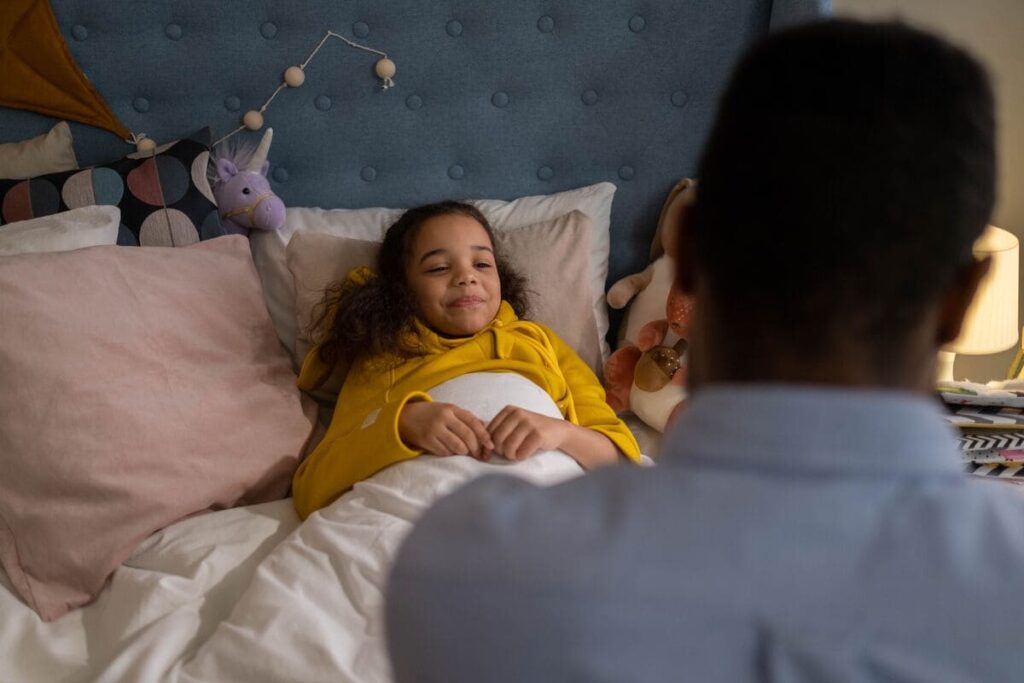
Think about the last few minutes before your child falls asleep. The toys are in the box, the big light is off, and only a small lamp is glowing in the corner. In a Russian family a father might sit on the edge of the bed at this point and say, very quietly, “Спокойной ночи, солнышко” (Spokoynoy nochi, solnyshko), which means “Good night, little sun.” The girl answers “И тебе, папа” (I tebe, papa), “You too, Dad,” and turns over to sleep. Nothing more is needed, just a few soft words.
Those words are спокойной ночи (spokoynoy nochi), and they are the first thing to learn if you want to know how to say good night in Russian. They mean something like “a calm night,” and you can say them to anyone who is going to bed, from a baby to a grandmother. Later on you will meet a few warmer phrases, some wishes for sweet dreams, and the sweet little words that children love. We have arranged them by age, so it will be easy to find the right one for your child, a friend, a partner, or an older relative.
How to Say Good Night in Russian: Spokoynoy Nochi
Let’s start with the main phrase. Most people say спокойной ночи, and you can say it to anyone who is about to go to sleep. FluentU writes that it is the most common one. People use it with friends, family and acquaintances, but it would sound strange to a boss at work. On Clozemaster You can see it in real sentences. For example, “Спокойной ночи, мама” (Spokoynoy nochi, mama) is “Good night, Mom,” and “Спокойной ночи, друзья мои” (Spokoynoy nochi, druz’ya moi) is “Good night, my friends.”
How does it sound? Say “spah-KOY-noy NO-chee.” The stress is on КОЙ in the first word and on НО in the second. Beginners often rush here, and the words melt into one. Try to slow down and say each word on its own.
You don’t have to change anything when you talk to one person or to an entire room. If you want to be closer to the person, add a name after it, or just мама (mama), or друзья (druz’ya).
And what if you are the one going to bed? Clozemaster has two short sentences for that: “Я иду спать. Спокойной ночи” (Ya idu spat’. Spokoynoy nochi), “Я собираюсь лечь спать. Доброй ночи.”
Dobroy Nochi and Why the Endings Look That Way
Sometimes you will hear доброй ночи (dobroy nochi). It also means “good night.” The word добрый (dobryy) means “kind,” so you could say it wishes someone “a kind night.” FluentU says it feels warmer and more affectionate, and that people use it with close friends and family. It also works well with a romantic partner, as in “Доброй ночи, моя любовь. Сладких снов” (Доброй ночи, моя любовь. Сладких снов).’
Most people use both phrases without thinking, so you don’t have to worry about the difference. If you aren’t sure, choose спокойной ночи. It is the safe one. Now imagine that you are writing to a friend you haven’t seen for a long time. You want to sound softer, and that is a good moment for доброй ночи.
A brief grammar note will help you here, because it explains several phrases at once. Спокойной ночи, доброй ночи, сладких снов and приятных снов all end in the genitive case, since each of them is a short form of “Желаю вам спокойной ночи” (Zhelayu vam spokoynoy nochi), “Желаю вам хороших снов”. The verb желать (“to wish”), which takes the genitive, is also used in this context. This is also why Clozemaster has “Спокойной тебе ночи и хороших снов” with тебе in the middle: it is the “to you” from the full sentence.
Sweet Dreams: Wishing Someone Sweet Dreams
After the first phrase, many people add a wish about dreams. The favorite is сладких снов (sweet dreams), which sounds a bit poetic and suits both everyday talk and close, tender moments. You can say it alone, or right after the good night, like this: “Спокойной ночи, сладких снов!” (Spokoynoy nochi, sladkikh snov!).
There are two more to choose from. Приятных снов (pleasant dreams), “pleasant dreams,” is a little more polite, and хороших снов (good dreams), “good dreams,” fits just about anyone. If it helps, think of сладких as the one for a child or a loved one, приятных as the one for a neighbor or an older relative, and хороших as the one you pick when you aren’t sure. You can also tell the person you will see them soon with “До завтра” (Do zavtra), “Until tomorrow,” or with the full FluentU example, “Спокойной ночи, мама. Увидимся завтра.”
One phrase needs a warning. Some learners say “Спи спокойно” (Spi spokoyno), which does mean “sleep well,” and it can work at bedtime. But Russians also use it in eulogies and on gravestones, so people may flinch when they hear it, and it is safer to stick with “Спокойной ночи.”
Good Night for Little Children
Now we come to the youngest, because a child’s bedtime in Russian has its own sweet words. The standard phrase is still fine, and parents like to add a pet name to it, such as “Spokoynoy nochi, malysh” (Spokoynoy nochi, malysh), “Good night, little one,” or “Spokoynoy nochi, zaychik” (Spokoynoy nochi, zaychik), “Good night, bunny.” Our post on Russian terms of endearment has a long list of these names if you want more of them.
For a very young child, you can use споки ноки (spoki noki), which is very similar to the English “nighty-night.” FluentU describes it as playful and informal, and says it suits young children. A parent might say “Споки ноки, моя малышка. Люблю тебя” (Spoki noki, moya malyshka. Lyublyu tebya), “Nighty-night, my little girl. I love you.” It is baby talk, so it is best to keep it for children and close family.
Before the good night, there is the bedtime routine, and it has its own phrases. Parents say “Пора спать” (Pora spat’), “It’s time for bed,” and “Ложись спать” (Lozhis’ spat’), “Go to bed.” Then comes the good night, and maybe a story. And if your child asks for just one more minute, the answer is “Завтра” (Zavtra), “Tomorrow,” a word that parents all over the world seem to know.
Lullabies and the Famous Bedtime Show
You can’t talk about bedtime in Russian without lullabies. They are called колыбельные (kolybel’nyye), from колыбель (kolybel’), “cradle.” Transparent Language blog says that the name itself brings comfort to mind, and that the soft Russian л makes it sound even gentler, like in любовь (lyubov’), “love.” One well-known lullaby starts with “Баю-баюшки-баю” (Bayu-bayushki-bayu). The words баю-бай don’t mean much on their own in everyday speech, but they are related to the verb баюкать (bayukat’), “to lull to sleep,” a good word for a parent to know.
Many lullabies ask the child to close their eyes, and some intentionally add a bit of fear. The same blog tells about a gray wolf (серенький волчок) who comes and grabs the child by the side if they lie too close to the edge of the bed. The author thinks this small scare can help little ones fall asleep. It sounds odd, but plenty of families know the song.
Russian children also have a famous bedtime show on TV. It is called “Спокойной ночи, малыши!” (Spokoynoy nochi, malyshi!), “Good Night, Little Ones!”, and according to Wikipedia It went on air for the first time on September 1, 1964. A 2024 article on the broadcaster’s site, smotrim.ru, says that it was still on the Karusel channel when it turned 60. In each episode a host talks to puppets like the piglet Хрюша (Khryusha) and the dog Филя (Filya), then a short cartoon plays, and in the end everyone says good night and waves. Its theme song is “Спят усталые игрушки” (Spyat ustalyye igrushki), “The Tired Toys Are Sleeping,” and the Transparent Language blog says that almost every child in Russia knows it. And the name of the show is the phrase you are learning, with малыши, “little ones,” added at the end.
Good Night for Friends, Partners and Older Relatives
When children grow up, they keep the same phrases, but they put different words around them. A couple might say “Доброй ночи, любовь моя,” or “Сладких снов, милый” (Sladkikh snov, milyy), “Сладких снов, милая,” to a man and “Сладких снов, милая,” (Sladkikh snov, milaya) to a woman. Friends usually just write “Спокойной ночи!” in a message and add an emoji.
With an older person, or when you want to be extra polite, add a respectful word. “Спокойной ночи, бабушка” (Spokoynoy nochi, babushka), “Good night, Grandma,” is perfect in a family setting. In a message to a teacher late at night, you could write “Спокойной ночи, Анна Сергеевна” (Spokoynoy nochi, Anna Sergeyevna), using the first name and patronymic. Keep in mind that спокойной ночи is for someone who is about to go to bed. If you pass a neighbor in the yard at seven in the evening, you say “Хорошего вечера!” (Khoroshego vechera!), “Have a nice evening!”, or simply “До свиданья” (Do svidaniya), “Goodbye.”
What to Answer to Good Night
Since a good night is a wish, people usually answer it. To a friend you can say “И тебе” (I tebe), “You too,” and to someone you address politely, “И вам” (I vam). You can also repeat the whole phrase, “И тебе спокойной ночи” (I tebe spokoynoy nochi), “Good night to you, too.” For a quick and friendly answer there is “Взаимно” (Vzaimno), “Likewise,” and when someone wishes you sweet dreams, “Спасибо, и тебе” (Spasibo, i tebe) sounds warm.
Frequently Asked Questions About Saying Good Night in Russian
How do you say good night in Russian?
The standard phrase is спокойной ночи (spokoynoy nochi). It works for children, friends, family and most other people who are going to bed.
What is the difference between спокойной ночи and доброй ночи?
Both mean “good night.” Доброй ночи (dobroy nochi) feels a bit warmer and is often used with close friends, family and partners, while спокойной ночи is more common.
How do you say sweet dreams in Russian?
Say sweet dreams (sladkikh snov). For a more polite version, say pleasant dreams (priyatnykh snov), and for a neutral one, good dreams (khoroshikh snov).
How do you say good night to a child in Russian?
Say good night with a pet name like малыш (malysh) or зайчик (zaychik). For a very young child, you can also say споки ноки (spoki noki), a playful “good night.”
What do you say in reply to спокойной ночи?
Say “И тебе” (I tebe) to a friend, “И вам” (I vam) to someone you address politely, or “Взаимно” (Vzaimno), “Likewise.”
What do you say in the evening if it is not bedtime?
Say “Хорошего вечера!” (Khoroshego vechera!), “Have a nice evening!”
Free download
500 Russian Words for Kids
A starter word list to help your child begin speaking Russian abroad
What to Do Next
Bedtime phrases are some of the first words children want to say in a new language, since they use them every single day. In a small group lesson kids can act out an entire evening, from “Time to go to bed” to “Good night,” and they remember the words because it feels like a game. If your child is just starting out, our Russian as a foreign language A course is a good first step. If you speak Russian at home and your child wants to read and write with more confidence, take a look at Russian for bilinguals.
At Palme School you don’t have to decide right away, because the first step is two free lessons. In the first one you meet a curriculum specialist for an introductory session, and in the second your child joins a trial lesson in a small online group. Each lesson lasts 40 minutes, and we work with students from 4 to 17.