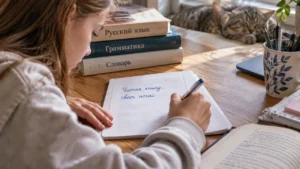
In families abroad, it's usually an adult who writes the postcard, and the child signs their name at the bottom. The reason is simple: a blank page is more intimidating than any mistake, and the child doesn't know where to start. The generator below removes precisely that obstacle. Choose the occasion and the recipient, get a ready-made text, and the child just needs to rewrite it in their own handwriting on thick paper. In search engines, this task is often looked for as "Russian handwriting practice.".
Generator
Choose an occasion and recipient, and enter the child's name. The finished text will remain to be rewritten by hand on thick paper and supplemented with a drawing.
To whom
Occasion
Length
How to sign
A postcard goes in an envelope, while everyday correspondence with Grandma happens on the phone, and there, the child is hindered by something else. The Russian keyboard layout is foreign, they have to search for letters one by one, and a long message turns into a smiley face. It slows down our typing. Typing tutor. And the word "babushka" itself managed to make its way into English and turned into a headscarf, this and other word migrations are about A separate analysis of Russian loanwords.
As the hand writes letter by letter, the word manages to imprint itself entirely, including the ending and the soft sign. Neither a keyboard nor reading offers this. Therefore, a handwritten postcard to grandma works better than regular exercises, and at the same time, brings a response letter. At Palme School, children from four to seventeen years old study online in small groups where everyone speaks and writes. You can learn more about the school at two free lessons.
Frequently asked questions about a postcard for Grandma
01 What should I write to my grandmother if my child isn't very good at writing in Russian?
Take the shortest option of the three lines and don't aim for length. The salutation, congratulation, and signature already make up the actual letter. Mistakes in such a card don't matter because grandma is waiting for a message from her grandson. In a year, the same child will write twice as much if you start small now.
02 Is it really necessary to write it out by hand, since you can just send a message?
You can send it, but handwriting works differently. While the hand is writing the letters, the child says the word to themselves and remembers its spelling, which doesn't happen when typing on a keyboard. Plus, grandma will put a paper card on a shelf, while a message will get lost in the correspondence within a week.
03 How can I get my child to write to Grandma if he refuses?
Forcing is useless, but removing an obstacle is possible. Most often, a child refuses not the grandmother, but a blank sheet of paper on which it's unclear what to write. A ready-made text removes this fear, because rewriting is easier than coming up with something. Then, drawing, stickers, and an envelope come into play, and the work proceeds on its own.