
Names and identifying details of every student below have been changed.
Forty minutes over a cup
There were four cups in that cupboard and Kostya wanted the blue one, which was in the dishwasher. He was nine, he lived outside Boston, and what came next took the rest of the afternoon.

Parents describe this to me with a particular kind of bewilderment, because the trigger is always absurd and they know it is absurd, and knowing that doesn’t help at all. A pencil breaks, or a sock feels wrong, or somebody says actually in a particular tone, and then the afternoon is gone. His name and the details are changed, as they are everywhere on the blog.
Worth saying first: the cup wasn’t the reason. It was the last item in a queue that had been forming since about two in the afternoon, somewhere between a difficult lunch break and a piece of homework nobody mentioned.
What is actually happening
Emotions do not arrive fully formed. They assemble, the assembly takes time, and along the way there are several separate points at which a person can step in and change what the finished thing turns out to be. James Gross laid this out in a model that has organized the field ever since. Five strategies, sorted by when they act. You can choose which situations to be in, change a situation you are already in, move your attention elsewhere, or change what you think the situation means. And last, once the response has already arrived, you can do something about it.
Four of those five act before the emotion has fully developed. Only the fifth acts once it has.
Nearly all parenting advice lives in that fifth strategy. Breathe. Count backward. Tell me what’s wrong. Every one of those arrives at the point where the least leverage remains, and the experimental work comparing the two kinds points the same way.
The advice you were given is aimed at the smallest of the five.
By the time you are dealing with the explosion, the useful moments have all gone past. None of that is a counsel of despair so much as a relocation of effort, and the rest of this article is about where the effort goes instead.
Why «use your words» fails
Ask a child at full volume to explain what is wrong, and watch. Usually nothing happens, and sometimes, because you have just added a demand to a system that has no spare capacity at all, the volume goes up instead. Such a request assumes access to language, sequencing, and self-observation, three things that are expensive at the best of times and largely unavailable in the middle of a flood. You are asking for the report while the fire is still burning.

Adults differ only in practice here. Recall being genuinely furious while somebody asked you to calmly explain your position. The honest answer is usually that you could not, quite, and that you said something worse instead.
A child has less practice and a smaller system. Inhibitory control is one of the three core abilities Adele Diamond separated out, and holding back a response is exactly the job it does. Harvard’s Center on the Developing Child puts the finish line on all three somewhere in a person’s twenties.
What to do mid-meltdown, honestly
Which is honest rather than modest. The goal in the middle is not teaching, not reasoning, and not resolution; it is getting through the thing without adding fuel and without anybody being frightened. Four things help, and none of them are clever.
Less than you want.
Use fewer words. Not silence, which a child reads as withdrawal at exactly the moment withdrawal costs most, but short flat sentences with long gaps between them. Still here. No rush. Repeated, unhurried, without variation, because variation invites processing and processing is not currently available. Lower everything else: your voice, your posture, the room. A parent who sits down on the floor changes the physics of a situation more than any sentence does, and it costs nothing. Remove the audience where you can. Not as a punishment, but because performance makes recovery harder, and a child with an audience has a role to go on playing until somebody leaves the room.
Then wait longer than feels comfortable. My rough estimate is that the average parent intervenes again about ninety seconds too early and restarts the whole thing, and I should say plainly that this is an impression from years of watching, not a number anybody has measured.
And one thing to hold off on. The conversation you want to have belongs later that evening, or the next morning, at whatever distance is long enough for the child to actually hear it instead of defending against it.
The four places you can actually work
This is the part that matters, and it maps onto the four early strategies in Gross’s model without much translation. Start by choosing the situation. A supermarket at six in the evening after a full school day is not a neutral setting; it is a stress test with a cart. Some fights are optional. The way to decline one is to not schedule it. Then there is changing the situation you are already in. Food, water, a coat taken off, a window opened, a task cut in half. Most of what looks like emotional volatility in a nine-year-old, once you have gone through the list, turns out to be an ordinary physical state with a story attached to it after the fact. Moving attention comes next, and it means the genuine article, not distraction as dismissal. A question about something concrete, a job that needs doing, a different room to be in. This one works best early, while the queue is still forming.
Last of the four, change what the thing means, out loud and in advance and repeatedly. Losing a game is not the same as being bad at it. Said calmly on a Tuesday, that sentence becomes available on the Saturday when the game is actually lost.
Doing something about the response itself, the fifth strategy, is the mid-meltdown work above.
The timeline nobody hands you
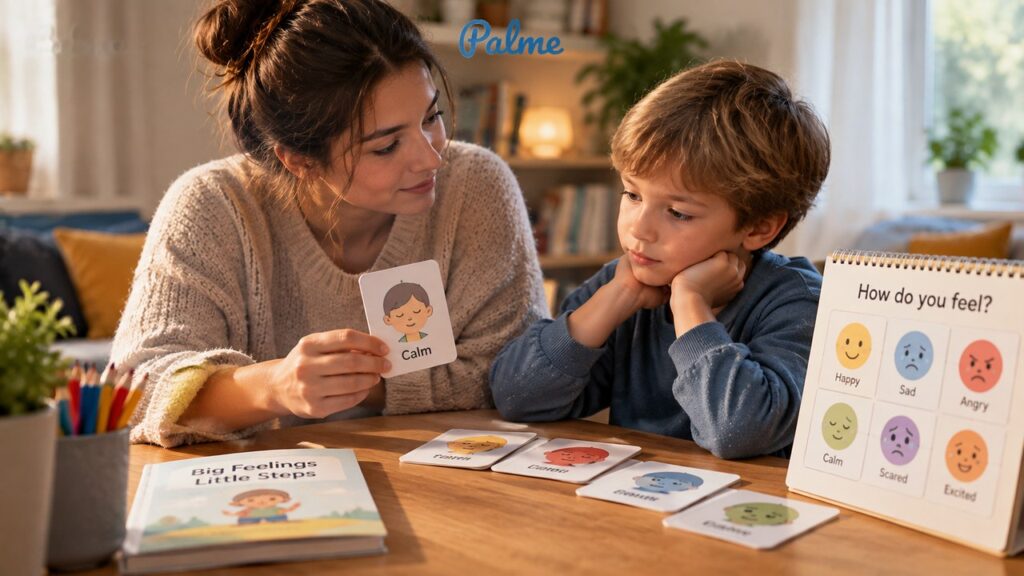
What follows is my classroom shorthand and not a developmental norm. At four or five, expect the storm to be physical, and expect the body to be as much the subject as the event. Naming feelings is the work at this age, and for several years you do the naming, out loud, before the child manages it alone. You wanted the blue one. That’s a real thing to be upset about.
By seven a child can start to notice the build, which is the point at which the queue becomes visible to them. The useful question stops being what happened and becomes what was happening beforehand. Not in the moment, though. Later.
Eleven is the frustrating one. Most children this age can do the reasoning perfectly well when calm and still cannot reach it when hot, which parents read as deliberate. It isn’t deliberate at all. It’s the ordinary gap between knowing and doing, and that gap closes slowly. Somewhere around fourteen the explosions get quieter and better aimed, and the aim is often you. A teenager who blows up at home and holds together everywhere else is not more comfortable being cruel to you. They have spent the day suppressing and arrived somewhere safe enough to stop.
Sit with that last one for a moment, because the conduct that feels most like disrespect is frequently the strongest available evidence of trust that a parent will ever get.
The words themselves
Parents ask for exact words, so here they are. None of them are magic, and all of them should be changed until they sound like you.
I’m not going anywhere and you don’t owe me a sentence. That one goes in the middle. Then nothing, for a good deal longer than feels natural to anybody standing there watching a child cry. As it starts to fade, that was a big one, with no analysis attached. The sentence acknowledges the size without asking for an account of it. Hours later, and only hours later, comes the question that actually teaches. What was happening before the cup? For the times you got it wrong yourself there is I shouted. That wasn’t fair, and it wasn’t about you. Children pick up repair by watching it happen, and no other route to this one exists.
And for the build, in advance, you look like you’re running out of room. A sentence the child can eventually say to themselves is the whole point of the exercise.
The evening I lost it
I’ve been on the other side of this more than once, and one occasion is instructive. Three weeks of a twelve-year-old refusing to read aloud, and on the third Thursday I heard my own voice go up. Something about how we could all just sit here in silence then, if that was what he wanted.

He went quiet for the rest of the lesson, and his mother wrote that evening to apologize for him. Two things about that. My frustration had been building since the first Thursday, and I had done nothing about it, which is precisely the failure I’ve spent this article describing. And the sarcasm was a response-focused move, made at the worst point in the process, by a grown adult who knows better and had known better for three weeks.
He and I are fine. I apologized at the start of the next lesson, in one sentence, and we read a page together with me going first and stumbling on purpose.
What makes it worse
Reasoning during it comes first on the list. Every parent tries this, and every parent knows by the second sentence that nothing is landing, and goes on to the third sentence anyway.
Matching the volume comes next, and it is so understandable that I hesitate to list it, except that it reliably converts one person’s storm into a shared one.
Consequences announced mid-flood belong here too. Whatever gets said at minute four gets forgotten or remembered as unfair. Often both.
Public commentary does long damage for how casual it sounds. He’s very sensitive, said within earshot, becomes a description the child accepts and then lives up to.
Worst of the lot is treating the calm-down as the finish line. The moment things settle is when parents most want to move on, and it is also the only moment the actual learning is available, later that same evening, at a distance.
When it is more than immaturity
Most of this is ordinary, and ordinary is exhausting without being alarming. Some patterns are worth taking further. Outbursts that appear everywhere and not in one setting. Six months or more, not a hard stretch after a move or a new sibling. Aggression that frightens rather than simply spills. And a child left distressed by their own reactions afterward, which is a different situation from a child who shrugs and moves on.
Executive function difficulty is closely tied to ADHD, one important component of it rather than a defining feature, and inhibition sits inside that picture. Our checklist of ten signs sets out the pattern in a form you can print.
A blog article is a decent place to recognize a pattern and a poor place to name one.
Several of those together, and it stops being a parenting question. A pediatrician or the school psychologist takes it from there, and what helps them is specifics: what happened, at what hour, how long it ran, and what the hour before that looked like.
What actually builds this
Regulation gets learned the way most difficult things do, by being done badly, repeatedly, over a long stretch of ordinary weeks, in the presence of somebody who does not panic while it is being done badly. School programs that teach these skills directly show gains in behavior and attitudes alongside academic results, according to the meta-analytic evidence, and American schools file the whole area under social and emotional learning.
The mechanism is unremarkable. Every time a child comes apart and the adult stays intact, the child gets one more piece of evidence that the feeling is survivable, and nothing else in the household does that particular job.
There is no shortcut through it. It is slow and unglamorous, and no version of it skips the coming apart, which is the part every parent would pay money to skip.
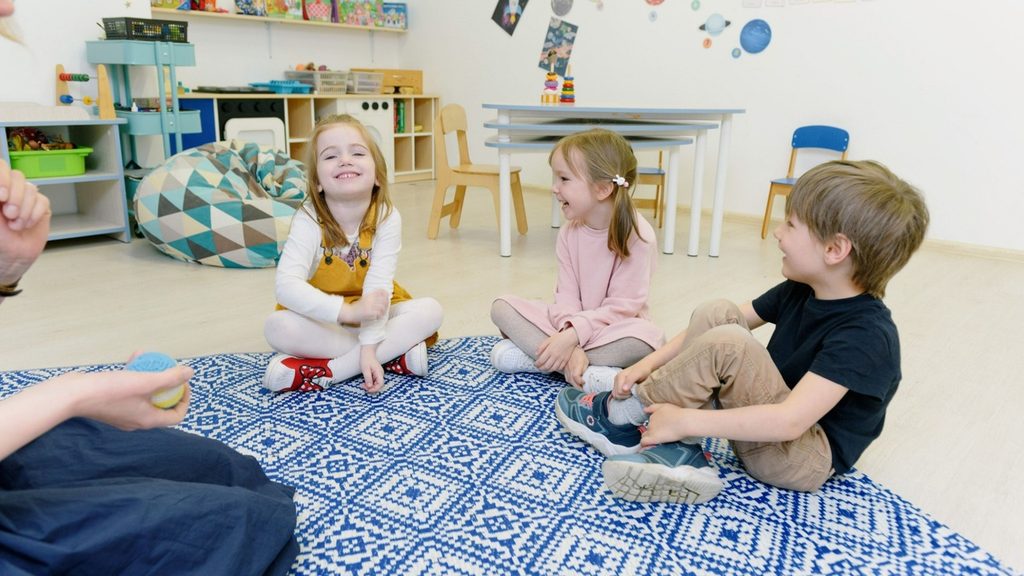
Some of the practice needs to happen away from you as well. A parent is a soft audience by design, and a child who only ever loses their temper at home never finds out what it costs elsewhere. In our lessons for bilingual kids, a child holds a turn while four others hold theirs, and the conversation school puts the same demand on speaking. Neither is therapy. Both are rooms where the frustration is real and the audience is not obliged to be kind.
Kostya is eleven now. He still hates losing, and he now leaves the room on his own about half the time, which nobody taught him directly and which took the better part of two years of ordinary evenings where the adults in the house declined to come apart alongside him.
At Palme School we teach online, in groups of up to eight, two forty-minute classes a week, and the first two lessons are free. You can book those here, and there are printable materials for parents in our resource library.
Frequently asked questions
Mostly before the event, not during it. Four of the five strategies in the standard model act early: choosing situations, changing them, moving attention, and changing what a thing means.
The fifth, doing something once the emotion has landed, is the one parents are usually taught, and it has the least room to work.
Because the little thing is rarely the cause. It is the last item in a queue that has been building for hours, and the queue is usually physical as much as emotional.
Look at the hour before rather than the minute of.
Less than you think. Short flat sentences, long gaps, lower voice, fewer onlookers, and considerably more waiting than feels comfortable.
Teaching, reasoning, and consequences all belong later, when the child can actually hear them.
Usually because home is where the suppressing stops. A child who holds it together all day arrives somewhere safe and puts it down.
It is unpleasant to be on the receiving end of, and it is not evidence that you have done something wrong.
Sources
- Center on the Developing Child, Harvard University. (2012, May 20). InBrief: Executive Function. developingchild.harvard.edu
- Collaborative for Academic, Social, and Emotional Learning. (n.d.). What Is SEL? casel.org
- Diamond, A. (2013). Executive functions. Annual Review of Psychology, 64, 135–168. doi.org
- Durlak, J. A., Weissberg, R. P., Dymnicki, A. B., Taylor, R. D., & Schellinger, K. B. (2011). The impact of enhancing students’ social and emotional learning: A meta-analysis of school-based universal interventions. Child Development, 82(1), 405–432. onlinelibrary.wiley.com
- Gross, J. J. (1998). Antecedent- and response-focused emotion regulation: Divergent consequences for experience, expression, and physiology. Journal of Personality and Social Psychology, 74(1), 224–237. doi.org
- Gross, J. J. (1998). The emerging field of emotion regulation: An integrative review. Review of General Psychology, 2(3), 271–299. psycnet.apa.org
- Willcutt, E. G., Doyle, A. E., Nigg, J. T., Faraone, S. V., & Pennington, B. F. (2005). Validity of the executive function theory of attention-deficit/hyperactivity disorder: A meta-analytic review. Biological Psychiatry, 57(11), 1336–1346. pubmed.ncbi.nlm.nih.gov
Palme School: Russian for bilingual children · Conversation school · Free materials for parents
Lily Rozberg has been teaching for sixteen years, first English in Russia and now Russian to bilingual children across the US and Canada. She writes for Palme School about heritage language, reading, and the things report cards do not measure.