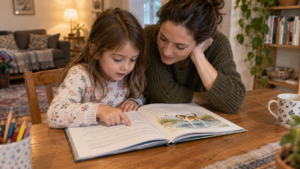



It's a weekday evening in a Boston suburb. Eight-year-old Vera is peeling an orange while her mother asks in Russian how school was. Vera replies in English. Her mother stirs a pot on the stove. Vera spends nearly all her waking hours in English, at school and with friends, and Russian is relegated to the fringes of her day, leaving her mother to wonder what future it holds within their home.
If she is pushed to do it, Vera could say the same thing in Russian. Roughly twenty times more of her daily practice is conducted in English than in Russian, and a young brain will gravitate toward whichever language it has had the most exposure to.
Children who speak multiple languages represent the global majority.

For a parent whose household is set in an English-speaking suburb, one language per child can be considered the default. Carrying several languages is more common among people than carrying only one, and for this reason, it is the monolingual childhood, not the multilingual one, that stands as the exception across most of the world.
The question her mother is asking is which of the two will be used enough over the next ten years to still be around when Vera becomes an adult.
A multilingual child leans on the language that gets more practice.

The survival of a language in a child happens through hours of use, and in Vera's case, those hours are not divided evenly.
The Russian language is given the dinner hour and one Sunday call that is made to the grandmother in Saratov. For most of the everyday things, Vera uses two words, one in English and one in Russian. The English word has been spoken so much more often that it comes to mind first, before the Russian word has a chance.
Vera's comprehension is sound, which is why the conversation in the kitchen functions. Understanding runs well ahead of speech, and the Russian that is not being produced by Vera has not been lost. The grandmother in Saratov, by whom no English is understood, is the one situation each week, on the Sunday call, where English will not serve, and across those twenty minutes Russian is produced by Vera, because the call leaves her no alternative.
The lasting benefits of multilingualism for a child

On the "bilingual advantage"
Tested on ~4,500 children, the advantage did not replicate.
A 2019 study in Nature Human Behaviour involving American 9-10 year olds; the famous effect yielded no results.
A whole shelf of parenting books has for years made the promise that Raising a bilingual child secures sharper focus and stronger self-control in later years. A 2019 study published in Nature Human Behaviour then analyzed data from approximately 4,500 American children aged nine and ten, and that celebrated advantage [of early self-control training] yielded no results. Replications carried out since then have mostly failed to find the effect as well, although a small number of reviews continue to report a modest effect.
The honest case is located on quieter ground. If Vera retains Russian, her grandmother in Saratov is kept as someone she can know directly, in her own words, through those Sunday calls. The family jokes, whose effect is lost in English, are also retained, along with a second perspective on other people's thinking.
Multilingual education builds on the home language

UNESCO has supported the case for multilingual education. By that organization's 2025 count, roughly 40 percent of the world's population lacks access to schooling in a language they fully understand. The finding, repeated from one country to the next, is that knowledge built through the home language is the knowledge that is retained. In those classrooms, the language a child brings from home is regarded as an asset by teachers, and students manage the switch with far less strain than adults assume.
Multilingual ability in the labor market

Bilingual job demand
~240,000 → ~630,000
US job postings seeking bilingual candidates, the count over five years (New American Economy).
A survey of US job postings conducted by New American Economy found that listings asking for bilingual candidates more than doubled over a five-year period, from about 240,000 to around 630,000. Most of this demand came from jobs that involve speaking with clients and patients in more than one language. A language learned at a young age tends to last a lifetime and will remain an asset in the multilingual workforce of the 2040s.
What keeps a language going is its repeated use with other people, and our school has been set up around that single fact. The groups remain small and meet a couple of times a week, and the hour is never used as a Russian lesson. Two free lessons open the door, one following the other. A methodologist first meets with the child to determine their proficiency level, and after that, a full group lesson is conducted by a teacher.
The kitchen scene had changed as well, at a point a few months into the lessons. The answers began to come back in Russian, first as single words tucked inside English sentences and later as whole sentences, because by that time more people than one grandmother were expecting Russian from Vera, and she had her own reasons for using it.
Common questions from parents about multilingual children
My kid understands Russian but keeps replying in English. Is that something to worry about?
Nothing is wrong here, and it isn't a sign of some limitation in your child. Understanding matures long before confident speech, and when a child's entire day is spent in English, responding in English is the cheapest option available. The environment helps more than pressure does, and for this reason, it's worth creating a few situations where the only way through is Russian.
Will doing more Russian at home set her English back?
This worry has been around in families for a long time, and the studies do not bear it out. Children manage both languages at the same time, and the two grow side by side, with neither one developing at the expense of the other. English already saturates the day, through school and every screen in the house, and for this reason, the language spoken at home must be intentionally protected.
Can a child be too old to start, or to pick up Russian again?
No age within childhood is too late. A four-year-old and a fifteen-year-old can both get there, by different routes, which is why our groups range from four to seventeen. Starting early is the gentler path, but children whose Russian has drifted are regularly brought back by our teachers, and for this reason the current level of a child matters more than the age which is written on her paperwork.