



The postcard arrived on Thursday. A regular white envelope with a stamp from Saratov, grandma's return address written askew in blue ink. Mom took out the sheet, and her face became the way it does when someone calls from far away. She read it, folded it, and put it on the table. Eight-year-old Sonya took it, unfolded it, looked at it, and said, «Mom, there are some waves here. Is this Russian?»
Sonia knows Russian letters. Printed ones. She reads signs in the Russian store and cartoon titles on YouTube. But on Grandma's paper, the letters are different. Smooth, slanted, flowing into each other without a single break. Sonia didn't recognize a single one. Mom explained: it's the same Russian, just handwritten. Russian cursive. To Sonia, this explanation explained nothing.
This is not a question of calligraphy. It's a question of who can read Grandma's voice.
Grandma wrote about the apple tree in the garden, which yielded fewer apples this year. About the neighbor, Aunt Valya, who got a puppy. About how she misses Sonya and wants her to visit in the summer. Ordinary things, written in an ordinary hand on ordinary paper. But for Sonya, it was a closed world. She heard her mom's voice reading aloud and felt that behind these waves on paper was something warm, but she couldn't reach it herself.
In the evening, she approached her mother and said, «Teach me to read Grandma's letters.» Not «teach me cursive.» Not «I want to learn the handwritten Russian alphabet.» But specifically, «Grandma's letters.» For the child, the goal was concrete and personal. Not an abstract skill, but access to a person.
Dad reacted in his own way when he heard. He had long said he wanted Sonya to be able to read and write in Russian, not just speak it. «Speaking is only half the battle. If she can't read what Grandma wrote, what's the point?» Dad is one of those who prefers to delegate: he finds a school, pays for it, the child studies, and there's a result. But with cursive, he had to get involved personally because his daughter asked her mom, and her mom asked her dad for help.
First evening with Grandma's letter
The three of them sat down at the kitchen table. Mom placed the postcard in front of Sonya and asked, «Which letters do you recognize?» Sonya looked for a long time. She found «a» because the cursive «a» is almost identical to the printed one. She found «o.» She found «s.» Three letters out of the whole letter. The rest looked like an electrocardiogram.
Then Mom pointed at the word «потом» and asked, «See this letter?» Sonya looked and said, «Is that an «m»?» No. It's a «t». In Russian cursive, a lowercase «t» looks like a Latin «m»: three sticks joined at the bottom, with a line on top. Sonya didn't believe it. She looked at her mom. «Seriously? Did you intentionally design it that way to make it harder?»
At that moment, Mom realized that cursive was not a continuation of the alphabet. It was actually a second set of characters that needed to be learned separately. Russian cursive alphabet looks like a different script not because Russians wanted to confuse foreigners, but because a hand writing quickly turns right angles into smooth curves. Each cursive letter is the result of having been written millions of times, and it has been smoothed out like a river stone.
Print vs. Italic
Why did Sonya read «d» as «g» and cry?
A week later, Sonya already recognized a dozen letters. But then came the word «dear» from the beginning of the letter. The capital «D» was manageable, although it looked unusual. But the lowercase «d» in the middle of the word brought Sonya to tears. She saw a loop going downwards and read «g.» «Mom, does it say «gorogaya» here? What's that?» Mom explained: the italic «d» looks like the Latin «g,» but it's a «d.» Sonya put down her pen and said, «That's not fair.».
Unfair. This is a word we've heard from many children at Palme School when they first encounter cursive Cyrillic. They learn the letter, memorize its shape, but it looks different in cursive. A brain accustomed to the Latin alphabet sees a familiar shape and substitutes the Latin meaning. It sees something similar to «m» and reads «m.» It sees something similar to «u» and reads «u.» But in reality, it's «t» and «i.» Counterintuitive, frustrating, but fixable.
4 letters that children confuse most often
It is precisely because of these trap letters that Russian cursive has become a meme on the English-speaking internet. Photos of handwritten words like «лишишь» (lishish) or «шиншилла» (shinchilla), where all the letters look like a series of identical sticks, get thousands of comments. For a native speaker, everything is read instantly. For a beginner, it's a test of patience.
Refrigerator experiment

Sonya's mom came up with a simple idea. Every morning, she started leaving a note in cursive on the refrigerator. One or two words. «Milk.» «Love.» «Good luck.» Sonya would come home from school and decipher them. The first week, she spent ten minutes deciphering them. By the second week, she recognized them in seconds.
It wasn't a lesson. It was a a code-breaking game woven into an ordinary day. No one sat at a desk with practice sheets, no one cried over the letter «d.» The notes were short and clear, the words familiar. «Mama,» «cat,» «soup,» «came,» «kisses.» Sonya already knew these words by ear and in print. Now she was learning their third form, cursive, and each recognition was a small victory.
A month later, Dad joined in. He started leaving his own notes, but his handwriting was worse than Mom's. The letters jumped, and the slant changed. Sonya began to decipher his scribbles too, and it turned out to be even more useful: perfect handwriting is rarely found in real life. Grandma's letters were also far from calligraphic models.
A family from Chicago that we work with came up with «cursive mail.» The mother would write a note to her daughter in cursive and hide it under her pillow. The daughter would decipher it and write a reply. At first, the replies were one word. After a month, they were sentences. After three months, they were writing to each other every day. The grandmother from Krasnodar, upon learning about this, started sending not Postcards, and the actual letters are two pages long.
Another family from Boston went through recipes. The mom printed out Grandma's handwritten pie recipe, and the ten-year-old son deciphered every word like a puzzle. «Flour,» he understood. «Eggs,» he understood. «Dough» got him stuck because the cursive «t» looked like an «m» again. But when he deciphered it and realized it was what pies are made of, he was as proud as if he'd cracked a safe. He asked for more recipes. In two months, he read seven of Grandma's recipes and now knows how to bake Russian apple charlotte.
When the American dad sat down to practice his penmanship

A separate story, which we hear more and more often. It's not the child learning cursive, but the dad. An American husband of a Russian-speaking wife, who decided to figure out what his mother-in-law writes on New Year's postcards.
One such dad from Seattle told me that he started learning cursive Cyrillic after his wife received a long letter from her mother in Yekaterinburg. His wife was reading it and crying. He sat next to her and didn't understand a word. Not because he didn't know Russian: he had already been learning conversational Russian for two years. But because the handwritten text looked like a completely different language. He could read printed letters slowly, but he could read them. He couldn't read cursive at all.
He bought children's handwriting practice books on Amazon and started practicing in the evenings after his daughter went to bed. He wrote in a lined notebook, just like a first-grader. His wife laughed at first, then helped, and then started leaving him notes in cursive on the bathroom mirror. After four months, he was able to read his mother-in-law's letter himself. Not all the words, not without mistakes. But enough to understand what she wrote about. When his mother-in-law found out, she didn't believe it. She called and asked him to read it aloud. He read it. She said to her husband, «Our son-in-law is reading my letters. Do you hear that?»
For blended families Italicization often becomes a bridge not only between generations but also between cultures. An American dad who can read his grandmother's note is perceived differently by his Russian-speaking relatives. He's no longer «that guy our daughter married.» He's one of them. He invested time, he figured it out, he respects them. This is understood without words.
By the way, the daughter of that dad from Seattle saw her dad doing calligraphy and said, «I want to do that too.» So they started practicing together. Every evening for fifteen minutes, father and daughter, in silence, each in their own notebook. Mom said those were the quietest and warmest fifteen minutes in their home.
Why did Grandma cry on the phone?

After three months of studying, Sonya read an entire sentence from her grandmother's letter by herself for the first time. «I miss you, Sonechka.» Five words. She called her grandmother and read them aloud, right from the page. Her grandmother on the other end was silent for a second, then started crying.
For Grandma in Saratov, it wasn't about letters. It was about her granddaughter from another continent deciphering her handwriting. Not her mom's retelling, not a voice message, but her own, Grandma's, scribbles on paper. It meant the connection hadn't been broken. That the child growing up in Toronto, speaking English with friends and teachers, could still read what Grandma had written at the kitchen table in Saratov.
Many grandmothers, with whom we spoke through our students« parents, say the same thing. »I was afraid my grandson would grow up and not be able to read my letters. That my words would remain unread." For grandmothers, Russian cursive is not an academic discipline. It's a communication channel. The only one they know and have used their whole lives. When a child learns to read cursive, they aren't just mastering a skill. They are opening a door to someone who loves and awaits them.
Ten minutes between dinner and sleep
Russian cursive practice sheets only work with consistency. This is confirmed by all families with whom we have worked. Two hours of practice on Saturdays yield less than ten minutes every evening for a month. Muscle memory is formed by repetition, not duration.
Sonia's family found their time: after dinner, before bed, when homework was done and there was no rush. A pen, a notebook with slanted lines, one or two lines. First, large, each letter half a line. Then smaller. Not the whole alphabet in order, but specific words Sonia already knew. «Mom.» «Cat.» «Love.» A familiar word in a new script is read easier because the brain recognizes the meaning and reconstructs the form.
Important observation: writing large isn't for aesthetics. In Russian schools, children start with huge letters precisely because the hand needs to memorize the trajectory. Where to start a stroke, where to guide it, where to end it. When the letter is large, the movement is remembered. Then the size decreases, but the movement remains. If you write small from the start, the hand doesn't remember, and the letters turn out unreadable.
Another technique that has worked for several families: reading other people's cursive, not just writing your own. Grandma's postcards. Handwritten recipes from the internet. The signature on an old photograph. A menu at a Russian restaurant, if it's handwritten. Reading someone else's handwriting trains letter recognition just as well as writing your own. And it's often more interesting because it's a detective game.
When a child writes an answer
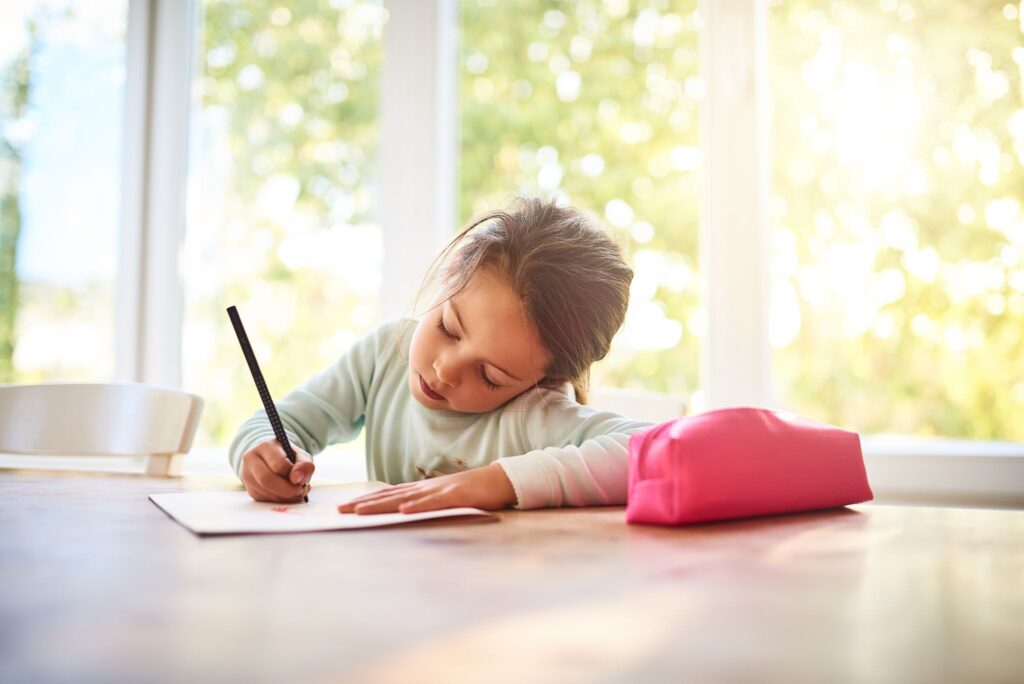
Reading cursive is one thing. Writing is another. And the moment a child first writes a reply to their grandmother by hand is often more significant than the moment they first read her letter.
Sonia wrote her first letter to her grandmother after five months. Four lines on a notebook sheet. «Dear Grandma. I'm doing well. The cat has grown up. Kisses, Sonia.» The letters were large and crooked. The «sh» in «she» (implied) sloped slightly to the right. She didn't dare to write «zh» in the word «cherish» and instead wrote 'love'. But it was a letter. A real, paper, handwritten letter, in cursive. Mom put it in an envelope and sent it.
Grandma keeps this slip of paper in a box with photos. She showed it to her neighbor, Aunt Valya, showed it to her friends at the clinic, showed it to the saleswoman at the store. «My granddaughter from Canada writes to me. In Russian. By hand.» For Grandma, four crooked lines on a lined sheet of paper weighed more than a hundred voice messages.
The boy from Boston, the one who dissected recipes, went further. He wrote his grandmother his own recipe. The recipe for «American pancakes» in italics, with ingredients and steps. His grandmother from Nizhny Novgorod baked it according to his recipe and sent a photo. The boy looked at the photo and couldn't believe it: his grandmother, six thousand kilometers away, was cooking from his note. From his handwritten note.
Such moments don't happen every day. But when they do, the family understands why this year of practicing handwriting and notebooks was necessary. Not for a grade, not for a resume skill, not for an exam. But so that a handwritten word can cross the ocean and remain understood.
Why use italics if everyone types on their phones?
A question both children and parents ask. The honest answer: for most tasks, italics aren't necessary. But there are things a keyboard can't replace.
Grandmother receives a card with a handwritten signature and reacts differently than she would to printed text. A handwritten signature is physical, human. It shows that the child spent time and effort. In family archives lie letters and diaries, all written in cursive. A child who doesn't know cursive cannot read their own family's history. Mom's diary from eighth grade. Grandfather's notes. Grandmother's recipes in the margins of a cookbook.
And practically: Russian alphabet handwriting is part of the Russian school curriculum. If a family plans to send their child for the summer to relatives and the child will go to the local school, at least for a week, italics will be needed. Everyone writes by hand in notebooks there, and a child who only knows how to type will feel like a foreigner.
Printables for download
We have compiled a set of handwriting sheets that you can download for free and print at home. They are suitable for both children and adults who are learning Russian cursive from scratch.
The practice sheets are not structured alphabetically, but rather by the principle of «result first.» The first pages feature letters that change very little in cursive: a, o, e, s, u. The child traces dotted lines, then writes them independently. Success from the first page. Next come syllables and short words made from familiar letters: «mama,» «kot,» «sok,» «nos.» Then phrases: «mama doma,» «kot spit.» Difficult letters, those very «t,» «d,» and «g,» appear in the middle of the set, when the hand is already accustomed to the pen.
We've compiled a set of cursive worksheets that you can get for free and print at home. They are suitable for both children and adults who are learning Russian cursive from scratch.
The practice sheets are not structured alphabetically, but rather by the principle of «result first.» The first pages feature letters that change very little in cursive: a, o, e, s, u. The child traces dotted lines, then writes them independently. Success from the first page. Next come syllables and short words made from familiar letters: «mama,» «kot,» «sok,» «nos.» Then phrases: «mama doma,» «kot spit.» Difficult letters, those very «t,» «d,» and «g,» appear in the middle of the set, when the hand is already accustomed to the pen.
Print on regular A4 paper. If possible, buy a notebook with an oblique ruling. They are sold in Russian stores on Brighton Beach or Bathurst in Toronto. You can also find them on Amazon by searching for "russian cursive practice sheets." The oblique ruling helps maintain the slant.
Print on regular A4 paper. If possible, buy a notebook with an oblique ruling. They are sold in Russian stores on Brighton Beach or Bathurst in Toronto. You can also find them on Amazon by searching for "russian cursive practice sheets." The oblique ruling helps maintain the slant.
How we work with italics at Palme School

During lessons, cursive is integrated into practical tasks. The child labels a drawing. They write a postcard to Grandma. They make a grocery list in Russian. Each time, it's practice that doesn't feel like a lesson.
For children who already write in Latin letters, we separately go over words where tricky letters cause confusion. Not with a list of letters, but through specific words. «Look, here's the word «tetrad». See this letter that looks like an «m»? That's a «t». And here's the «d» at the end, with a tail going down. Let's write it together.» Point-by-point comparisons save weeks of confusion.
Fathers who want to delegate education are usually satisfied: the child comes from class and shows a note written in cursive. The result is visible, concrete. Mom doesn't need to sit down with handwriting practice every evening. It's enough to offer support: leave a note on the fridge, reply to the child's cursive note, show grandma's postcard.
The result in two to three months is usually like this. The child can write a short note in cursive and read their grandmother's letter. The handwriting isn't perfect, the letters sometimes dance. But the connection is restored. For a family separated by an ocean, this means more than any exam.
The first two lessons at Palme School are free. You can see how cursive writing is taught and decide if it's right for your child.
How does Russian cursive differ from printed letters
In printed text, letters stand separately. In cursive, they are slanted, rounded, and connected in a single line within a word. Some even change to the point of being unrecognizable, and you have to learn them all over again. This is precisely why bilingual children who can already read printed Russian cannot read their grandmother's postcard.
What's the best way to start learning cursive?
With short, familiar words, not the alphabet in order. «Mom,» «cat,» «house,» «nose» in italics look beautiful and recognizable. The child sees results from day one, and that provides motivation to continue.
How long does it take to master Russian cursive?
With ten minutes of daily practice, basic reading and writing will appear in two to three months. Beautiful calligraphic handwriting takes longer, but it is sufficient for reading letters and signing postcards.
Is italics necessary if a child is already reading printed Russian?
Everything written by hand is written in italics. Postcards, notes, recipes, signatures on photographs, diaries. Without italics, a child reads only half of the Russian world: the part typed on the computer.
Yes, an adult can learn cursive Cyrillic from scratch.
Adults often learn faster than children. Fine motor skills are developed, and the principle of connecting letters is understandable from Latin. Practice books work the same for any age. Many start learning Russian cursive for a partner or for work, and the results appear faster than expected.
Why did Russian italics become an internet meme
Because some italicized words look like one continuous wavy line. The letters «ш,» «и,» and «т» in the middle of the word look alike, and for a beginner, the word «лишишь» turns into a series of identical sticks. Native speakers read this instantly, while foreigners don't believe it's possible.
Where can I get Russian cursive handwriting practice sheets?
This article has a free downloadable and printable set. Handwriting practice sheets are also sold in Russian bookstores and on Amazon by searching for "russian cursive practice sheets". Notebooks with slanted lines are sold in the same places and are very helpful for maintaining the correct slant.