

Somewhere in Rome or Jakarta, a toddler freezes in front of a screen, giggles, and hums a song, while on the screen, a mischievous girl in a pink sundress drives a big, kind-hearted bear to despair. This child has never heard of Russia, yet their favorite character comes from there. It so happened that two Russian cartoons quietly, without fanfare, conquered children's hearts all over the world, from Italy to Southeast Asia, and now stand shoulder to shoulder with the most famous animated series on the planet.
The discussion is about Smeshariki and Masha and the Bear. Abroad they are searched for with the queries "smeshariki," "masha and the bear," and "russian cartoons," while back home, they have long become a part of a generation's childhood. For a child growing up away from Russia, these cartoons are almost magical because they can watch them in Russian and know that their peers in dozens of other countries are watching the exact same thing. Next, we'll explore where both series came from, who created them, and how it happened that the round characters and the mischievous girl became known in dozens of languages.
And here we should pause for a moment and be amazed. Cartoons rarely cross borders easily; foreign humor and unfamiliar characters often remain misunderstood abroad. Disney and Japanese anime managed this, but Russian animation almost never did, and for many years Our cartoons They were mostly loved at home. "KikoRiki" and "Masha and the Bear" broke through this wall first, and with such success that today they are recognized by children who can't even find Russia on a map. How they managed to achieve this is worth examining in order.
A World Without Villains, the Kikoriki Universe
Smeshariki first appeared on screens in 2004, created by a St. Petersburg studio with the simple name "Peterburg," part of the Riki group of companies. The project was spearheaded by producers Ilya Popov and Anatoly Prokhorov, along with artist Salavat Shaikhinurov. They had an ambitious vision for the time. Instead of drawing with pencils as before, they decided to use computers and Flash animation, which was a novelty in the post-Soviet space at the time. This is why the characters turned out to be unlike anything drawn before – round, as if assembled from balls, hence the name itself, "funny balls," or "Smeshariki." Even the shape itself contributed to the concept, as there's nothing frightening about these rounded, soft creatures without a single sharp angle, making them cozy to watch.
However, another idea turned out to be even more important than the animation. The series was built as a world without violence, without a single villain. In the land of Kikoriki, there is simply no one to scheme against; there are no negative characters to battle. There is only a colorful company of dissimilar friends, each with their own character and quirks. The restless rabbit Krosh always drags the cautious Hedgehog along, the flirty Nyusha dreams of a prince, the sad poet Barash writes poems, the good-natured gardener Kopatych tends to his garden beds, the scientist moose Losyash explains everything in the world, the inventor Pin builds machines, and the wise Sovunya and the reasonable Kar-Karych watch over this cheerful gang. The stories about them initially seem simple, but in reality, they are full of subtle, cleverly constructed, two-layered humor. A child laughs at the amusing surface-level situation, while a parent sitting nearby catches a deeper, much more adult meaning in the same episode, about friendship, loneliness, envy, or stubbornness. That's why Kikoriki isn't turned off when a child grows up; they are rewatched.
In over twenty years, the studio has released hundreds of episodes about round characters. The series has its own children's magazine, which has long been one of the most widely read in the country, and the restless Krosh has long been a national favorite, winning children's audience polls year after year. The Kikorikis live in the cozy Chamomile Valley, separated from the outside world by forests, the sea, and mountains. This warm, safe little world itself appeals to both children and parents tired of noisy action movies.
This uniqueness quickly helped the series expand beyond Russia. As early as 2005, while still very young, it won the Grand Prix at a major animation festival in Guangzhou, China, and received the audience award in Italy. Subsequently, the round characters were noticed in other countries, translated into more than fifteen languages, and shown in dozens of countries. Abroad, the series was known by different names, such as Kikoriki and GoGoRiki. It was particularly well-received in China, where, according to some reports, the audience for Smeshariki even surpasses that in Russia. Back home, a whole universe has grown around the series: Malyshariki is aimed at toddlers, and the educational Pin-code is for curious older children. A feature-length film, Smeshariki. The Beginning, was also released. The same team later brought children the famous Fixies, and the round characters themselves have even reached youth platforms like TikTok, gathering millions of fans there. Over twenty years, several generations of children have grown up watching Smeshariki, and the series has long become one of the most recognizable faces of new Russian animation.
Masha, who lives on YouTube
The second hero of this story is much younger and much louder. The animated series Masha and the Bear was released at the very beginning of 2009, created by the Animaccord studio, and the idea was conceived by director Oleg Kuzovkov. He had extensive experience working abroad, and he organized production according to modern, streamlined rules, which was almost unheard of in Russian animation before then. And Masha began to be drawn differently than the flat Smeshariki, immediately in three-dimensional graphics, beautiful and truly cinematic, with the shine of fur and light through the leaves. The plot, meanwhile, is simple and as old as time itself. The restless little Masha settled next door to a former circus bear and turned his quiet forest life into one continuous, hilarious mess. The bear grumbles and clutches his head, then melts with affection and forgives, while the girl just keeps pulling one prank after another.
The name Masha is not accidental here; it comes from an old folk tale about a girl and a bear. However, the cartoon created a completely new heroine and its own plot. And here's what turned out to be the trickiest part. Masha's antics hardly require words. The series has little dialogue and a lot of fun chasing, scuffles, and tricks that are understandable without any translation, like in good old silent films. It's precisely without words that it conquered the world. One episode, "Masha Plus Porridge," in which the girl decides to cook porridge herself and floods the entire house with it, has garnered over four billion views on YouTube. No other cartoon clip in the world has achieved this, and the Guinness Book of Records named it the number one animated clip by viewer count. This seven-minute episode remains among the most popular videos in the site's history to this day, side-by-side with clips from global pop stars. Moreover, it's not the only record-breaker; other episodes have also surpassed the billion-view mark, and all the clips featuring the mischievous Masha have collectively gathered many tens of billions of views.
This fame spread throughout the world, and sometimes in the most unexpected places. Masha has been translated into dozens of languages and is shown in over a hundred countries. In Italy, it was once the most popular children's cartoon, and on the local children's TV channel, hundreds of thousands of viewers watched it simultaneously, which had not happened with any children's show there. Specialists calculated that more than two-thirds of all European children know Masha and have ranked her alongside giants like Peppa Pig and SpongeBob. And at home, the series has spawned a whole family of sequels, including Masha's Tales, where the same Masha retells Russian folk tales in her own way, the noisy Masha's Spooky Stories, and the catchy Masha's Songs, and for her thirteenth birthday, the character is heading to the big screen, where the studio is preparing the first feature film.
Off-screen, Masha has long since transformed into a global brand. Her cheerful face looks out from toys, books, clothes, and candy wrappers produced by major international companies alongside the series. The project itself continues to conquer new markets year after year, even reaching Japan, which is notoriously discerning about animation. It's funny that the cartoon didn't turn a profit for quite some time, only after several years of its debut. However, this modest girl in a sarafán later became one of the most successful cultural products ever to emerge from Russian animation.
What made them understandable to the whole world
It's easy to ask how it happened that cartoons from Russia became loved by children who don't really know anything about Russia. The answer lies in the fact that both series speak to the child in a language that is understood everywhere, in the language of simple human feelings and situations familiar to every child.
Masha's antics are conveyed with almost silent mischief. She doesn't need many words; her pranks, grievances, and joys are readable at a glance, making her just as understandable to an Italian or Indonesian child as to a Russian one. A bear clutching its head is equally funny in any language. The Smeshariki have a different secret, a conversational one, but no less universal. Their stories about friendship, quarrels and reconciliations, about sharing the last of something and making up after being offended, are suitable for any culture, because children everywhere learn to get along with each other in the same way. And the world without villains, conceived by the creators, endeared itself to parents in all countries, because rare cartoons are made without fights and chases after bad guys, and moms and dads quickly identified the series where children are not shown getting beaten.
And Masha captures the hearts of parents in all countries for a very simple reason: in this noisy, curious, restless girl, every mom and every dad recognizes their own child, that little whirlwind that turns the house upside down and immediately disarms you with a smile. The bear, who sighs, endures, and loves anyway, is really about them themselves, about adults. This recognition needs no translation and touches equally in Moscow, Rome, and Jakarta.
Of course, the meticulous work of translators also helped. Both heroes were re-voiced in many languages. Somewhere their names were changed, somewhere jokes understandable only in their homeland were removed. Thus, the round "Smeshariki" became known in America as "GoGoRiki," and Masha started speaking in English, Italian, Spanish, Chinese, and dozens of other languages. The cartoon, conceived in Russia, is now watched by children in their native language, often without even realizing its origin.
It's also worth noting that this success wasn't entirely accidental. From the very beginning, the creators thought beyond their own country and made the cartoons in such a way that they would be easily understood and loved anywhere. Oleg Kuzovkov, who came up with Masha, didn't bring techniques he'd seen overseas to the studio for nothing, and the Kikoriki team consciously moved away from anything too local, retaining what is universal and understandable to a child anywhere on Earth. Both series were seemingly tailor-made for growth and for the wider world from the outset, and the wider world embraced them.
How are these two cartoons completely dissimilar?
It's interesting that with all the general fame of Smeshariki and Masha, they are designed almost as opposites, and it's useful for parents to understand the difference. Smeshariki are flat, drawn, unhurried, and talkative, closer to an intelligent conversation with a child wrapped in a fun story. Masha is volumetric, three-dimensional, fast-paced, and almost speechless, a pure whirlwind of movement, where the joke relies on a trick rather than a line.
This is why they suit different ages and moods. A very young child, who still can't follow the plot and is simply delighted by movement and colors, will find Masha closer with her mischief that is understandable without words. A slightly older child, who is already able to sit and think, will discover Smeshariki with their characters and second meanings. It's good when a home has both, because one teaches to laugh and be surprised, while the other gradually teaches to think and feel. And both of them do the main thing, keeping the child immersed in the Russian language easily and without coercion.
Your cartoon, that the whole world watches
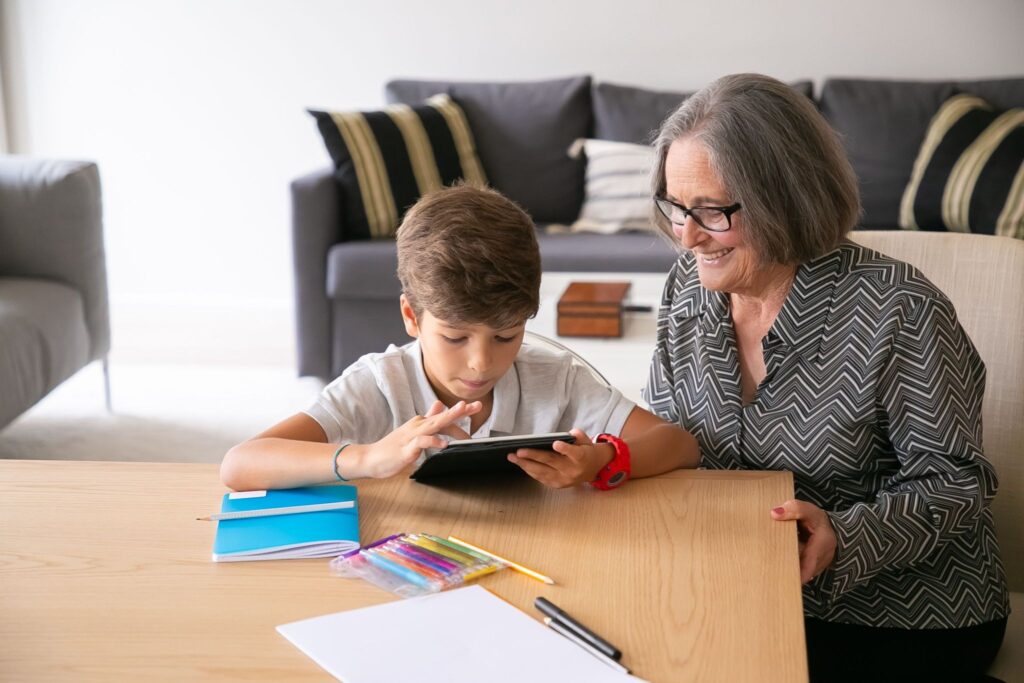
For a child from a Russian-speaking family abroad, this is a real gift. Usually, their native culture seems distant and not very fashionable to such a child; something only their family knows about, while everyone around is obsessed with something else entirely. And suddenly, it turns out that their cartoon, the very one they watch with their grandmother in Russian, is also adored by their classmates at the local school. Their own culture transforms from a reason to be ashamed into a reason for pride.
Here, however, there's a nuance worth remembering. The cartoon is only beneficial for language learning when the child watches it in Russian, not in the local dub, however convenient that might seem. Therefore, parents should find the Russian voiceover in advance, and after the episode, it's worth chatting about it, asking what happened and why Masha acted that way. A couple of minutes of such conversation is enough to turn what was seen into living words that the child will then use themselves. And if you watch together, even more so, because shared laughter and a shared favorite character bring you closer no less than playing together, and the Russian language subtly becomes the language of joy, not boring lessons.
And these cartoons are simply a convenient and joyous way to support the language. The child watches their favorite episode in Russian, laughs, and imperceptibly absorbs living speech, intonations, and new words, making it not a lesson, but pure pleasure. It is precisely this interest that is relied upon in Palme School, where children from Russian-speaking families aged four to seventeen learn the language through subjects that are truly close to them, be it cartoons, games, or stories. You can get acquainted with the school through two free lessons. First, an introductory meeting and assessment with a methodologist, which will show what the child is already good at and where they need help. Then, a trial lesson in a live group, along with other children. No obligations, just to see if this format suits you.
A brief overview of two champions

Smeshariki and Masha and the Bear have proven that a good cartoon knows no borders. Smeshariki, conceived by the Petersburg studio in 2004 as a kind world without villains, has captivated audiences from China to America, where it became known as Kikoriki and GoGoRiki, and developed into a whole universe from Malyshariki to Fixies. Masha and the Bear, created in 2009 by the Animaccord studio, has set a world record; its episode about porridge made it into the Guinness Book of Records and became one of the most viewed videos on YouTube. One series is unhurried and talkative, the other is fast-paced and almost silent, but both are not just entertainment for a child from a Russian-speaking family, but a lively and joyful bridge to their native language, which is also loved by children all over the world.
When did Kikoriki and Masha and the Bear appear?
Smeshariki was the first to hit screens back in 2004, released by the St. Petersburg studio of the same name, which is part of the Riki group. Masha and the Bear reached viewers five years later, at the very beginning of 2009, from the Animaccord studio. So, there's not much separating the two series, and both are still in production and delighting more than one generation of children.
The studio that created Masha and the Bear is Animaccord Animation Studio.
The animation studio Animaccord is behind Masha and the Bear, and the character and the concept itself were invented by director Oleg Kuzovkov. He set up the production in a modern, almost assembly-line manner, unheard of in our animation at the time, and the series was drawn entirely in 3D computer graphics, which is why it looks so visually appealing. The cartoon premiered in January 2009 and has since grown to include many seasons and standalone stories, including Masha's Tales and Masha's Songs.
Is it true that the Masha series made it into the Guinness Book of Records?
Yes, that's right. The episode "Masha Plus Porridge" is to blame. It has been watched more than four billion times on YouTube, and by that count, it has no equal among cartoons, which was recorded by the Guinness Book of Records. The short clip is still among the most popular videos in the platform's entire history, alongside music videos by global artists, and other series have long since surpassed a billion views.
How many countries broadcast these cartoons?
Both series have long since crossed Russia's borders. Masha and the Bear has been translated into dozens of languages and is shown in over a hundred countries, while Kikoriki has been translated into more than fifteen languages and sold in dozens of countries. They are particularly well-received in Italy, Indonesia, and China, where the love for these characters sometimes rivals that in Russia, and, according to specialists, Masha is known by more than two-thirds of European children.
Is it beneficial for a child to watch these cartoons in Russian?
It's very useful if you watch them specifically in Russian. The favorite cartoon captivates the child on its own, and with an interesting plot, they unnoticeably hear spoken language, learning words and intonations without any rote memorization. And it's also nice for a child to know that their cartoon is loved by peers all over the world, and their native language turns from a boring obligation into a reason for pride.