
Names and identifying details of every student here are changed, as they are everywhere on the blog.
Nagging is not a phrasing problem. It is a pricing problem, and every parent I know has discovered this the same way, which is by repeating a perfectly reasonable sentence four times in eleven minutes and hearing it lose value with each repetition until the last one is worth nothing at all.
The fourth time you ask, the asking is free
Your first ask costs the child something to ignore. The fourth costs them nothing at all, because by then you have demonstrated three separate times that ignoring the request produces nothing worse than another request, which is a price any nine-year-old will happily pay all evening.Better wording doesn’t survive being said four times.
I did it twice this week, and noticed the second time that the second time was already the loss.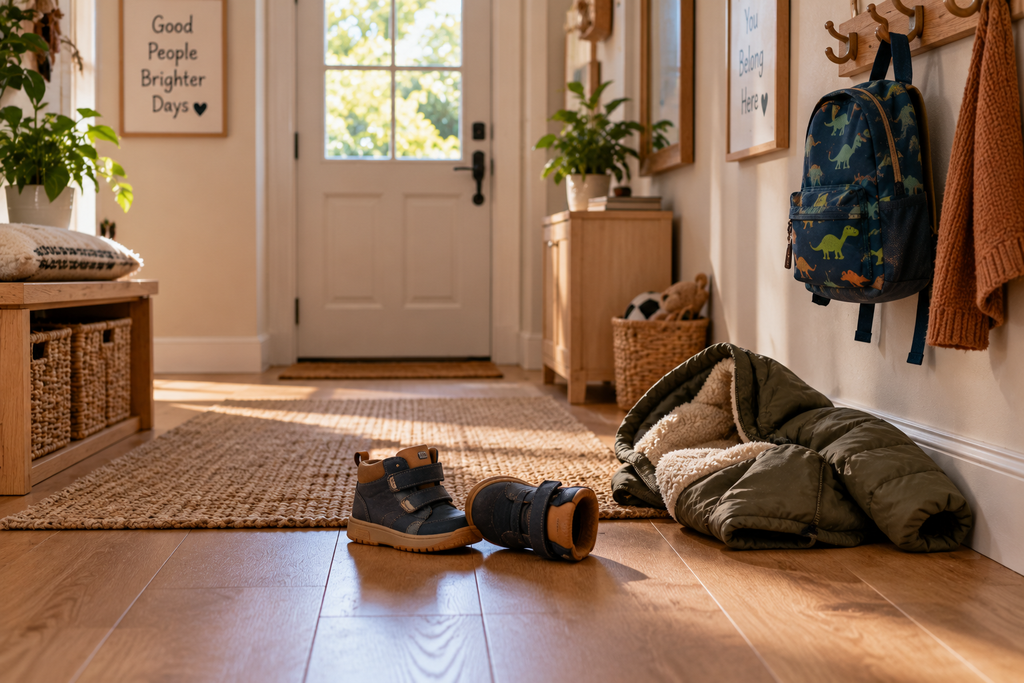
Ask once, then change what happens
The phrases below assume you have said it once and aren’t going to say it again in the same form. Without that, they are just politer nagging.| Instead of | Try | What it does |
|---|---|---|
| Put your shoes away | Where do the shoes go? | Makes them retrieve the rule, not obey it |
| I’ve told you three times | I’m not going to ask again. What’s your plan? | Names the ending and hands over the problem |
| Why haven’t you started | What’s the first thing you need? | Turns a reproach into a question with an answer |
| You never remember anything | The bag’s still by the door | Reports a fact and stops talking |
| Do your homework now | Dinner’s at seven | Gives the deadline and leaves the choice inside it |
The second half is the part nobody wants
Ask once. Then let something other than your voice do the reminding.
Something has to happen after the single ask, and it doesn’t have to be a punishment. The shoes stay in the hallway. The bag is not brought to school. The consequence does the repeating so you don’t have to, and it is considerably better at it. At Palme School we teach online, in groups of up to eight, two forty-minute classes a week, and the first two lessons are free. You can book those here, and there are printable materials for parents in our resource library.My mother tried both, and only one of them worked
Her first attempt was written. Every mislaid thing went onto a sheet by the kitchen door in her own handwriting, a running tally kept without comment, and I loathed it and went on losing things at precisely the rate I had before. A record of failures is still a reproach. It just arrives in silence. She kept it up until I was about twelve.
Her second attempt was carpentry. A hook, in the hallway, level with a ten-year-old’s reach, meant for keys and nothing else. Not one word came attached to it. No morning prompt, no glance toward the wall, no version of did you. Keys stopped disappearing for the better part of a year. Then we moved, the hook stayed behind in that hallway, and they started disappearing again immediately, which should have told me something and did not. I was at university before it occurred to me that the wall had been holding the whole responsibility and my head had never once been asked to.Writing it down changed nothing. A piece of hardware in the hallway changed everything.
Frequently asked questions
Say it once, in the form of a question where possible, and then let something else carry the message. Repetition is what teaches a child that the first request was optional.
Only alongside the second half, which is letting the result arrive. A phrase hands the problem back; letting the result arrive is what teaches a child to solve it, and raising an independent child is mostly the second thing.
Then they meet the result, which is a better teacher than a fifth reminder and requires nothing from you except not rescuing them.
For homework specifically, our piece on procrastination covers why the delay is usually about a feeling rather than a plan.
Palme School: Russian for bilingual children · Conversation school · Free materials for parents
Lily Rozberg has been teaching for sixteen years, first English in Russia and now Russian to bilingual children across the US and Canada. She writes for Palme School about heritage language, reading, and the things report cards do not measure.