



Names and identifying details of every student here are changed, as they are everywhere on the blog.
Ask a chatbot the same grammar question four times over seven months and you will get four correct answers, four different examples, and nothing at all connecting them, because each reply is generated fresh with no record that the first three ever happened.
It answers every question as if you had never asked one before
That is not a subscription problem. It is what the thing is, and one of my students spent most of a year discovering it the slow way.

Four correct answers to one question is not teaching. It is a search engine with manners.
Somebody finally compared them properly
A 2025 study put a teacher, the students themselves, and ChatGPT against each other on translation work by forty-five graduate students.On one measure the model did well: lexical scores improved in the texts it had graded. Then it came third, behind the students correcting themselves.
Three reasons are given, and the first is a caveat for us rather than a finding against the tool: those were advanced translation students, already skilled, which left little room to improve anything. The third reason is the one that matters here. Feedback was inconsistent. It caught an error in one student’s text and missed the same error in another’s, because nothing carries over between replies and no sense of who it is talking to ever builds up.
What it does better than me, and I mean that
I’d rather be honest than defensive, so here is the list, and the last row took me two years to admit.
It answers at two in the morning, when I am asleep. It explains one rule nine times without the ninth sounding any different from the first, which I cannot do and have stopped pretending I can. Fifty sentences on the instrumental case, where I would produce eight and get bored. Long text simplified faster than I manage.
And it never makes anybody feel slow, because it has no face. Adults learning Russian are held back by embarrassment at least as often as by grammar, and for the first hundred hours a machine that cannot judge you is genuinely useful. If you want the same accounting applied to the apps rather than the chatbots, we went through their feature lists separately.The evening a student caught what I had missed
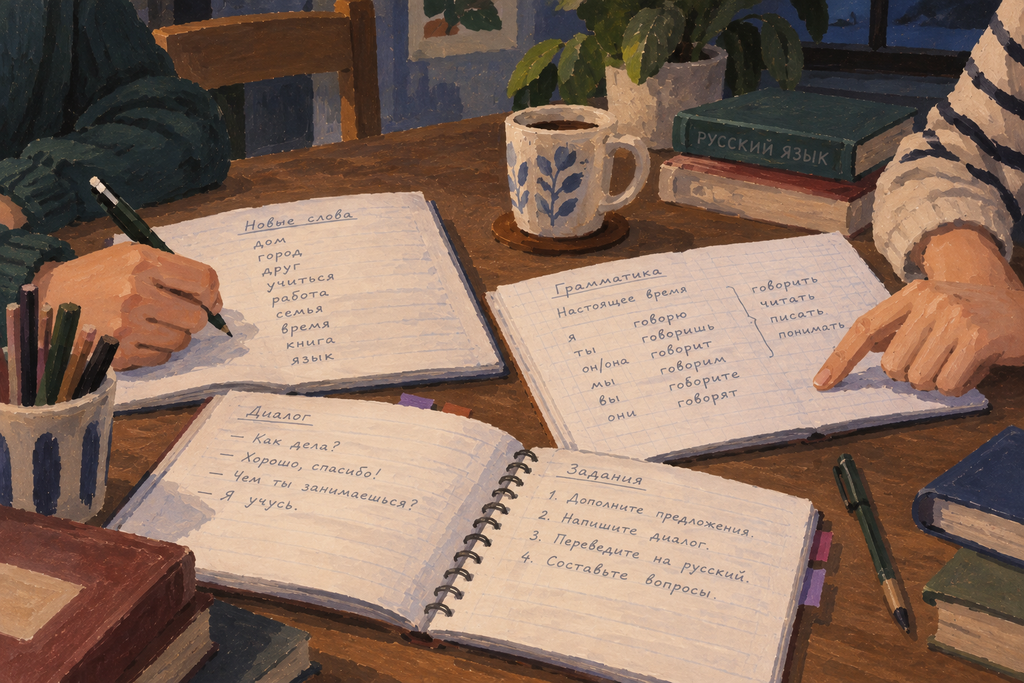
Last winter I had a model generate forty practice sentences on verbs of motion, because generating forty is exactly what it is good at and I had a lesson in the morning. I skimmed them and they looked fine, which is a sentence I would like to have back. Skimming is what you do when you are checking work you already trust.
In the lesson a woman in her fifties stopped at number nineteen and said it was strange. She was right. The sentence was grammatical and no Russian speaker would ever build one that way, and I had read straight past it because I was checking for errors, not for strangeness.
What saved that lesson was not my expertise. It was that eight people were reading the same sheet, which is the whole argument for a group rather than a tutor and one I had not fully believed until that morning.I check whether something is wrong. A room checks whether anybody would say it.
Supply the memory yourself
The tool has no memory of you. You are the memory.
Memory is the gap, so you carry it by hand, every session, which is tedious and works better than people expect. Both help. Neither closes the gap, because you still have to notice what is worth pasting, and noticing is the skill you are trying to build.The thing a person does that a prompt cannot
Third lesson, five adults, ordinary Tuesday
Student Я был в Бостоне. Я ходил… I went to the museum.
I Stop. You just avoided a word. Which one?
Student …the museum one. I don’t know the case.
He had not made an error. He steered around one, and no correction tool can flag a sentence you decided not to say.
A model corrects what you write. A teacher notices what you avoid.
For a first hundred hours of reading, vocabulary, and grammar drills, it can largely replace me, and I would rather say so plainly than pretend my job is harder to replace than it is. For speaking, no. The sentences you never attempt leave no trace, and those are the ones holding your Russian where it is. He still uses the chatbot daily, on my advice, and brings me a list of what it could not settle. That combination beats either half, and it took us a month to work out. At Palme School we teach online, in groups of up to eight, two forty-minute classes a week, and the first two lessons are free. You can book those here, and there are printable materials for learners in our resource library.Frequently asked questions
It can carry reading, vocabulary, and grammar explanation a long way, and for the first few months that is most of the work. What it cannot do is notice the sentences you quietly avoid, which is where most adult Russian stalls.
Because explanation is not the bottleneck. Each answer arrives fresh, with no record of the four times you asked before, so nobody is tracking the pattern except you.
Not according to the comparison that has been run. In a 2025 study it improved vocabulary but came behind both teacher feedback and students correcting their own work, and the paper points at inconsistency as the cause.
Use the model daily and bring the leftovers to a person. Keep a running list of errors, paste it into every session, and note what the model could not settle.
Sources
- Cao, S., & Zhou, T. (2025). Exploring the efficacy of ChatGPT-based feedback compared with teacher feedback and self-feedback: Evidence from Chinese-English translation. SAGE Open, 15(3). doi.org
Palme School: Russian for bilingual children · Conversation school · Free materials
Lily Rozberg has been teaching for sixteen years, first English in Russia and now Russian to bilingual children across the US and Canada. She writes for Palme School about heritage language, reading, and the things report cards do not measure.