
Names and identifying details of every student here are changed, as they are everywhere on the blog.
I put down an X on it for 2 years

For 2 years I circled away while the same kids made the same error from one week to the next and there was no progress to be had. What escaped me was that you would hardly ever see the mistake in reverse. They were not mixing up the two forms so much as applying one to do the work of both, which is quite another matter and no red circle will remedy.
Why it seemed like teaching
A child with a single verb where Russian has two is not in error. He is operating a smaller system, and it holds up until it does not.
It gave something to show for the hour’s work. The parent saw the corrections on the page, I saw my effort reflected there, and come the next week the identical form would be returned to me unmarked.I chalked it up to the difficulty of aspect, as it is difficult enough. It has a reputation for being the thing that puts learners off, so when one fails at it it is taken as the natural order rather than a sign to be heeded.
Then a boy who was good at Russian made me take notice. His reading was fine, he spoke with speed and in his narratives every past-tense verb was perfective. Not most of them. All of them.
To anyone listening there was nothing amiss with his Russian, and that was what was troubling. You can help a child who makes a mistake. One who makes none but is still doing something odd is a different sort of problem.
What the research has to say
Maria Polinsky looked at adult heritage speakers of low proficiency and found what put my red circles in a new light: the perfective-imperfective pairs are not just weak but absent, with only one member left to cover both meanings. Anna Mikhaylova has done some work that makes the issue teachable. She shows that aspectual morphology can be as much a hindrance as a help to a learner’s comprehension, contingent on whether the meaning of the verb is in accord with its present form. Oksana Laleko went a step further to account for my good reader. In her study of covert restructuring she found high-proficiency heritage speakers to be indistinguishable from monolinguals to the ear even as their aspectual system had reorganized itself in quiet fashion. Laleko’s data on distribution is the clearest for a teacher. Where a monolingual will use whatever the sentence requires, the heritage speaker in her figures lets the object have its say. With one type of object they are perfective 9 times out of 10, with another imperfective almost without fail, on the very same verbs. In conversation the problem is hidden because a child whose form is dictated by the object sounds as if he is making a choice; you only know if you count.The two forms
The distinction has not been lost, they have simply ceased to need it, which is more difficult to spot and to put right.
With the Russian past tense one must make a choice each time, and it has nothing to do with the timing of the event but its shape. Замечал (zamechal) is the imperfective and заметил (zametil) the perfective. Two forms of the same verb and the latter brings the event to a close: he noticed, once, and it is done.замечал
zamechal
Imperfective. Used to notice, kept noticing
заметил
zametil
Perfective. Noticed, once, and the noticing landed
писала
pisala
Imperfective. Was writing, spent the evening at it
написала
napisala
Perfective. Wrote it, and the letter exists now
ходил / пошёл
khodil / poshyol
Motion verbs, a separate system. Пошёл completes the setting off, not the walking
Where you can hear the alternation

Parables and folktales are made of this from one end to the other and are far better at instructing in it than any table of endings. A long stretch sets the scene of someone living or waiting or searching. Then a perfective verb will break the stretch and the story pivots: she found, he noticed, they arrived. Put any Russian tale to the test by reading it out loud and you will find the break in the same spot. A child who has heard it 2 times is past the need for the rule to be put to him.
The boy with all-perfective narratives
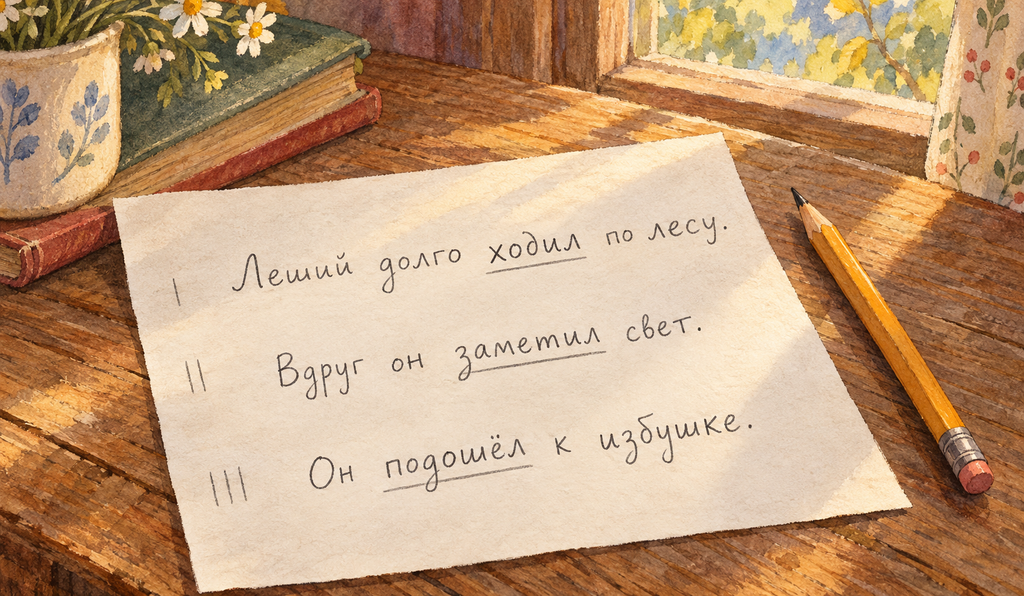
The imperfective is the room, the perfective the door.
He turned in a page on his summer with 30 past-tense verbs. I went through and counted them that night, something I had never bothered to do with another’s work. 29 were perfective. The one imperfective was было (bylo), which has no aspectual partner of any consequence here and is not really a choice. What he produced was a catalogue of completed events with no background to speak of. In English it would be clipped but passable. In Russian it was like a police report on one’s own holiday. We did not resort to rules to set it right. I took a paragraph of his and put it through 2 rewrites, one version stretching everything and the other collapsing it. He could tell both were wrong and that was enough. The third version he put together himself in the course of the week and I have kept it as the only page of a student’s Russian I ever have.Try it yourself
Choose the form the sentence needs.
- Леший (Leshiy) долго (dolgo) ________ по лесу (po lesu). [ходил / пошёл]
- Но вдруг (vdrug) он ________ свет (svet). [замечал / заметил]
- Он долго (dolgo) не ________ свет (svet). [замечал / заметил]
- Она (ona) ________ письмо (pis’mo) за вечер (za vecher). [писала / написала]
Показать ответы
1. ходил (khodil)
2. заметил (zametil)
3. замечал (zamechal)
4. написала (napisala)
Courses at Palme School
Russian for bilingual children
When the language is at home and starting to slip
Conversation school
For children who understand more than they will say
Free materials
Printable activities for families to use at home
Frequently asked questions
Ходил covers a stretch of walking with no endpoint. Пошёл completes the setting off rather than the walking, and Russian motion verbs run a system of their own.
Yes, and that is the common case. Research on high-proficiency heritage speakers found them indistinguishable from monolinguals while the aspectual system underneath had already reorganized.
Heritage speakers often keep only one member of an aspectual pair and use it for both meanings. It is a reorganized system rather than a gap, which is why correcting individual verbs rarely moves it.
Stories, read aloud, with the break heard rather than explained. The alternation between a long stretch and one completed action is the whole pattern, and folktales repeat it on every page.
Sources
- Laleko, O. (2010). On covert tense-aspect restructuring in heritage Russian: A case of aspectually transient predicates. In Proceedings of the 2009 Mind/Context Divide Workshop (pp. 72–83). Somerville, MA: Cascadilla Proceedings Project. lingref.com
- Mikhaylova, A. (2011). Interaction of aspectual morphology in L2 and heritage Russian. In Selected Proceedings of the 2010 Second Language Research Forum (pp. 63–77). Somerville, MA: Cascadilla Proceedings Project. lingref.com
- Polinsky, M. (2008). Without aspect. In G. G. Corbett & M. Noonan (Eds.), Case and Grammatical Relations: Studies in Honor of Bernard Comrie (Typological Studies in Language 81, pp. 263–282). Amsterdam: John Benjamins. doi.org
Palme School: Conversation school · Russian for bilingual children · Free materials for learners
Lily Rozberg has been teaching for sixteen years, first English in Russia and now Russian to bilingual children across the US and Canada. She writes for Palme School about heritage language, reading, and the things report cards do not measure.