

Names and identifying details of every student here are changed, as they are everywhere on the blog.
Why the train leaving Station A gets nowhere
Children who say they are bad at math are usually reporting something narrower and more accurate: the problems in front of them have no consequences.
Two trains leave two stations. The child computes, or does not compute, and either way nothing follows. The trains do not arrive. Nobody is waiting for them, and no part of the afternoon goes differently depending on what the child wrote down. An answer that changes nothing is difficult to care about, and a child who has noticed this is not being lazy. They are being reasonable.
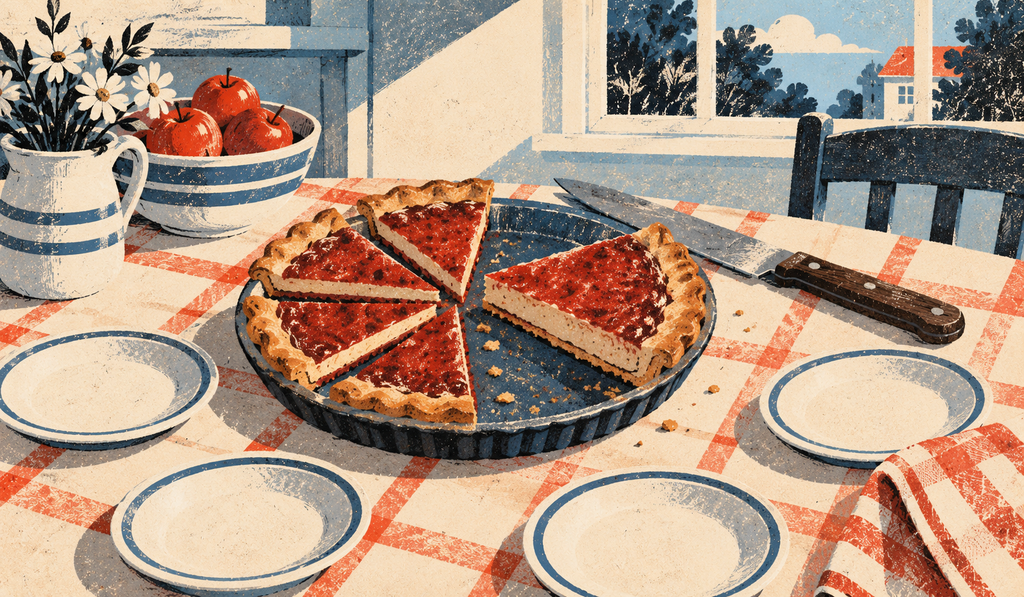
Cut the pie wrong and somebody at the table gets less. That is the difference, and it is not about the pie.
The kitchen is full of arithmetic that pays out immediately, which is why it teaches faster than any worksheet. Nobody has to be told that a quarter is smaller than a half when the quarter is the slice they have just been handed, and no diagram I have ever drawn made that point as quickly as a sibling sitting across the table holding the bigger piece.
What makes a home game work
Three things, and none of them is enthusiasm.
One is that the number has to matter to something. Weighing a bag of flour is an activity; weighing it to find out whether there is enough for pancakes is a question with a stake in it.
Another is that being wrong has to be cheap. A guess about which package is heavier costs nothing and can be settled in four seconds, and the settling is the part that teaches.
And the adult has to genuinely not know the answer sometimes, or at least be willing to be surprised, because a game where the grown-up is quietly holding the right answer the whole time is a test with better lighting.
Consequence
The number decides something
If the count is off, the table notices before the parent does.
Cheap error
Being wrong costs four seconds
A guess that can be checked immediately is a guess worth making.
Real uncertainty
The adult does not always know
Otherwise it is an exam with nicer scenery.
Three games at the kitchen table
In my experience kitchens supply two things a worksheet cannot: objects that can be divided, and an audience that cares how the division goes. Both of those are doing work that no amount of colorful printing achieves.
In the kitchen
Cut the pie
Halves, quarters, and why a quarter is the smaller one. The child cuts and hands out; the fairness argument that follows teaches more than the fractions.
Guess the weight
Cereal or salt, which is heavier. Guess first, then weigh. The surprise when the small dense thing wins is the whole lesson about volume against mass.
Set the table by rule
Fork, knife, spoon, in that order; two napkins left, one right. The child repeats a pattern, then invents one, then catches you breaking it.
That third one looks like chores and is the closest thing to early algebra on this page, because a rule that holds for every place setting is a rule with a variable in it, whatever anybody calls it. Children who invent their own version have done the harder half already.
Two games on the way somewhere
Walking produces a different kind of math, the kind where the pattern is already sitting in the world and the child’s only job is to notice it. Nothing has to be set up, which matters more than it sounds on a weekday.
A shape hunt turns a walk into a search, and in my experience children search harder than they study.
On the way somewhere
Call the next house number
Odds on one side, evens on the other. Predict before you reach it. The child who figures out why the sides differ has understood something about how systems get designed.
Hunt the shapes
Five cylinders, three boxes, and every triangular sign between here and the corner. Posts, bins, buses, bricks. Geometry stops being a chapter and becomes a property of objects.
At the store
Spend five dollars, not six
A basket, five dollars, and a job: snacks for the week without going over. Every choice removes another choice, and that is subtraction with stakes.
Beat the register
Figure out the change before the machine does. Losses are frequent, the margin is visible, and the arithmetic goes fast because somebody is waiting.
The rule that matters more than any of the games
None of this survives being graded.
My own voice does it too. Something changes in how I say the next sentence after a wrong answer. Every child I have taught caught that change; not one adult in the room ever did.Being wrong has to stay free. Charge for it, even once, and you have made homework with vegetables in it.
Check instead of correcting. Not no, think again, but let’s weigh it and find out. Four seconds either way, and the child’s standing in the room survives one of them.What I got wrong with my own kitchen counting
I taught Russian numbers to a five-year-old for months using objects on a table, which I had every reason to believe was the right approach.
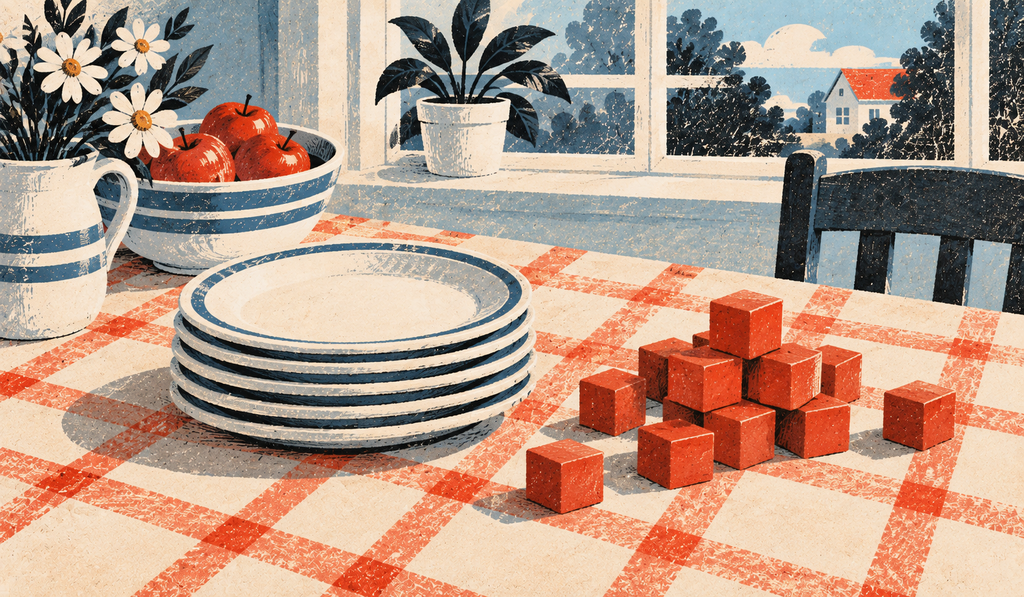
He counted beautifully. Then his mother mentioned that he refused to count anything at home, and it turned out that my objects were counting objects: little blocks that existed for the purpose and had no other job. He had figured out, correctly, that this was schoolwork wearing a costume.
My grandmother taught me fractions with a loaf of bread and four people at the table, and I was well into my twenties before it occurred to me that this had been a lesson. What changed it was counting things that were on their way somewhere. Plates for dinner, one per person, with a person visibly missing if you got it wrong. Socks out of the machine. Names and identifying details of every student and colleague here are changed, as they are everywhere on the blog.A block on a table is an exercise. A plate is a plate, and the count has to be right because somebody is about to eat off it.
Courses at Palme School
Russian for bilingual children
When the language is at home and starting to slip
Conversation school
For children who understand more than they will say
Free materials
Printable activities for families to use at home
At Palme School we teach children online, in groups of up to eight, two forty-minute classes a week, and the first two lessons are free. Both courses above take bookings the same way, and the printable material is free whether or not you ever book anything.
Frequently asked questions
Start where the answer changes something. A child who will not do a worksheet will often divide a cake correctly on the first try, because the stakes are visible and the audience is right there.
Cutting and counting work from about five, house numbers and shape hunts from six, and the money games from around seven, when mental arithmetic gets fast enough that the register does not win every time.
Check it rather than correct it. Weighing the two packages settles the question in four seconds and costs the child nothing, which is the entire difference between a game and a test.
No, and they are not meant to. They build the thing school assumes and rarely supplies, which is a reason to care whether the number is right.
Palme School: Conversation school · Russian for bilingual children · Free materials for learners
Lily Rozberg has been teaching for sixteen years, first English in Russia and now Russian to bilingual children across the US and Canada. She writes for Palme School about heritage language, reading, and the things report cards do not measure.