


Names and identifying details of every student here are changed, as they are everywhere on the blog.
The US Foreign Service Institute has been teaching diplomats languages since 1947, and that gives it the one thing nobody else has: decades of records on how long the job actually takes.The number everybody quotes
For Russian the figure is roughly eleven hundred class hours to reach what the government scale calls general professional proficiency. Full-time, that comes to about forty-four weeks. It is real, and it is a great deal more than Spanish.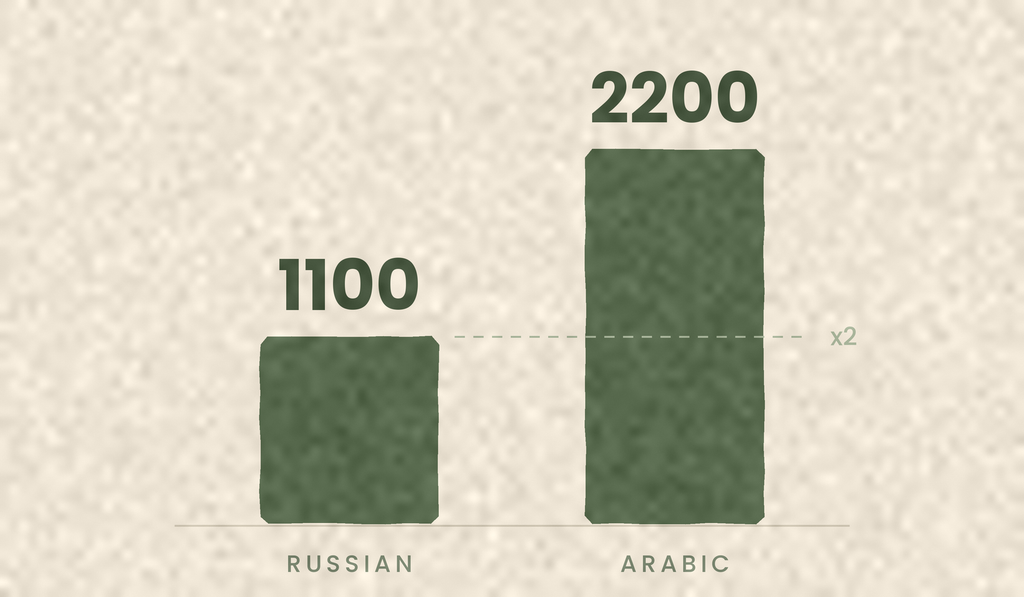
Russian is a hard language. It is not one of the hardest.
Two cautions before you quote any of this at anybody. Published versions of the table disagree about whether Russian sits in the third tier or the fourth, because some lists count the super-hard group separately and some fold it in. The hours are consistent. The label is not. And the table itself was built from institutional experience rather than from a study. A conference talk by Charlene Polio reported a small comparison of beginners in Spanish, Russian, and Chinese, in which reading scores fell in the order the table predicts and speaking scores barely differed. If that holds, the table may mislead at exactly the level most learners are actually standing on.Class hours
Full-time study to professional proficiency, by the Foreign Service figures
The hardest group
Arabic, Chinese, Japanese, Korean. Russian is half of that
The alphabet
Thirty-three letters, six of them already familiar
The part everybody fears is the part that takes a week
Cyrillic is the reason most people never start, and it’s the least of the problem. Thirty-three letters. Six of them look like English letters and behave like them. Another handful look familiar and mislead you, genuinely annoying for the first couple of weeks and then not annoying at all.The alphabet takes about two weeks.
Most adults I teach are reading street signs by then, and I have stopped being surprised by it, and reading slowly but properly inside a month, faster than anybody expects and much faster than they expected of themselves. Nobody warns you about the next part. Russian spelling runs close to phonetic, so once you have the letters you can take a run at a word you’ve never seen and be understood. Where the stress falls is the part somebody has to tell you, and it is not written down. English speakers, who spend childhood memorizing that though, through, and tough have nothing in common, tend to find this almost suspicious.Where the difficulty actually sits
| Skill | How hard, honestly | Why |
|---|---|---|
| Reading the alphabet | Weeks | Thirty-three letters, six already familiar |
| Pronunciation | Weeks, then years | Basics are mostly phonetic; stress moves, is unmarked, and catches people for years |
| Vocabulary | Months | Few cognates, but the word-building is regular |
| Grammar | Years | Six cases, verb aspect, gender on everything |
| Listening | Years | Fast speech, heavy consonant clusters |
Being understood does not wait for correctness.
Nobody masters either of these in a year. I have never met an adult who did, including the ones who read beautifully. Everybody uses them badly for a long time and is understood anyway.What Russian does without
There are no articles. Not a, not the, not the rules governing when English uses which, which nobody can list from memory. Russian simply does without, and learners of English spend years on this and never quite stop making mistakes.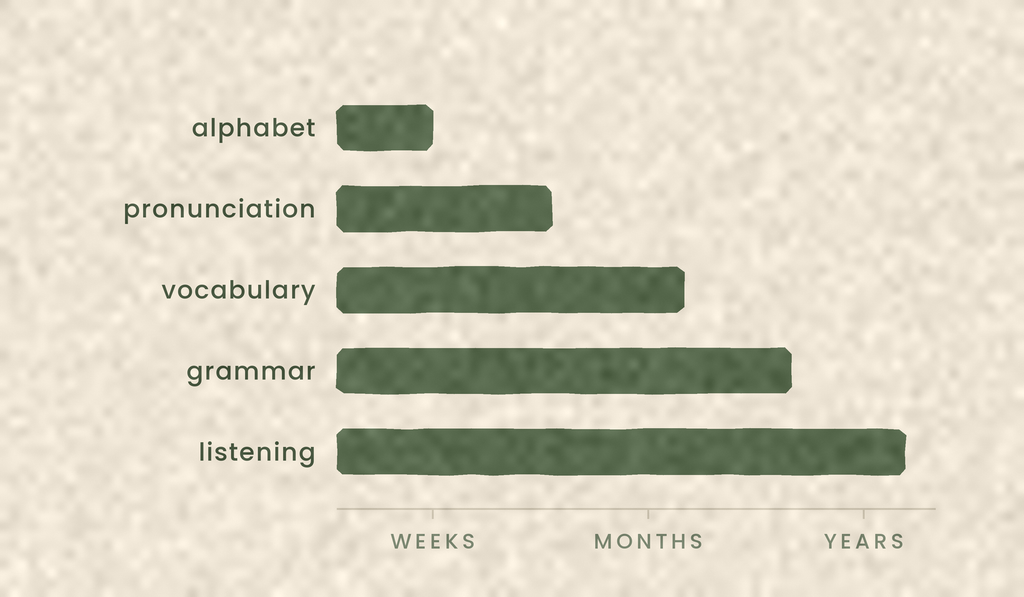
What actually predicts whether you get there
I taught English in Russia for years before I taught Russian in America, and the pattern held in both directions. The adults who got somewhere weren’t the ones with a talent for grammar.
They were the ones who kept talking while being bad at it, week after week, in front of people who could hear exactly how bad at it they were.
Anton, an engineer in his forties who came to me two years ago, has grammar I wouldn’t put in front of an examiner on any day of the week, and he has been holding forty-minute conversations in Russian since the middle of his second year. He also holds forty-minute conversations with his wife’s parents, who understand every word and correct nothing, because there’s nothing worth interrupting for. His details are changed, as they are everywhere on the blog.
Speaking badly for a year is the method, not a failure of the method.
A learner who waits until the cases are solid before speaking doesn’t speak. There’s no version of this where the grammar arrives first and the conversation follows.So how long, realistically
That Foreign Service figure assumes full-time study, five days a week, with professional instructors and nothing else in your life. Almost nobody reading this is doing that. Give an adult a job, a few hours a week, and genuine consistency, and two to three years gets you somewhere useful. A real conversation. A third of a movie understood. A menu read without help.
Faster if you speak it regularly with people who won’t switch to English. Considerably slower if you rely on an app, and nothing on the market currently runs a conversation in Russian anyway. That last part is the whole practical answer. Hours are not the constraint. Finding somebody to be bad at Russian in front of, week after week, is the constraint. At Palme School our conversation school exists for exactly that, and the first two lessons are free. If you are learning alongside a child who already hears Russian at home, our lessons for bilingual kids run on the same principle. There’s printable material in our resource library if you’d rather start alone.Frequently asked questions
Harder than Spanish, easier than Arabic or Chinese. The Foreign Service Institute puts it at roughly eleven hundred class hours to general professional proficiency, against about twenty-two hundred for the hardest group.
The alphabet, which is what most people fear, takes about two weeks.
Grammar, and specifically the case system and verb aspect. Both require decisions made mid-sentence that English makes elsewhere or not at all.
Neither prevents you from being understood while you are getting them wrong.
Full-time, about forty-four weeks by the Foreign Service figure. For an adult studying a few hours a week alongside a job, two to three years to hold a real conversation.
Consistency matters far more than hours per session.
No, and it is the single most overestimated obstacle in the language. Thirty-three letters, six of them already familiar, and spelling close to phonetic once you know them.
Sources
- Foreign Service Institute, U.S. Department of State. (n.d.). Foreign Language Training. Retrieved September 4, 2026. state.gov
- Interagency Language Roundtable. (n.d.). ILR Skill Level Descriptions for Speaking. Retrieved September 4, 2026. govtilr.org
- Polio, C. (2019, April 16). Are some languages really more «difficult» to learn? [Conference presentation]. Language Resource Center Speaker Series, Cornell University. events.cornell.edu
Palme School: Conversation school · Russian for bilingual children · Free materials for parents
Lily Rozberg has been teaching for sixteen years, first English in Russia and now Russian to bilingual children across the US and Canada. She writes for Palme School about heritage language, reading, and the things report cards do not measure.