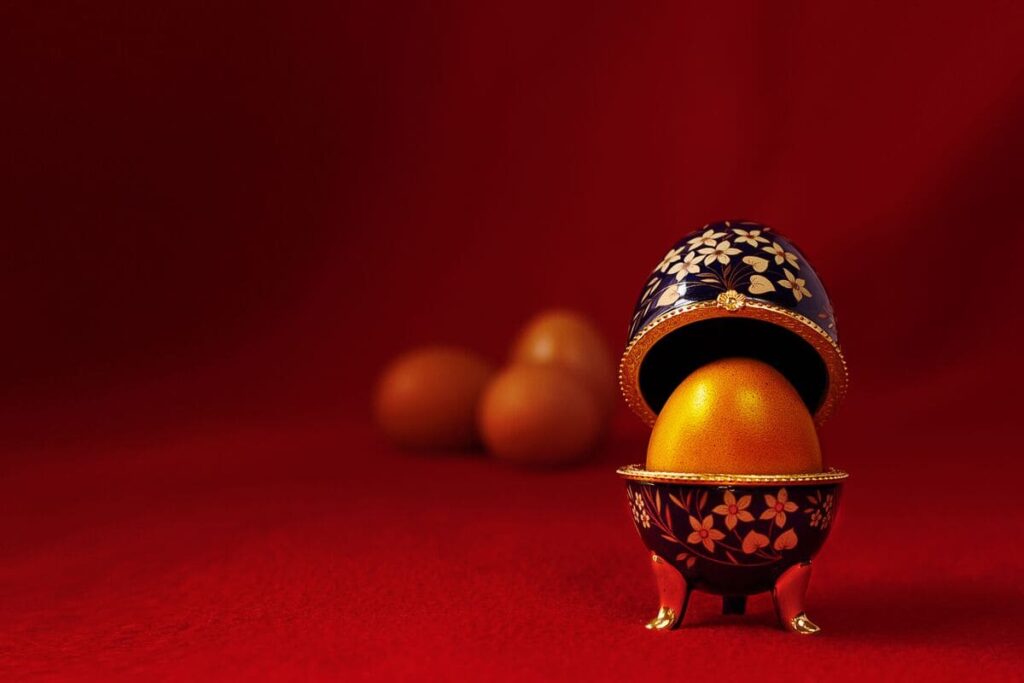
Type “faberge egg” into a search bar and you get a wall of gold, enamel and diamonds. Pretty, sure. But what are you actually looking at? Google lumps together the Easter eggs made for the Russian tsars, the eggs the Fabergé firm sold to ordinary rich customers, and a pile of modern jewelry that just borrows the name. Three different things, one search. So what is a Faberge egg? And why does anyone still stand in line for hours to see a few dozen of them?
What are Faberge eggs, in short? They are jeweled, enameled, egg-shaped objects made by the St. Petersburg firm of Peter Carl Fabergé. The famous ones are the Imperial eggs: fifty Easter presents that the last two Russian emperors gave to their wives, and in Nicholas II’s case also to his mother, between 1885 and 1916. Each one hid a surprise. Some survived wars, a revolution and decades of being lost. One was nearly melted down for scrap.
Here is the full story, with the numbers and where each number comes from, because the sources don’t always agree.
What Is a Fabergé Egg and Who Made Them
Peter Carl Fabergé owned and ran a jewelry house in St. Petersburg. According to the Fabergé company’s history page, Emperor Alexander III noticed Fabergé’s work at the Pan-Russian Exhibition in Moscow in 1882. The emperor liked it so much that he kept coming back. And in 1885 he asked the jeweler for something special. He wanted an Easter present for his wife, Empress Maria Feodorovna.
That order is where the whole story begins.
The eggs were not just common souvenirs. It took one year or more to create one. But from 1887 on, Fabergé had complete freedom over the design. There was only one rule: there should be a surprise in every egg. Workmasters and miniaturists were doing the bench work, and their names can still be checked in museum records. For example, the Fabergé Museum credits Mikhail Perkhin and the miniaturist Georg Stein with the Coronation Egg. And the Virginia Museum of Fine Arts credits Perkhin and Vasilii Zuiev with the Peter the Great Egg. Fabergé supervised the work. This is why we can see his name on all the pieces.
Before we go on, a small note for you: the Fabergé firm that made these eggs does not exist anymore. After the revolution the Bolsheviks took over its workshops (Swissinfo’s timeline puts that in 1918), and Carl Fabergé left Russia. If you see the Fabergé name on today’s jewelry, you should know that it belongs to a different company. Now, it is a luxury brand that investors relaunched in the late 2000s. Their website provides a lot of useful information, and we use it here in the article. But every time we do so, we clarify it. And when there is a museum source, we lean on the museum.
A quick note on spelling. You’ll see “Fabergé egg,” “Faberge egg” and “Faberge eggs” everywhere. The accented form, with the é, is the correct one.
Why Easter Eggs? The Russian Tradition Behind the Gift
But why an egg? Why not a brooch, a snuffbox, or something else? The reason is simple: eggs were part of Russian Easter long before any jeweler started making them. Our article on Easter in Russia: history and traditions explains those customs in detail, and they are interesting enough to read more about them.
Fabergé moved that custom up the social ladder. According to the Fabergé company, giving pricey Easter presents had already become a thing in St. Petersburg high society. And the first Imperial egg? The company says the Empress’s aunt in Denmark owned an 18th-century egg, and that one inspired it. This is what the company says, but we couldn’t find any museum confirmation. So, you can treat it as one version of the story. Either way, the present looked like an egg and was made of gold.
The Russian word for egg is яйцо (yaytso), and the holiday itself is called Пасха (Paskha).
The Imperial Fabergé Eggs: How Many Were Made and How Many Survive
Let’s get the numbers straight.
When people talk about an imperial Faberge egg, they mean one of 50. Yes, this is how many Imperial eggs Fabergé made. Both the Fabergé company and Smithsonian Magazine give this figure. The first was delivered in 1885 and the last in 1916. So, the tradition of presenting eggs lasted 32 years. The company also says that no egg was presented in 1904 or 1905, because of political unrest and the Russo-Japanese War.
How many eggs still survive? It depends on whom you ask, and when:
- The Fabergé company says that 43 eggs survived.
- Smithsonian Magazine mentions that seven eggs are believed to be lost. So, it confirms that 43 eggs survived. But if you check the sources before 2015, you will find that eight eggs were lost.
- A December 2013 report in The Jewellery Editor claims that 42 eggs survive. It matches Smithsonian’s pre-2015 count of eight lost.
- Wikipedia says that there are 44 eggs that survived and six are lost.
Surprisingly, all four entries tell the same story but at different moments. Eggs are being found (more on that below), this is why the number of lost eggs is decreasing. This is why we advise you: when you see a number, check the date next to it.
The eggs were private gifts. They weren’t sold, and most people outside the court never saw them. That changed in 1917.
| What | Number | Source |
| Imperial eggs delivered, 1885–1916 | 50 | Fabergé company, Smithsonian Magazine |
| Surviving eggs | 43 (42 in a 2013 report) | Fabergé company; The Jewellery Editor |
| Eggs were believed to be lost | 7 (8 before 2015) | Smithsonian Magazine |
| Eggs in the Kremlin Museums, Moscow | 10 | Kremlin Museums |
| Eggs at the Fabergé Museum, St. Petersburg | 9 | Fabergé Museum |
| Eggs at the Virginia Museum of Fine Arts | 5 | VMFA |
| Eggs at Hillwood, Washington, D.C. | 2 | Hillwood |
| Eggs at the Walters Art Museum, Baltimore | 2 | Walters |
A word of caution about the museum rows. Museums lend, borrow and reinstall their collections all the time, so a count that is right today may change. We checked the sources named above in October 2026, but we recommend looking at the museum’s own page before you plan a trip.
A word on prices, since people always ask. Imperial eggs are almost never sold. This is why it is difficult to tell the numbers. The best-documented one is the Winter Egg. Nicholas II gave this rock crystal egg to his mother in 1913. According to an Associated Press report, it was sold at Christie’s in 1994 for $5.6 million. Then, this egg was sold again in 2002 for $9.6 million. Finally, on December 2, 2025, this egg was sold again in London for £22.9 million, about $30.2 million with the buyer’s premium. That last price grew above the $18.5 million paid in 2007 for a Fabergé egg made for the Rothschild family. However, that egg, per PBS NewsHour, was not an Imperial egg. So Fabergé made eggs for private clients too, but the fifty Imperial ones are the famous set.
The Most Famous Eggs, from the First Hen Egg to the Imperial Coronation Egg
Fifty eggs won’t fit in one article, so here are the ones that come up most often.
The Hen Egg, 1885. The very first. Its plain-looking white enamel shell opens to reveal a gold “yolk,” which in turn opens to reveal a gold hen with ruby eyes. The hen originally held a miniature diamond replica of the Imperial crown, with a small ruby pendant; according to Wikipedia’s entry on the egg, both are now lost. The egg itself is in the Vekselberg collection at the Fabergé Museum in St. Petersburg.
It looks modest next to what came later, and that’s part of the point. Nobody knew yet that this was the beginning of a series.
The Third Imperial Egg, 1887. This is the one with the flea-market story, which we come back to in the next section.
The Imperial Coronation Egg, 1897. If you want one egg that explains the whole idea, this is probably it. The Fabergé Museum describes it as the first Imperial egg dedicated to a major political event: the coronation of Nicholas II. The shell is translucent yellow guilloché enamel, a pattern that echoes the gold brocade mantles worn at the ceremony, and black enamel double-headed eagles sit where the lines of a gold laurel trellis cross. The Empress’s initials, in diamonds and rubies, appear on the shell.
Then comes the surprise. Inside is a tiny gold carriage, a copy of the coach that carried Alexandra into Moscow on May 9, 1896 (Old Style, which is May 21 in the Gregorian calendar we use today). The original coach was built in 1793 for Catherine the Great. The model rolls on spring suspension, its doors open with little gold handles, and folding steps swing out from inside. Georg Stein, the miniaturist, studied the coach in the court stables to get every detail right.
How long did it take? Fifteen months, says the Fabergé company, with craftsmen putting in 16-hour days on the carriage. The museum’s own page for the egg gives no time at all, so take that number with a grain of salt. And where is it now? With Viktor Vekselberg, on display at the Fabergé Museum in St. Petersburg.
Lost Fabergé Eggs and How One Was Found at a Flea Market
After 1917 the Bolsheviks confiscated many of the eggs. By the Kremlin Museums’ account, crates of the imperial family’s valuables reached Moscow that September and went into the Armoury Chamber. By 1927 it held 24 eggs. Then came the sales: eleven went abroad in 1930, three more in 1933, and ten stayed. Other eggs ended up with private buyers, and one of them is the Third Imperial Egg, made in 1887 for Alexander III’s wife. Time Out says it was sold in Moscow in 1922, under a Soviet policy grimly nicknamed “Treasures into Tractors.” After that, it vanished from the public record for decades.
Now for the part everyone loves.
Here is the story as PBS NewsHour told it in March 2014. A scrap metal dealer, who wanted to stay anonymous, paid about $14,000 for an egg at a flea market somewhere in the Midwest. His plan was simple: sell it for the gold. Then he read about Imperial Fabergé eggs and started to wonder. He got in touch with Kieran McCarthy of Wartski, the London firm that specializes in Russian works, and McCarthy knew it was the real thing. Other tellings, Wikipedia’s among them, say he bought it for the weight of its gold and gems, and that he worked out what he had by typing “egg” and “Vacheron Constantin” into a search engine, since there is a watch hidden inside. The details wobble from one version to the next. That happens with a story this good.
Time Out adds that two researchers, Vincent and Anna Palmade, had earlier traced the egg to a 1964 New York auction catalog. Wartski bought it for a private collector, and it went on public view in London in April 2014, as The Moscow Times reported. The sale price was never disclosed. Headlines mention about $33 million, but that’s an estimated value, not a sale price. The egg is in a private collection, so you can’t go see it. That’s a shame, but at least it isn’t a lump of melted gold.
It’s also why the count of lost eggs keeps falling. Somebody, somewhere, may still have another one sitting on a shelf.
Where to See Fabergé Eggs in the US and Russia
Most of the surviving Imperial eggs are in museums. Here is where to find them, as of our October 2026 check. Opening hours change, so check each museum’s website before you go.
In the US
- Virginia Museum of Fine Arts, Richmond, Virginia. There, you can see five Imperial eggs, according to the museum. Among them, there are the 1903 Peter the Great Egg and the Imperial Red Cross Egg with Portraits. Smithsonian Magazine also names the 1912 Imperial Tsesarevich Egg. The collection came from Lillian Thomas Pratt, who assembled it between 1933 and 1946 and left it to the museum in 1947. The VMFA says that it consists of 190 objects that were made by or attributed to the Fabergé firm. Address: 200 N. Boulevard, Richmond, VA 23220.
- Hillwood Estate, Museum & Gardens, Washington, D.C. Marjorie Merriweather Post bought her first Fabergé piece in 1927. Then, she left her collection to Hillwood. The museum’s own page names two eggs. The first one is the Twelve Monograms Egg which, as the page says, is known as one of the two Imperial eggs made in 1896. The other is the Catherine the Great Egg, it was acquired in 1931. Smithsonian Magazine dates the Catherine the Great Egg to 1914. The page we checked listed hours of 10 a.m. to 5 p.m., Tuesday through Sunday, closed Mondays.
- Walters Art Museum, Baltimore. The museum’s collection lists two Imperial eggs, both shown as on view when we checked: the 1901 Gatchina Palace Egg and the 1907 Rose Trellis Egg.
- Cleveland Museum of Art. The 1915 Red Cross Egg with Resurrection Triptych. Be careful with names here: Fabergé made two Red Cross eggs in 1915, and the one with portraits of the imperial family is at the VMFA. Smithsonian Magazine says the Cleveland egg wasn’t on view at the time of its writing, so check first.
- Metropolitan Museum of Art, New York. The Met’s press page describes three Imperial eggs from the Matilda Geddings Gray Foundation on long-term loan: the Danish Palaces Egg (1890), the Caucasus Egg and the Napoleonic Egg (1912). The page doesn’t confirm what is on view today, so ask the museum before you go.
In Russia
- Fabergé Museum, St. Petersburg. The museum is located in the Shuvalov Palace at 21 Fontanka River Embankment. According to The Jewellery Editor, it was opened in 2013. The museum says it holds more than 4,000 objects, including nine Easter eggs made for the last two Russian emperors, among them the Hen Egg and the Imperial Coronation Egg. Its website lists hours of 10 a.m. to 8 p.m., seven days a week, and offers a virtual tour.
- Kremlin Museums, Moscow. Ten Imperial eggs, shown in the Armoury Chamber for more than 70 years, according to the Kremlin Museums.
Whether and how Americans can travel to Russia right now is a separate question, and the answer changes. Check current government travel advisories before you book anything.
Fabergé Eggs and Russian Decorative Art
The eggs belong to a long line of Russian decorative objects. If you enjoyed the craftsmanship, our pieces on Russian folk crafts and the Russian matryoshka doll show the other end of the same tradition: wood, paint and village workshops instead of gold and diamonds. A nesting doll and an Imperial egg are both containers with something hidden inside. Funny, isn’t it?
The end of the egg story is also the end of the Romanov era. We cover that history in two separate articles, the death of the Romanov family and Nicholas II and the death of the Romanov family, so here we’ll only note that the last eggs were delivered in 1916, a year before the revolution.
Words to Know: Russian Vocabulary for the Eggs
If you visit a museum with Russian labels, these are good words to recognize.
| Russian | Transliteration | English |
| яйцо | yaytso | egg |
| Пасха | Paskha | Easter |
| царь | tsar’ | emperor, tsar |
| императрица | imperatritsa | empress |
| сюрприз | syurpriz | surprise |
| карета | kareta | carriage |
| эмаль | emal’ | enamel |
| ювелир | yuvelir | jeweler |
Frequently Asked Questions About Fabergé Eggs
How many Fabergé eggs are there?
Fabergé delivered 50 Imperial Easter eggs between 1885 and 1916. About 43 survive, according to the Fabergé company and Smithsonian Magazine, though older reports say 42 and Wikipedia lists 44. The firm also made eggs for private clients, so the full count of Fabergé eggs is higher.
What is the most expensive Fabergé egg ever sold?
The Winter Egg of 1913, which sold at Christie’s London on December 2, 2025, for £22.9 million, about $30.2 million with fees. The Third Imperial Egg is often quoted at around $33 million, but that is an estimate, and its sale price was never made public.
Where can you see Fabergé eggs in the US?
The Virginia Museum of Fine Arts in Richmond, Hillwood in Washington, D.C., the Walters Art Museum in Baltimore and the Cleveland Museum of Art all hold Imperial eggs, and the Met in New York has a loan from the Matilda Geddings Gray Foundation. Check each museum’s site for what is on view before you go.
What is the Imperial Coronation Egg?
It is the 1897 egg that celebrates the coronation of Nicholas II, made for Empress Alexandra. Its surprise is a tiny gold carriage modeled on the coach she rode into Moscow in 1896. It belongs to Viktor Vekselberg and is displayed at the Fabergé Museum in St. Petersburg.
Where to Go From Here
At Palme School we teach Russian online, and history comes up a lot, because it’s hard to separate a language from the story behind it. Our history lessons are one example, and the Russian as a foreign language course is for students who are learning Russian as a new language.
Here’s how a trial works. Palme School offers two free lessons: an intro session with a curriculum specialist and a trial lesson in a group. Everything is online. Lessons run 40 minutes, groups stay small, and the ages go from 4 to 17. Looking for classes for yourself? There’s a separate page for Russian for adults.
If a gold egg with a tiny carriage inside is what made you curious about Russia, that’s a good enough reason to start learning the language. People have started for worse ones.