

The search query «online Russian classes» yields millions of results on Google: app ads, tutor listings, platform reviews, "top 10" ratings, and university courses. For someone without pedagogical experience, it's almost impossible to figure out what actually works and for what purpose.
At the same time, Russian remains one of the most difficult languages for English-speaking students to learn. In the U.S. Foreign Service Institute’s proficiency ratings, Russian is classified as Category IV. It takes approximately 1,100 hours of classroom instruction to master the language. This means that choosing the right platform for regular study is critical. An ill-chosen format could add another year or two of wasted time to the learning process.
This review examines the main platforms where you can study Russian online today. Coursera, italki, Preply, and Palme School. We compare formats, prices, target audiences, and suitable scenarios. We advise on how to choose a course for a specific student. And we answer the eight most frequently asked questions about Russian courses online, which are posed by both adult foreigners and parents of bilingual children in the USA and Canada.
How to choose an online Russian course

Before comparing platforms, it's important to define your own parameters. Without them, any comparison becomes guesswork.
The main question is the student's age. Courses for adults and courses for children are two very different products. Adults are suited to intensive programs with a focus on grammar and speaking practice. A seven-year-old child needs a game-based format, an engaging teacher, and a small group of peers. A one-on-one tutor platform is practically useless for a three-year-old, while an intensive grammar course for a working foreigner preparing for TORFL will work as intended.
The second question is about level. Some students start from scratch, others maintain their native Russian as bilinguals, and those who studied Russian in school or university speak almost fluently. A good platform will offer entry at any level. A bad one will impose a single starter program on everyone.
The third criterion is the goal. Talking with grandma, going to Russia to visit literary sites, reading Chekhov in the original, passing TORFL for university or obtaining citizenship, helping a child maintain a second language. Each of these goals requires its own format. A grammar course will not teach you to speak. A conversation club will not prepare you for a certification exam. You can read more about the exam in our article about TORFL.
The fourth criterion is the format of the lessons. Recorded video lectures, individual tutoring sessions, group classes, mobile apps. Each format addresses a specific set of tasks, and usually the best results are achieved by combining two or three. For example, group classes plus independent practice in an app.
The fifth criterion is budget. The hourly rate for online learning platforms today ranges from three dollars (Preply on the lower tier) to a hundred dollars and more (Professional Teachers on italki, individual lessons at premium schools). When planning, it's important to consider not the price of one lesson, but the cost of a month of regular study.
And the final criterion is the qualification of the teachers. This is especially important when studying Russian as a foreign language. A native speaker without methodological training often doesn't understand how to explain the difference between «делал» (delal) and «сделал» (sdelal) to a foreigner. A certified RKI methodologist will explain this in ten minutes with examples.
Top Platforms for Learning Russian Online in 2026
Below we will analyze the main platforms that cover almost the entire spectrum of Russian learning requests today.
Coursera
Coursera is the world's largest platform for massive open online courses, or MOOCs, taught by universities and educational organizations. Russian language courses were previously offered here seriously. Before 2022, nearly two hundred courses from Saint Petersburg State University and a number of other Russian universities were available on the platform, with a total audience for these programs approaching one million people.
Everything changed in the spring of 2022. Coursera suspended its partnerships with Russian universities, after which Russian language courses either disappeared from the catalog or became available only from specific regions. By 2026, there were virtually no systematic academic programs in Russian left on the platform. A search for "Russian language" now yields only fragmented materials and rare courses from foreign providers, and the former full MOOC format is gone. A Coursera Plus subscription costs around $39 per month and unlocks the entire platform catalog, but there is no point in paying for it now for the Russian language.
For those who specifically need a self-paced format with video lessons and exercises, it's worth looking into specialized services. Pimsleur builds its learning around audio courses for adults, with subscriptions costing $20-30 monthly. Rocket Russian offers a structured program with a one-time purchase of a level for $100 to $260. RussianPod101 teaches through podcasts with an analysis of words and grammatical structures, with rates here from $4 to $23 per month. None of these services provide a live instructor on screen, but each has a well-developed program and constant practice.
Neither of the self-instructional formats will be suitable for children and adolescents. An audio course or video lecture won't hold an eight-year-old's attention for three minutes.
italki
italki is an international marketplace that connects students with language teachers. By 2026, over 30,000 teachers for 150 languages are registered on the platform, and several thousand of them teach Russian. They are all divided into two categories. Community Tutors are native speakers without formal teaching diplomas, with lessons costing from $4 to $25 per hour. Professional Teachers are certified methodologists, whose lessons will cost from $10 to $40 or more per hour.
The main feature of italki is its pay-per-lesson model. There are no subscriptions. Students buy credits and spend them on specific lessons when it's convenient for them. This is a strong advantage for people with unpredictable schedules. If you go on a business trip, you don't lose money. If you have free time, you study more. Trial lessons usually come with a 30-50 percent discount from the regular price.
A weakness of italki in terms of quality. Among thousands of Russian-speaking teachers, you can find both very experienced ones and complete beginners. The platform provides ratings, video introductions, and reviews, but ultimately, you have to filter yourself. Finding one's ideal tutor usually takes a new student three to four trial lessons.
italki is suitable for adult learners who know what they want and are willing to spend time searching for a teacher. The platform works particularly well for conversational practice with a native speaker. It is possible to build a structured program from scratch on italki, but you will have to select materials yourself and track your progress.
Preply
Preply is structured similarly to italki, but it operates on a different earning model. By 2026, over a thousand people will be teaching Russian here, with their average rating holding steady at 4.97 out of five. The hourly rate varies significantly, from $3 to $100, although the typical price point hovers around $21-$22.
The main difference from italki is the payment format. Preply uses a subscription model. Students choose the number of hours per week and pay monthly. This is a plus for discipline. If a package is paid for, the student is more likely to study regularly. The downside is that if there's less time in a given month, the hours are still deducted.
Lessons are 25 or 50 minutes long, your choice. A trial lesson is usually free or discounted. If a tutor isn't a good fit, Preply offers two more free trials with other tutors until the student finds their perfect match.
Preply's quality control is softer than italki's for Professional Teachers. There are no formal diploma requirements, but ratings and reviews quickly weed out weak tutors. A particular strength of Preply is its specialization for children. Around 250 Russian tutors specifically focused on children and teenagers work on the platform.
Preply is suitable for students who value regularity and are willing to study several times a week on a schedule. For an unpredictable schedule, italki is better.
Palme School
Palme School is an online Russian language school for children in the USA and Canada. The fundamental difference from the three platforms above is that Palme is a full-fledged school with its own methodology, curriculum, and teaching staff, rather than a tutor platform.
Palme's target audience is children aged 4-18 from two categories. Bilinguals where at least one parent speaks Russian, and foreign children learning Russian as a foreign language from scratch. There are separate programs for both groups. Palme does not accept adults; all of the school's work is focused on children from Russian-speaking and mixed families abroad.
The children study in small groups of up to eight people, twice a week for forty minutes per lesson. When forming a group, not only the child's age and level are considered, but also their personality. The program itself is structured cyclically, so you can start classes any week of the academic year without missing anything.
Monthly training costs $149, and paying for the whole year upfront costs $1,229, saving you $559 compared to monthly payments. Palme offers beginners two free lessons. The first is an introductory lesson with a methodologist, where your level is assessed and a suitable group is chosen. The second is a trial lesson in a group with a teacher.
Palme's strength lies in the group format. The child learns the language not one-on-one with a teacher, but together with other children who are also bilingual or foreign. Studying also becomes a social interaction. The downside is that the group cannot help a child who truly needs a personalized approach, for example, with developmental differences.
For beginners
A separate question is where a beginner, especially an adult, should start. Before enrolling in a serious course, it is useful to take two steps.
The first is a basic introduction to the Cyrillic alphabet and phonetics through mobile applications. With their help, it's convenient to learn the letters, build a starter vocabulary, and get used to the pronunciation. We've put together a detailed review of such applications at best mobile app roundup.
The second step is a trial lesson with a teacher on any of the platforms listed above. A real conversation with a native speaker for twenty to forty minutes will give you a better understanding of your own level than a self-assessment test. And you’ll immediately see which format works best for you. Some people thrive in group settings, others in one-on-one sessions, and still others feel more comfortable with video lectures without a live person on the screen.
Comparison of Russian Language Learning Platforms Online
Four main types of platforms by key parameters. Data is current as of 2026. Specific prices and the number of instructors may change; focus on the order of magnitude.
| Criterion | Self-study (Pimsleur, Rocket Russian) | italki | Preply | Palme School |
|---|---|---|---|---|
| Format | Video and audio courses, exercises, without a live instructor | One-on-one private lessons with a tutor | One-on-one subscription lessons | Group classes up to eight people |
| Audience | Self-taught adults | Adults, teenagers | Adults, teenagers, children (individual tutors) | Children and adolescents aged 4-18 in the US and Canada |
| Instructor | No, just the program | Community Tutors or Professional Teachers | Tutors with ratings and reviews | Full-time teachers and school methodologists |
| Payment | Subscription or one-time course purchase | Pay-per-lesson, no subscription | Weekly watch subscription | Monthly or yearly |
| Price | $20-30 per month or $100-260 one-time | 4-40 dollars per hour | $3-100 dollars per hour, averaging $21-22 | $149 per month, $1,229 per year |
| Strength | Flexibility, low price, self-paced classes | Huge selection of tutors, flexible schedule | Regularity, free trials with different tutors | Peer group, school curriculum, methodology for bilinguals |
| Weakness | No speaking practice and feedback | The quality of tutors varies, so you have to filter yourself. | Writing off hours, even during busy months. | Not suitable for highly customized programs. |
| Trial lesson | Often a subscription trial period | Trial with a 30-50 percent discount | Free trial plus two spares | Two free lessons (introductory and trial group lesson) |
Group vs. Individual Lessons
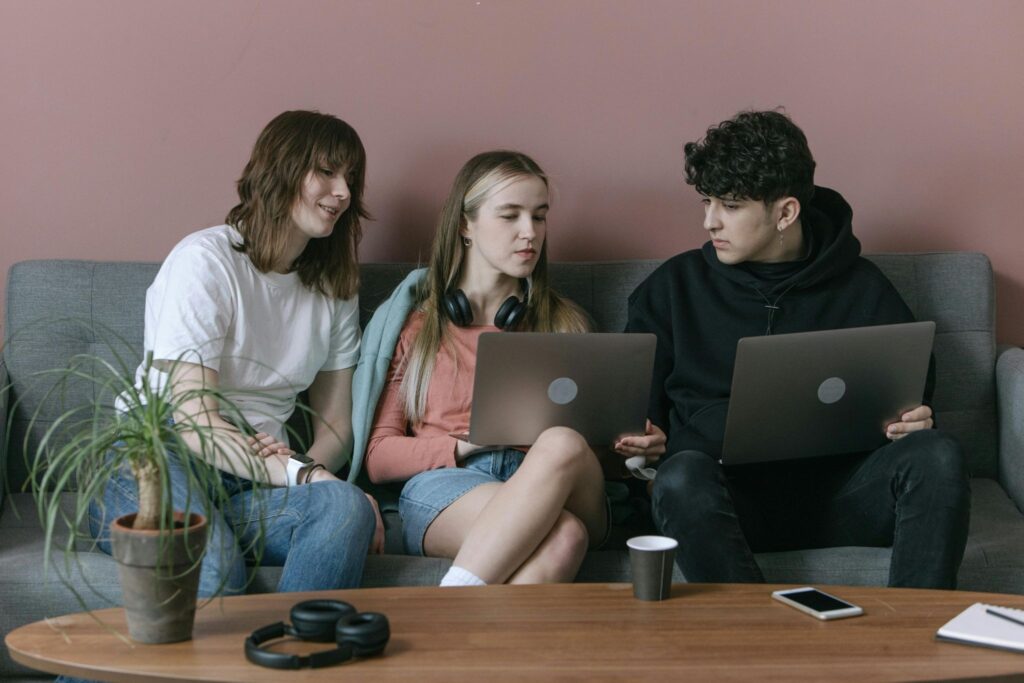
This is the second main choice after selecting a platform. Both formats work, but they address different needs.
One-on-one lessons offer maximum intensity. All forty minutes or hour of time is dedicated to a single student. Not a single mistake escapes the teacher, any rule is explained personally, and the pace is adjusted to the individual. This format is indispensable for adults with a clear objective, whether it's exam preparation, a quick trip to Russia, or the desire to converse fluently with their mother-in-law. The price for this is double: a high cost and the absence of live interaction with other students.
Small group classes, with four to eight students, have a different effect. The pace of the program is slightly slower because the instructor has to divide their attention. But social dynamics come into play. Children motivate each other. Adults in the group engage in lively conversations. Mistakes don’t seem like a disaster but rather a normal part of the process, because classmates also face their own challenges. The price per hour is usually lower because costs are shared.
The rule of thumb is this. If the goal is a certification exam or tight deadlines, choose individual lessons. If a child is learning a second language while emigrating or an adult wants to «immerse» themselves without a specific goal, group format works better.
There are also combined formats. For example, at Palme School, it's possible to combine group lessons with additional individual sessions if needed.
Pricing and Payment Options

The pricing on different platforms is structured differently, so comparing «hour for hour» isn't entirely accurate. italki sells credits, which students use to purchase lessons from their chosen tutor. Preply sells hours per week through a subscription. Palme School sells monthly or yearly subscriptions to the school. Standalone platforms Pimsleur and Rocket Russian sell the entire course or a subscription to the platform.
Italki has the lowest entry barrier. You can buy a trial lesson from Community Tutors for five dollars. The average price per hour for Professional Teachers is $15-25. On Preply, the average price is around $21-22 per hour. At Palme School, a monthly price of $149 covers eight group lessons per month, which is about $18-19 per group lesson. Self-study platforms like Pimsleur or Rocket Russian cost $20 to $30 per month with a subscription or from $100 one-time for a complete course.
A detailed price table broken down by format is available as a separate reference material. Refer to it when you need to compare specific rates.
Platform prices per hour and per month
2026 rates. Prices are approximate and depend on the chosen tutor, rate, and exchange rate. It is worth comparing platforms not by the price of a single lesson, but by the cost of a year of regular work.
| Platform | Payment method | Price | What's included |
|---|---|---|---|
| iTalki Community Tutors | Pay-per-lesson | $4.25/hr | Conversational practice with a native speaker without a diploma |
| iTalki Professional Teachers | Pay-per-lesson | $10-40/hour | Structured learning with a methodologist |
| Preply | Weekly watch subscription | $3-100/hr (average $21-22) | Regular tutoring sessions on a schedule |
| Palme School | Monthly or yearly | $149/month ($18-19 per lesson) | 8 group sessions per month, school program |
| Pimsleur | Subscription | $20-30/month | Audio courses for self-study |
| Rocket Russian | One-time purchase | $100-260/level | Lifetime access level program |
| RussianPod101 | Subscription | $4-23/month | Podcasts with vocabulary and grammar analysis |
How much does a year of regular classes cost?
Calculation for two lessons per week (about 100 lessons per year). Numbers are rounded.
| Platform | Calculation | In a year |
|---|---|---|
| italki Professional | $20 x 2 lessons x 50 weeks | around $2,000. |
| Preply | $22 x 2 lessons x 50 weeks | around $2,200. |
| Palme School | Annual subscription | $1,229. |
| Pimsleur (self-study) | $25 × 12 months | around $300. |
Self-study through apps and audio courses is the cheapest, but it doesn't provide conversation practice or feedback from a teacher. For systematic results, a live teacher is needed, either individually or in a group.
The main budgeting tip is this: don't count the price of one lesson. Count how much a year of regular work will cost. On iTalki, with two lessons a week at $20 per hour, it comes out to about $2,000 a year. On Preply, with the same schedule, it's approximately $2,200. At Palme School, it's $1,229 a year with annual payment. The figures are approximate; the exact amounts depend on the chosen plan and currency exchange rates.
How to choose a course for yourself

There is no universal answer, but there is an algorithm. First, answer five questions about yourself, then see which platform is a better fit.
First question: who are we teaching for? If it's for a child aged 4-12, consider Palme School and specialized children's sections on Preply. If it's for a bilingual teenager aged 13-18, add italki Professional Teachers. If it's for an adult beginner, consider italki, Preply, and self-study platforms like Pimsleur. If it's for an adult with experience who wants to maintain or improve their Russian, italki works best.
Second question: what's the goal? Talking with relatives means speaking practice, italki Community Tutors are the cheapest. Passing TORFL means a structured program with a teacher, italki Professional Teachers or a specialized tutor on Preply. To maintain a second language for a child means regular classes in a peer group, Palme School. Preparing a child for Avant STAMP or AP Russian means a specialized school with experience in such exams.
Third question: What’s your monthly budget? Up to $50 a month covers mostly self-study through apps and platforms like Pimsleur or Rocket Russian, plus occasional lessons on italki. From $50 to $200, you can take regular one-on-one lessons on italki and Preply or group classes at Palme. $200 and up gives you the flexibility to combine formats and study more frequently.
Fourth question: which format is convenient? For a regular schedule, subscriptions work well, such as Preply or Palme School. For an unpredictable schedule, the pay-per-lesson format is needed, like italki. For a completely self-study format, asynchronous platforms like Pimsleur or Rocket Russian are suitable.
Fifth question: which format is more comfortable? If peer interaction or study partners are important to the student, then a group. If maximum progress speed is important, then individual. If complete flexibility and working at one's own pace are important, then self-study through video or audio courses.
After answering these five questions, the platform is usually chosen almost automatically.
Common Mistakes When Choosing a Course

Mistakes in choosing a platform are the reason why many adult learners and parents of children give up on learning Russian within the first three months. Let’s take a look at the most common ones.
Most often, people are misled by choosing based on price without considering the format. The cheapest tutor at four dollars an hour is usually a native speaker student with no teaching experience. They are suitable for twenty minutes of conversation practice. For systematic learning from scratch, they are not. After two months of such work, progress is usually not visible.
A major mistake is transferring expectations from one format to another. The parent of a bilingual child signs their eight-year-old daughter up for one-on-one lessons with a tutor, believing this to be more effective. A month later, the girl refuses to continue because she finds it boring to be alone with an adult on the screen. The same child enjoys attending classes in a group of six peers.
A separate trap is trying to learn Russian only through apps. Duolingo, Mondly, and similar services work as an additional trainer. They do not replace a live teacher and do not provide conversational practice. Without a person on the other end of a video call, learning Russian is impossible.
Another common misconception is searching for the perfect teacher before you start lessons. Especially on italki, where there are thousands of tutors and each one looks appealing in their profile. The best strategy is to book a trial lesson with the first suitable one and start studying. After three or four lessons, it becomes clear if they are a good fit or not. If not, move on to the next one. It's impossible to figure out the ideal teacher through their profile.
And the last of the big mistakes is irregularity. Any course only works with consistency. One lesson every two weeks or once a month is a waste of money. The minimum effective frequency for children is two lessons a week, for adults one and a half to two. Less often yields no results, and after six months the student usually quits with the feeling that «Russian is too difficult.».
Conclusion

Choosing an online Russian language course in 2026 is no longer a question of «is there anything decent online,» but rather «what suits me best.» Independent platforms like Pimsleur and Rocket Russian work for disciplined adult self-learners who know how to study without a live instructor. italki offers maximum flexibility and a wide selection of tutors. Preply meets the demand for regular classes via subscription. Palme School specializes in bilingual children and foreigners in the US and Canada, with a group format and a program specifically tailored to this audience.
The main advice for parents and adult students is the same. Don't choose based on others' rankings and don't stay on free trial lessons for longer than two weeks. Sign up for a trial lesson on a platform that suits your learning style and start studying. Regularity and a live instructor are more important than the perfect platform choice.
If you are interested in Palme School for a bilingual child or for a foreign child learning Russian from scratch, we offer two free lessons for new students. The first is an introductory lesson with a methodologist, where their level is assessed and a group is selected. The second is a trial lesson in a group with a teacher. You can sign up on the page bilingual schools or Russian as a Foreign Language.
What platform is best for a bilingual child in the US or Canada
For bilingual students, a specialized school with a group format and a curriculum designed specifically for this type of student works best. Palme School works with bilingual children aged four to eighteen, and its curriculum takes into account the unique circumstances of bilingual families living abroad. On italki and Preply, there are individual tutors for bilingual students, but without a school structure and without interaction with other bilingual peers.
Is it possible to learn Russian only through free resources?
Theoretically, yes, for the basic A1 level. There are free video lessons on YouTube, mobile apps with basic plans, and audio materials from RussianPod101. However, without a live teacher, most students take three to four times longer on this path. And most importantly, without speaking practice with a native speaker, the language doesn't go beyond «I understand, but I can't speak.».
How long does it take to learn Russian from scratch
According to the U.S. Foreign Service Institute, it takes an English-speaking learner approximately 1,100 classroom hours to reach a level of confident proficiency. At two 40-minute lessons per week, this is about 8-10 years. With an intensive schedule (five lessons per week plus homework), it's about two years. Bilinguals who speak Russian at home progress faster because there is constant auditory context.
Russian for bilinguals is different from Russian as a foreign language.
These are two different methodologies. A bilingual child from infancy is surrounded by spoken Russian, so they already have an auditory intuition, an initial vocabulary, and a feel for how the language sounds. For such children, the program focuses on grammar, vocabulary building, and written language. A Russian as a Foreign Language course, on the other hand, starts from the very basics, with letters and sounds. Therefore, placing a bilingual child in a Russian as a Foreign Language course is a methodological error; they will be bored there.
What is better for an adult beginner, group or individual lessons
It is reasonable for an adult beginner to start with three to five individual lessons to get acquainted with the language. After that, you can switch to a group format if one is available. Individual lessons provide speed in the first few months. Group lessons provide conversational practice and reduce the price in the long run. Many platforms allow for combinations.
Do I need to prepare for the TORFL separately?
Yes, absolutely. TORFL is a certification exam with its own structure, question types, and grading criteria. A general Russian course won't automatically prepare you for it. If your goal is to pass TORFL, you need to work specifically with practice tests and question formats for the last three to four months before the exam.
Yes, you can learn Russian without phone apps.
Technically yes, especially if there's a teacher and regular classes. But apps are a convenient way to review vocabulary in your free moments (on the subway, in line, while waiting). With systematic classes with a teacher, an app increases the speed of progress by about 20-30 percent due to regular repetition.
What works best for bilingual teenagers aged 13-18
Teenagers are the most difficult segment. They get bored in younger age groups, and they often perceive individual lessons as coercion. Thematic clubs (literature, cinema, history, preparation for Avant STAMP) and individual lessons with a teacher who knows how to work with teenage motivation work best. Palme School and italki Professional Teachers best meet this need among other platforms.