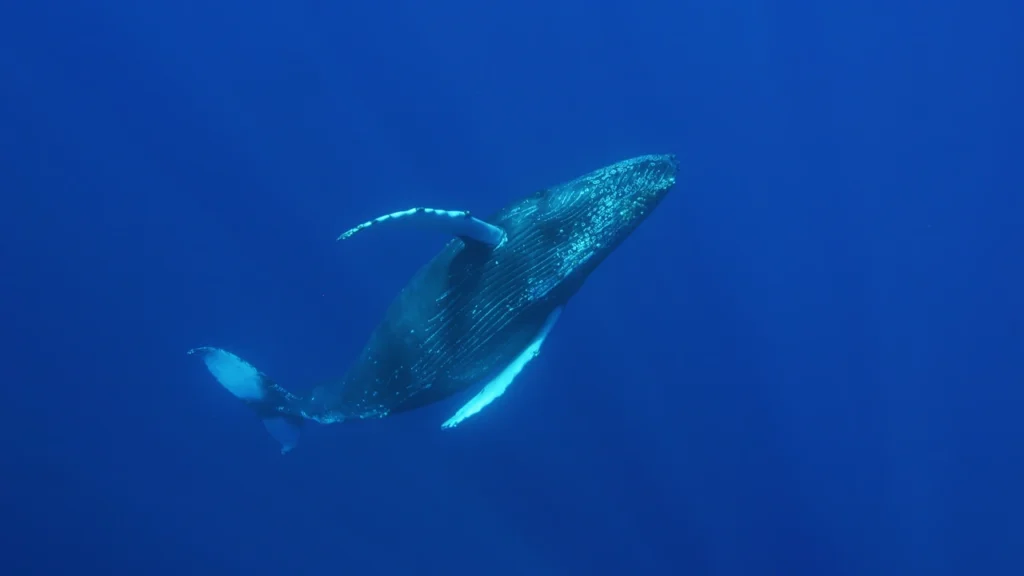
«All whales live in water. So, let’s say that’s the answer to the logic problem on the worksheet, written with a confident hand. Mom asks, »And the fish?« The child replies, »The fish aren’t whales; that’s different,« and looks puzzled, wondering what the fish have to do with it. Cards with animals from an old game are lying on the table nearby; a fish with its head up is among them. No one is in a hurry to turn them over.
Children learn about grouping and checking conclusions in class as well; that’s our approach. The course of logic.
The question that needs to be asked here is not about whales. A child knows who lives in the water just as well as an adult. He has reversed the conclusion, and it is worth checking how he understood the connection between the two sentences.
He himself will understand that fish are not whales.
The fish are not whales, the child said himself. The objection «he will grow up and figure it out for himself» is exactly half true, because the fact and the conclusion are different things here. He has known about fish for a long time. But the phrase «all whales live in water» sounds the same in both directions, and it doesn’t matter to change it; the word «all» in both sentences is the same. Just because all whales live in water, it doesn’t mean that all aquatic animals are whales. The adult hears that the second sentence is false because he already has fish and frogs in his head. To have them appear in the child’s mind, a card is needed.
Letter to the Princess
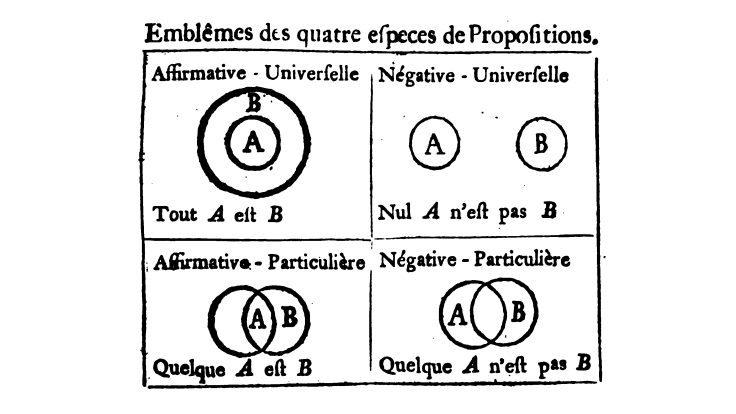
By 1760, Leonard Euler had served fourteen years at the St. Petersburg Academy, moved to Berlin and took on an unusual student: the young Princess Frederica Charlotte of Brandenburg-Schwedt. She lived far from Berlin, and the lessons turned into correspondence. For two years, from 1760 to 1762, the mathematician explained the sound, light, magnetism, and how reasoning works in French to her; in the process, he wrote 234 letters. The Academy of St. Petersburg printed the book, the first two volumes in 1768, the third several years later, and its title candidly promised letters to the German princess about physics and philosophy. Euler’s student Stepan Rumovsky translated the book; it was published in St. Petersburg from 1768 to 1774, and in its title, physics and philosophy were called the «physical and philosophical materials.».
For «all» and «some» Eiler started drawing circles instead of words. All whales live in water, so the small circle «whales» is entirely inside the big circle «who lives in water». On this drawing, both the princess and the schoolboy can see where the whale is sitting.
What does a reversed output look like in these circles?
As the circles are rearranged, «all who live in the water» within the «whales.» It is possible to draw such circles only if there is no space left for the fish. And the fish are there; in the original drawing they are inside the circle «who lives in the water», but outside the circle «whales». This can be suggested to the child to check on the fish card.
Two rounds
The big circle is «who lives in the water», the small one inside is «the whales». Click on the card: the first click places it in the small circle, the second moves it to the big one, and the third returns it back. When all the cards are laid out, choose a phrase and check it against the circles.
For an adult: the trainer first checks the layout and suggests what to move, and only then checks the selected phrase using the circles.
Cards
Some whales live in the water
The word «all» is clear; it is honest. The word «some» is more cunning, and we need to discuss that separately. In a conversation, «some» often means «not all.» If you say at dinner, «some children finished their soup,» the listener might understand that someone didn’t finish it. For logicians, the same word means something different: «at least one, maybe all of them.» For logicians, the phrase «some whales live in the water» is true, because at least one whale lives in the water. To a child, such a phrase might seem incorrect if they hear «not all whales live in the water,» and they would be right.
Because of this difference, one can misunderstand the task's requirements. When the task says «some students in the class go to the swimming pool,» a child might read it literally as «not all of them go,» and then proceed to speculate about those who don't go, even though there is no mention of them in the task. In English, «some» in conversation can also mean "not all of them," although in a logical sense, just one is enough, and a dad who doesn't speak Russian will recognize this trap by his own language.
Another example of how words change the condition of a task is discussed in the article about, What «four times less» differs from «four times less».
Card against
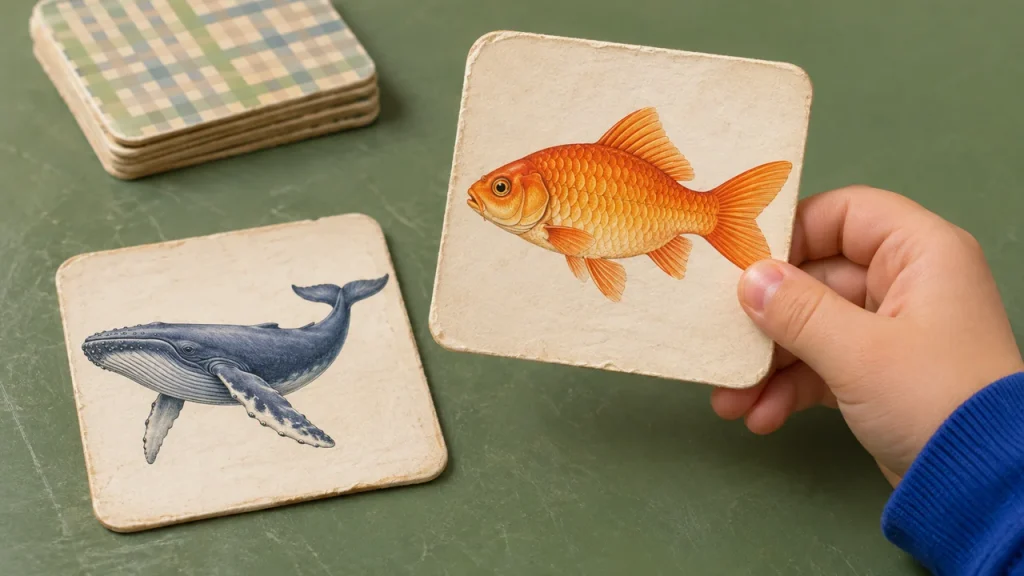
On the kitchen table are two circles drawn on a drawing board, one small inside the other large; and those same cards with the animals. The child places the whale in the small circle. He takes the fish, holds it over the table; in the small circle it does not move; the child knows that it is not a whale. But you cannot put it in the large circle either; the fish lives in the water. The card falls into the large circle, outside the small one, and the child says, «oh, the fish is in the water too.» He asks what phrase the fish is breaking, the first or the second. If he points to the second, the reversed conclusion has just crumbled away from a single card.
This card is the whole proof. A few suitable examples do not yet prove the phrase with the word «all.» But one example is enough to refute it, one fish. This injustice usually appeals to a child; there is something of a game in it, where one move decides the game.
The word «means»
Every flipped out statement starts with the same word. That is, «All whales live in water, so…,» and the child then says what seems obvious to them. The word itself is a good thing; without it there is no reasoning. It is dangerous because after it, very rarely is it checked. The phrase before «so» is taken from the task; it is true. The phrase after «so» is made up by the child, and no one has checked it except him.
And if we don't check?
The circles will remain on the paper, and whether the child can verify the next conclusion will remain unclear. All the excellent students read books; therefore, all those who read are excellent. All those who were late came by bus; therefore, all those who came by bus were late. And here we should look for a counterexample: a student who is not an excellent one, or a passenger who managed to get there in time. Sometimes the reversed sentence turns out to be correct when the two groups coincide, but this can only be determined by checking.
One conclusion and one sheet
For today’s evening, one conclusion is needed from the scene or conversation set up like a pro-whale show: «Everyone is like this, so….» There are two circles on the sheet, a small one inside the big one, with the words from the conclusion written on the bottom. Items from the table work as place cards. The apple in the small circle is a fruit, the banana in the big one is a fruit, and the outside of the small one is a banana. The child takes turns arranging the items, the adult asks one question, «where is this?» and holds the banana in his hand. Then the second question is on the same items, about «some things.» «Some fruits are apples; show me how that’s so.» An example is needed to support this, no problem, and the child puts the apple down. Five minutes, and the second conclusion is not needed for today’s evening.
Free material
Alphabet for Bilinguals
A colorful alphabet with pictures and tasks for each letter
Cards for Grandma, all for Papa
The grandmother gets the cards. They work the same way on her table, and she doesn’t have to explain to her that not everyone who lives in the water is a whale; instead, she’ll be happy to ask the question «where is this going?» Dad, who doesn’t speak Russian, gets all and some; with the English all it’s the same story as with the Russian «all»; and he’ll check the logic without a single word of Russian. It’s useful for a teacher to know what you now know. A child who wrote about whales might know the facts and still not be able to verify the conclusion; that’s a different gap.
But there remain two circles on the sheet, and the fish lie where they belong: in the water, not among the whales. Ailer explained the reasoning with those circles more than two hundred and fifty years ago, and since then the drawing has not become outdated on any map.
At the «Logic» course at the Palme School, children aged 4 to 18 learn to reason step by step: compare and group objects, find patterns and exceptions, assemble sequences and chains of «if-then» statements. Online classes, 40 minutes twice a week, through games, cards, comics, and visual tasks. For younger children, there are logical games and exercises in the form of worksheets.
You can get acquainted with the school at two free lessons. First, the methodologist determines the child's level and selects a program; then the family meets the teacher during a free session. The schedule is adjusted to the family's time zone.
Book a Free TrialFrequently asked questions about «everything» and «some things»
What are Euler circles in simple terms?
The drawing shows each group of objects surrounded by a circle. If one group completely fits into another, a small circle is drawn inside the larger one. If the groups only intersect, the circles overlap with their edges. This is how Leonard Euler explained his reasoning in 18th-century letters, and this method is still used in schools today.
From what age does a child understand «everything» and «some things»?
For this exercise, focus on how the child understands the task. Start by arranging familiar animals into groups, then offer to test one sentence using the cards. If it’s difficult, work through the example together; a drawing helps to see the connections between the groups.
Why can't we just reverse the sentence with the word «all»?
Because the reversed phrase already refers to a different group. «All whales live in water» refers to whales, «all who live in water are whales» refers to all aquatic inhabitants. The second phrase from the first does not follow; it must be checked separately, and often one example, fish, breaks it.
How can we explain to a child that in a logical question «some» does not mean «all»?
With a card as proof. The phrase «some of those who live in the water are whales» is true, if there is even just one whale. Let the child place one card with a whale in the circle and see that this phrase is enough. How many other animals are there, it doesn’t matter for this phrase.
How to say «all» and «some» in logical sentences?
All and some. There are also circles like that in English textbooks, where they are usually called Venn diagrams; the English all behaves like the Russian «all», and the phrase "all" must also be checked separately. This is a convenient way to connect a parent to the exercise who does not speak Russian.