

Sixty-one percent of American elementary school teachers said their students are struggling. It's not about arithmetic or reading. It's about understanding which TikTok video was made by a human and which was entirely generated by artificial intelligence. This finding was published by Education Week on April 20, 2026, and behind it is a large study by the EdWeek Research Center, conducted among American educators in February and March.
In middle school, 44% teachers chose the answer «very difficult.» In high school, 38% did. It’s an interesting reversal. The younger the child, the harder it is for them to distinguish machine-generated content from real content, and that makes sense. Basic critical thinking skills are formed in elementary school, and without them, any AI-generated content looks like a regular cartoon, a regular photo, or a regular news story.
For Russian-speaking families in the US and Canada, this topic is twofold. Their children attend the same schools where this discussion is currently taking place. Additionally, they encounter AI when translating Russian assignments through ChatGPT or when searching for information about Russian history in English.
What did the nationwide teacher survey show

According to Media Literacy Now, at least half of US states have already passed laws promoting media literacy as part of the school curriculum. Eleven of them have emerged since January 2024. This means the country has recognized the problem, legally codified it, and started taking action. But the pace of AI is outrunning any legislation.
«The world of media literacy and education is having a hard time keeping up with the world of technology, especially the development of AI,» says Brian Baker, a consultant for Media Literacy Now and head of the Oregon Media Literacy Coalition, which includes more than forty national and regional organizations. According to him, schools have found themselves in an «ideal storm.» Media literacy is not a mandatory subject everywhere, and technologies change every few months.
What exactly are children being taught nowadays
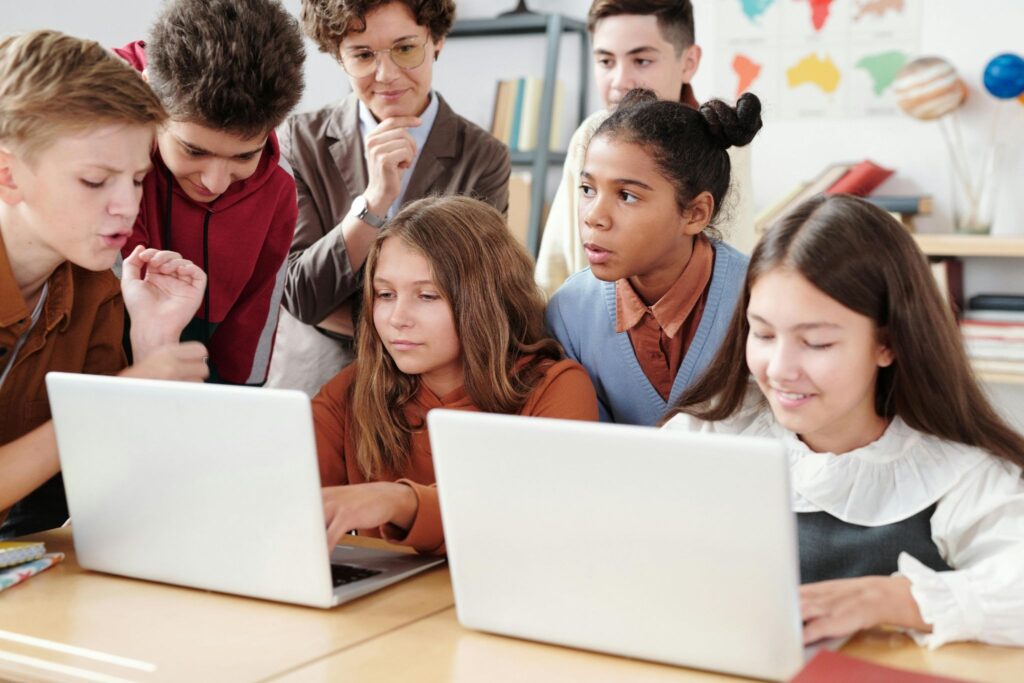
Brian Baker distinguishes between two approaches to teaching AI. The technical approach is about how to use AI tools safely, ethically, and effectively. The critical approach is about how AI influences the thoughts, feelings, and behavior of the child themselves and their peers. In his observations, the second approach is less developed in schools.
There are also specific practices. Kelly Guilfoil, an English teacher and specialist in bilingual students from Lake Stevens High School in Washington state, introduced three rules for her students. Always be honest about exactly how AI was used in completing an assignment. Critically analyze what AI is doing for you. And ask yourself one simple question. Would the teacher do this for me? If the answer is «no,» then AI shouldn't either.
In Wyoming, at Clearmont K-12 School, fifth-grade teacher Jonathan Broersma teaches students to verify the sources AI cites. He says the goal is not to get an answer quickly, but to understand where the AI got that answer from.
Justin Reich, an associate professor at MIT, believes that there is no universal recipe yet. AI development is moving so fast that the best strategy for schools is local experimentation. Try, observe, adjust.
A separate topic that emerged in the study is so-called «brain rot.» Literally, «brain decay.» Oxford chose it as its word of the year in 2024. This is what teenagers call the state after hours of watching low-quality content on social media. Chelsea Olson from the Department of Pediatrics at the University of Wisconsin-Madison works with the American Academy of Pediatrics and says that AI generation is now directly fueling this phenomenon. The more AI videos in the feed, the stronger the brain rot.
What does this mean for Russian-speaking families in the US and Canada

У bilingual children The situation is special. They additionally use AI where their monolingual peers do not. Translating Russian assignments into English, English into Russian, searching for information on Russian history, literature, and culture, and help with Russian grammar – AI works significantly more intensively for bilingual children than for their monolingual peers. And herein lies the main trap. AI is trained primarily on Western sources and hallucinates particularly strongly on Russian-language topics. Names of tsars, dates of wars, authorship of famous poems, geographical facts about Russia. The neural network gets confused on these topics more often than on American school questions.
What a parent can do right now. First, to personally check the child's assignments concerning Russian culture or history. Second, to talk to the child about the difference between an AI response and a verified source. Instead of forbidding AI, show its limitations. Third, to train critical thinking in family conversations. What is true in this article and what is not. Where did the author get this figure from. Who is behind this. This is media literacy, and it works best when it is taught at home, not just at school.
What's next

The topic of AI and media literacy in American schools will only heat up. Programs will appear in many states in the coming year, and immigrant parents will see them in their children's schools. It's better to prepare for this conversation in advance.Based on the materials Education Week from April 20, 2026.