

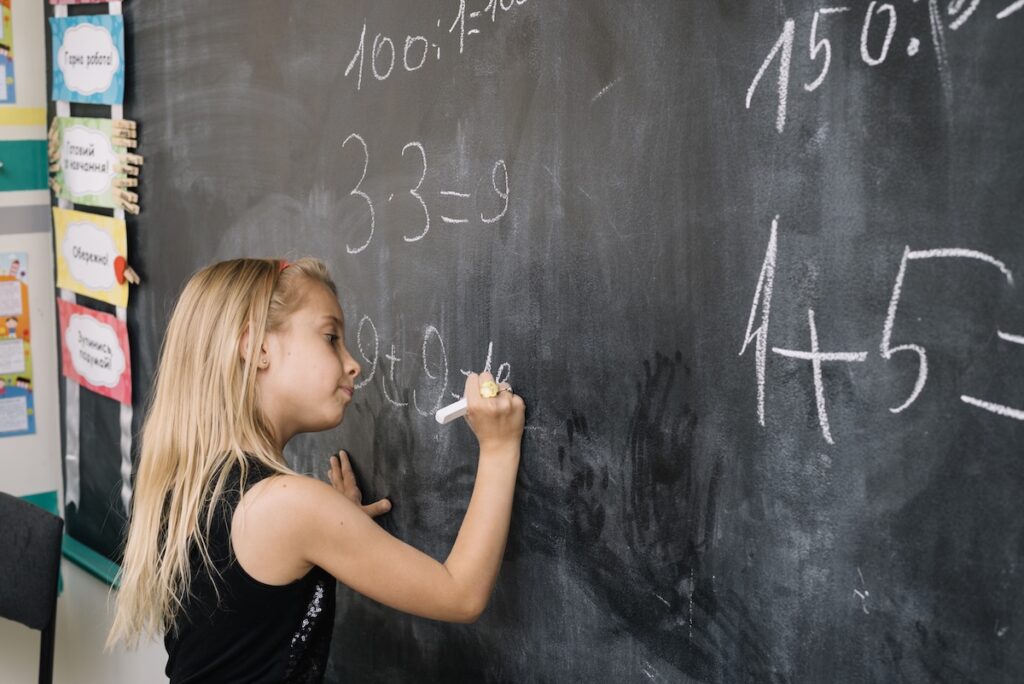

Many parents notice that their child is bored in math class. Or they don't understand the subject.
Perhaps the methodology of Ludmila Peterson, a famous Russian teacher, will suit him.
Her system has been used for many years in schools and homeschooling, especially among Russian-speaking families abroad.
What is the Peterson method
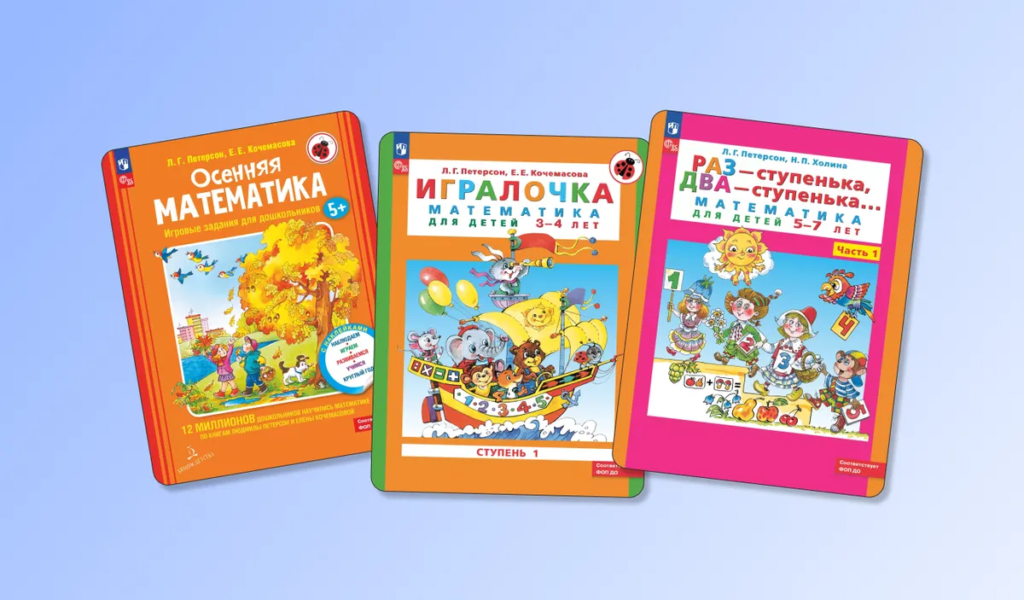
The Peterson method is a way of teaching math to children in which the child does not receive ready-made rules, but «reaches» them himself.
For example, a regular teacher will say, «Three times two is six.» A Peterson teacher suggests putting six items into two piles and asks: «How many in each?». In this way, the child notices the regularity himself.
This approach is called developmental math because it teaches you to think. Not just memorization. The method is designed for children from the age of three to sixth grade.
It works best in elementary school when the foundations of early math development are being laid.
How it differs from the regular school program
The way most schools teach it is, «Here's a rule. Here's an example. Do the same.» If a child makes a mistake, he is corrected, and that's it. In Peterson's method everything is different. What matters here is not what the answer is, but how it was arrived at.
The child is deliberately put in front of a problem that he cannot yet solve in a known way. He tries, compares and draws conclusions. And in the end, he formulates the rule himself. This develops children's logical thinking much more effectively than dozens of identical examples.
The main goal is not to teach you how to count fast. It is to teach you to understand why it is this way and not that way. Therefore, there is no place for mechanical memorization. All is built on an understanding.
Here's a visual comparison:
| Regular program | The Peterson Method |
| Gives ready-made rules | The child discovers the rule on his own |
| Emphasis on computation | Emphasis on reasoning and logic |
| Mistakes are counted poorly | Mistakes are part of the path to knowledge |
| One pace for all | Personalized pacing, supportive thinking |
What skills this technique develops
Children learning the Peterson method learn not only how to solve problems, but also:
- to see the connections between phenomena,
- to break down complex things into simple parts,
- to put their ideas to the test,
- not to be afraid to make mistakes.
These skills are useful not only in elementary school mathematics, but also in life in general. The ability to reason, analyze and find non-standard solutions is valuable in any profession.
The Peterson Method for bilinguals
For families living abroad, the Peterson Method is a great way to stay connected to the Russian educational tradition, but without «rote learning». Children's logical thinking develops independently of language.
A child who is used to thinking, not just repeating, adapts more easily to any school system in any country. And parents can support early math development in Russian. Even if the main school in another language.
At what age is the best time to start
It is best to start at the age of 3-4 through play activities. At this age, children learn to count, compare, and group objects.
From the age of 6-7, you can move on to Peterson's textbooks for 1st grade. But even if the child is already in the third or fourth grade, it is not too late to enter this system.
The Peterson method is a way to teach a child to think independently. It helps to develop logical thinking in children, teaches them not to be afraid of complexity and to find joy in the process of learning.
This is a great method if you want your child to understand how the world of numbers works. You want your child to understand how the world of numbers works.