

Your child is growing up in an English-speaking environment, but you speak Russian at home. At Palme School, we understand very well the challenges you may face in this situation.
There are several effective methods for teaching bilingual children. We will look at them in today’s article. But first, let’s talk about the characteristics of bilingual children.
Bilingual children: features of their learning
Bilingualism often includes mixing languages, using grammatical structures incorrectly, and thinking and speaking in different languages. All of these are natural aspects of a child’s development in a bilingual environment. They are considered normal and are not developmental problems.
What language do bilingual children think in?
It largely depends on the language environment they are most involved in. For example, at home you mainly speak Russian. However, at school or on the playground, your child is immersed in an English-speaking environment. In such cases, the child may think in Russian but express their thoughts in English. In this situation, Russian becomes a passive language. That is why in our school we focus not only on learning new words. Children actively start using them in different situations.
Challenges you may face during the learning process

- Limited vocabulary
If you are trying to instill a love of the Russian language and culture in your child, you have probably noticed that they sometimes struggle to express their thoughts clearly and correctly.
Examples:
“This cat is orange” (instead of the Russian word meaning “ginger”).
“The house has a red roof” with incorrect grammar.
- Grammar difficulties
Russian is considered one of the most complex languages in the world, and many studies confirm this. Cases, declensions, and verb conjugations can be difficult for children who are used to the simpler structure of English.
- Lack of motivation
A child may not see the value in learning their heritage language. The process may seem boring or routine and may not spark any interest. It is very important to engage bilingual children. That is why, in our lessons, native Russian-speaking teachers actively use interactive tasks and involve every student through exciting learning adventures with elements of immersive education.
Methods for teaching Russian to bilingual children Vocabulary development

- Vocabulary development
- Actively include frequently used words in everyday speech: house, family, tree, street, apple, toy, and so on.
- Visualize what you are talking about. For example, you can draw a family portrait and name each element in the picture. This method is especially effective for younger children.
- Create short stories together using newly learned words. For example, if your child recently learned the word “street,” discuss what can be found on a street, how big it is, and how far it is from school.
- Integrate Russian into daily life
- Play traditional Russian games such as “Family,” “Ring Game,” or “Edible or Inedible.”
- Cook using Russian recipes. This helps children learn new words while also developing practical skills.
- Watch Russian cartoons and read books together. The materials should match your child’s language level.
- Daily reading and retelling
Regular reading expands vocabulary and improves grammar. For younger children, fairy tales and short poems work well. Teenagers may enjoy reading classical literature.
- Culture as motivation
Teaching Russian to bilingual children should also include learning about their parents’ culture. Holiday calendars and Russian traditions can help motivate children and make learning more meaningful.
- Professional support and guidance
Supporting bilingual children is not always easy for parents. Busy schedules may not allow enough time to fully immerse a child in learning Russian. In such cases, professional teachers can help. They make the learning process comfortable and effective for your child.
Advantages of studying at the online school Palme School
- Cycle programfocused on an individual approach for each student.
- Combination of lexical and communicative methods.Children learn to speak in full sentences and study words in context rather than individually, allowing them to start speaking much sooner.
- Interactive learning using multimedia materials.
- Development of creativity. Students are placed in engaging situations where they use imagination and learn “living” Russian.
- Articulation exercisesthat help develop correct pronunciation.
What people say about us:
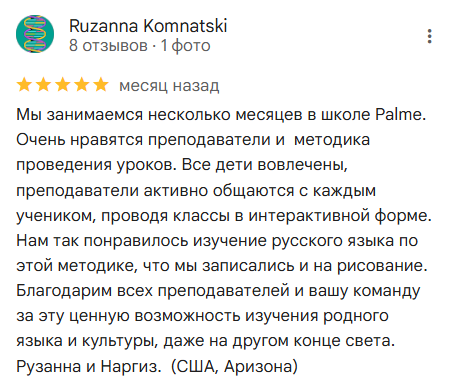
With the online school Palme School, you can forget about the typical challenges of teaching Russian to bilingual children. You can try your first lesson for free by filling out the form below.