
Mathematics in Russian
Teaching a child to solve problems and count «the smart way»—using the Russian school curriculum, but in a lively way without rote memorization


Free lesson and school introduction
These lessons are for your
the child, if
How the class goes
Why mathematics at Palme
From meeting the teacher to fluent speech
The student's path
From counting on fingers to confidently solving problems
Training Program
Select a group based on the child's age and skill level
Preschoolers with zero level
1 month
- Numbers and numbers, number composition, simple addition and subtraction
- Correct pronunciation of the names of numbers from 0 to 20 in Russian
- Counting forward and backward up to 20
- Understanding the nature of addition and subtraction
2–3 months
- Numbers up to 100, number composition, addition and subtraction
- Correct pronunciation of the names of numbers from 0 to 100 in Russian
- Counting in ones, tens
- Knowledge of the names of the mathematical operations «+» and «−»
4–5 months
- Numbers up to 1000, digits, addition and subtraction of large numbers in a column
- The correct pronunciation of the names of numbers from 0 to 1000 in Russian
- Counting in units, tens, hundreds
- Knowledge of the names of digits from units to thousands
- Ability to divide a number into its components by digits
- Adding and subtracting two-digit and three-digit numbers in a column
6–9 months
- Adding and subtracting in your mind, solving problems using math
- Addition and subtraction of units, tens, hundreds
- Adding and subtracting numbers within 20 in your mind
- Adding and subtracting two-digit and three-digit numbers
- Ability to divide a number into its components by digits
- Interpreting problems into mathematical models
- Ability to solve problems mathematically
Preschoolers with advanced levels
1 month
- Adding in the mind, numbers up to 1000, number composition, digits
- Adding numbers within 20 in your mind
- The correct pronunciation of the names of numbers from 0 to 1000 in Russian
- Forward and backward counting in units, tens, hundreds
- Knowledge of the names of digits from units to thousands
- Ability to divide a number into its components by digits
2–3 months
- Adding and subtracting large numbers in a column, addition and subtraction in the mind, numbers up to 10,000
- Adding numbers within 100 and subtracting numbers within 20 in your mind
- Forward and backward counting in units, tens, hundreds, thousands
- Adding and subtracting numbers within 10,000 in a column
4–5 months
- Solving problems mathematically, counting in groups (introduction to multiplication), half-three-fourths (introduction to division and fractions), multiplication
- Effective account (in groups)
- Writing down the conditions of the tasks
- Solving text problems
- Choosing the best way to solve this problem
- Understanding the essence of multiplication
6–9 months
- Multiplication by one- and two-digit numbers, division with remainder, whole numbers, the concept of fractions
- Multiplication techniques (preparation for counting in mind)
- Division techniques (preparation for counting in mind)
- Column multiplication
- Understanding the nature of fractions
Junior group
1 month
- Adding in the mind, numbers up to 1000, number composition, digits
- Adding numbers within 20 in your mind
- The correct pronunciation of the names of numbers from 0 to 1000 in Russian
- Forward and backward counting in units, tens, hundreds
- Knowledge of the names of digits from units to thousands
- Ability to divide a number into its components by digits
2–3 months
- Adding and subtracting large numbers in a column, addition and subtraction in the mind, numbers up to 10,000
- Adding numbers within 100 and subtracting numbers within 20 in your mind
- Forward and backward counting in units, tens, hundreds, thousands
- Adding and subtracting numbers within 10,000 in a column
4–5 months
- Solving problems mathematically, counting in groups (introduction to multiplication), half-three-fourths (introduction to division and fractions), multiplication
- Effective account (in groups)
- Writing down the conditions of the tasks
- Solving text problems
- Choosing the best way to solve this problem
- Understanding the essence of multiplication
6–9 months
- Multiplication by one- and two-digit numbers, division with remainder, whole numbers, the concept of fractions
- Multiplication techniques (preparation for counting in mind)
- Division techniques (preparation for counting in mind)
- Column multiplication
- Understanding the nature of fractions
Junior group
1 month
- Adding in the mind, numbers up to 1000, number composition, digits
- Adding numbers within 20 in your mind
- The correct pronunciation of the names of numbers from 0 to 1000 in Russian
- Forward and backward counting in units, tens, hundreds
- Knowledge of the names of digits from units to thousands
- Ability to divide a number into its components by digits
2–3 months
- Adding and subtracting large numbers in a column, addition and subtraction in the mind, numbers up to 10,000
- Adding numbers within 100 and subtracting numbers within 20 in your mind
- Forward and backward counting in units, tens, hundreds, thousands
- Adding and subtracting numbers within 10,000 in a column
4–5 months
- Solving problems mathematically, counting in groups (introduction to multiplication), half-three-fourths (introduction to division and fractions), multiplication
- Effective account (in groups)
- Writing down the conditions of the tasks
- Solving text problems
- Choosing the best way to solve this problem
- Understanding the essence of multiplication
6–9 months
- Multiplication by one- and two-digit numbers, division with remainder, whole numbers, the concept of fractions
- Multiplication techniques (preparation for counting in mind)
- Division techniques (preparation for counting in mind)
- Column multiplication
- Understanding the nature of fractions
Senior group
1 month
- Mental math (addition, subtraction, mental multiplication), smart counting
- Adding numbers within 100 and subtracting numbers within 20 in your mind
- Practice multiplying two-digit numbers in your mind
- Techniques for effectively solving examples in your mind
2–3 months
- Mental addition within 1000, solving math word problems, skip counting in groups (multiplication and division)
- Mental addition of numbers within 1000 (mental math techniques)
- Effective account (in groups)
- Solving text problems
- Choosing the best way to solve this problem
- A deep understanding of multiplication and division
4–5 months
- Fractions (full introduction)
- The concept of fractions
- Comparing fractions in different ways
- Actions with fractions
- Right and wrong fractions, mixed numbers
6–9 months
- Fractions (advanced level)
- Techniques for comparing fractions effectively
- Converting fractions to the mathematical action of division and vice versa (through division with remainder)
- Solving problems with fractions and integers
- Solving problems to find the part of the whole and vice versa
- Solving ratio problems
Senior group
1 month
- Mental mathematics (addition, subtraction, multiplication, and division in the head), «smart» calculation, efficient problem solving
- Mental addition and subtraction of numbers within 1000 (smart counting techniques)
- Mental multiplication of two-digit numbers (smart calculation techniques)
- Solving text problems
- Choosing the best way to solve this problem
- A deep understanding of multiplication and division
2–3 months
- Fractions (advanced level)
- Techniques for comparing fractions effectively
- Converting fractions to the mathematical action of division and vice versa (through division with remainder)
- Solving problems with fractions and integers
- Solving problems to find the part of the whole and vice versa
- Solving ratio problems
4–5 months
- Negative numbers, techniques for solving examples efficiently
- Concepts of negative number, modulus of a number and opposite numbers
- Ability to quickly solve examples through efficient manipulation of numbers
6–9 months
- Equations and systems of equations
- Deep understanding of the nature of equations and unknowns
- Techniques for solving equations
- Solving problems with equations
- Techniques for solving systems of equations
- Choosing the most efficient technique for solving a given system of equations
- Solving complex problems with a system of equations

Cyclical Program 3.0: climbing stairs instead of walking a straight line
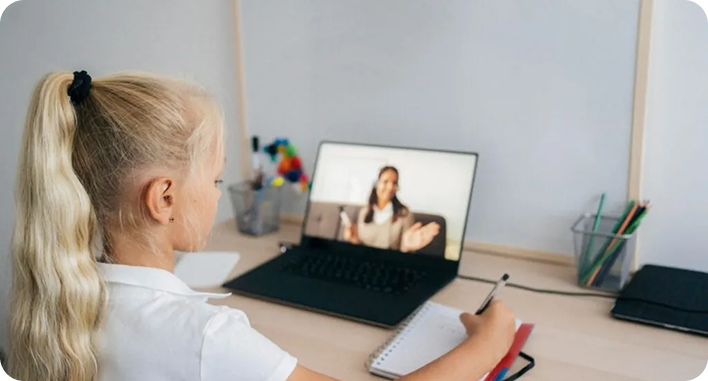
At Palme School, we use a cyclical program rather than a linear progression through the textbook from the first to the last page. This is important for bilingual students, as children join at different times, with varying levels and different workloads in the local school.
At the math school, learning is structured in cycles. At the start of the program, it is important for the child to feel confident with numbers and counting. During this period, they get acquainted with digits, learn to understand the composition of a number, add and subtract, and also master «smart» mental math techniques.
At the next stages, we no longer work with individual examples, but with word problems. Children learn to translate the problem statement into a diagram, and the diagram into a solution, analyze what exactly is being asked, and explain the course of the solution in their own words.
Each such stage is time-limited: the cycle has a beginning and an end. During this time, we return to important topics several times through games, exercises, and discussions so that new skills are truly consolidated rather than disappearing a week later. If a family joins not from scratch, but in the middle of the year, the child will still go through all the key stages: the cyclical structure ensures that important blocks of the program are not missed.
This relieves some of the parents' anxiety: it's clear what the child is doing right now, what result they are working toward, and what will happen next.

Choose the Perfect Plan for Your Child
Start for free, then choose the schedule that works best for you. No hidden fees, manageable workloads, and bonuses for long-term learning
2 free sessions to meet the teacher and see if our format is the right fit for your child
- Meet the teacher
- Assessment of your child's level
- Personalized program recommendation
2 free sessions to meet the teacher and see if our format is the right fit for your child
- Meet the teacher
- Assessment of your child's level
- Personalized program recommendation
2 free sessions to meet the teacher and see if our format is the right fit for your child
- Meet the teacher
- Assessment of your child's level
- Personalized program recommendation
2 free sessions to meet the teacher and see if our format is the right fit for your child
- Meet the teacher
- Assessment of your child's level
- Personalized program recommendation

Parents' reviews about Palme School
Start with a free trial, then choose the plan
that works best for your child
Your First Lesson & Assessment Are 100% Free
Leave your contact info below. A student success manager will reach out within 24 hours to find the perfect time and teacher for your child.
✓ No commitment or upfront payment required
✓ Taught by a certified educator
✓ Receive a personalized learning plan

Frequently Asked Questions
Start with a free lesson — then choose the format that works best for your child
At what age can they start?
Our programs are suitable for children from the age of 4. There are levels for preschoolers as well as for younger students - taking into account initial knowledge and experience.
Who's teaching the class?
Lessons are taught by experienced teachers with pedagogical education and practice working with children. All teachers are strictly selected and use author's methods.
How are the lessons going?
All classes are online, 2 times a week for 40 minutes. Individual and group formats are available. Materials are age and level appropriate.
What do we need to participate?
Internet-enabled device (computer or tablet) and Zoom only. All supplementary materials are provided digitally.
Can we try it for free?
Yes, you can try the first lesson for free to get acquainted with the program and the instructor.