Palme School

Online Russian Language School in the USA and Canada
Online school in Russian for bilingual children and teenagers
💡 Get bonuses with us! Referral program

Epiphany: the history of the holiday, traditions and bathing in the ice-hole

Where did the tradition of bathing on Epiphany come from, what is celebrated on this day and in what countries bathe in winter. Today we will tell you about the customs of this winter holiday.

On the History of the Feast of Epiphany

On January 19, the holiday of Epiphany is celebrated in Russia. This day is one of the most important church holidays in Christianity. According to the Bible, at the age of 30, Jesus Christ came to the Jordan River to be baptized by John the Baptist. During the rite, all those present saw a dove that descended from heaven and began circling over Jesus. At the same moment they heard a voice announcing that Jesus was the Son of God. This was the first time the believers saw the manifestation of the Holy Trinity - father, son and holy spirit.

Traditionally, the evening before Epiphany is called Christmas Eve, as is the evening before Christmas. We wrote about it in detail in another article.

As on Christmas Eve, on this day it is customary to keep a strict fast and not to eat until evening. But for dinner, they prepare fasting dishes - kutya, make compote and bake fasting pies.

Traditions on Epiphany night

The most famous traditions for celebrating Epiphany are related to with the rite of consecration of water. In churches, a sacrament is performed, at the end of which a cross is dipped into the water, after which it becomes holy. This water is kept in the house until the next Baptism and used in extreme cases, for example, during illness.

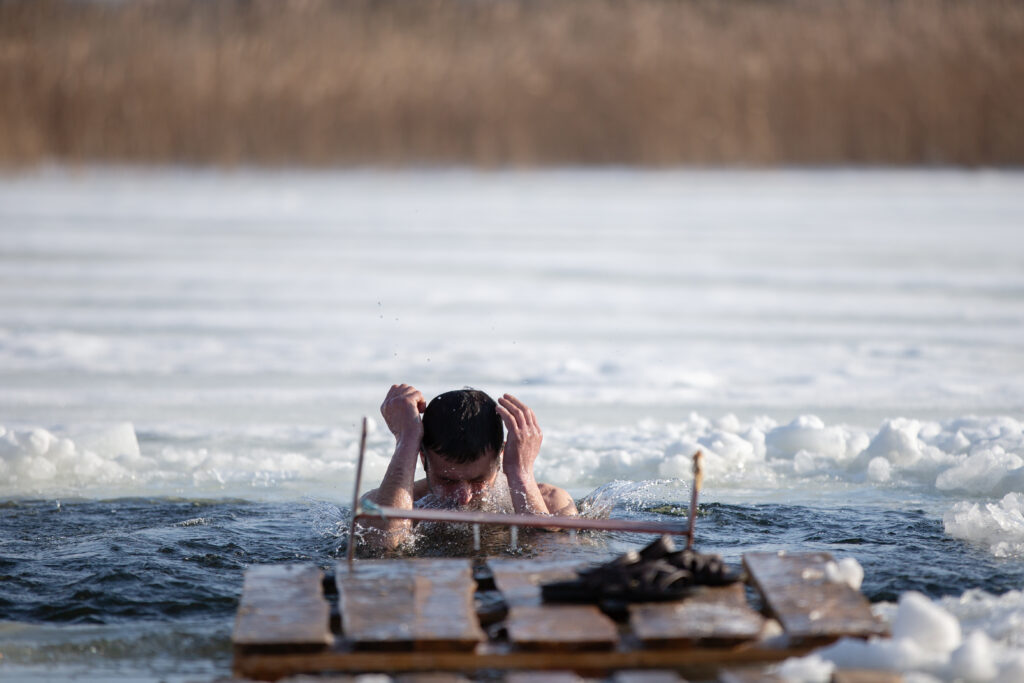
But there is one more unusual tradition, which I would like to dwell on in detail. At the end of the 20th century, a mass custom of bathing on Epiphany in a special ice-hole in a body of water took root in Russia. And even people who are far from "walrus bathing" come in any weather to perform this rite. At the same time, the church officially does not recognize the need to dip in icy water on Epiphany. But despite this, people firmly associate this ritual with the religious holiday.

Why this happened, there is no exact answer. It is known that back in the olden days peasants used to dive into the water on Epiphany by analogy with bathing after a bath. But again, this bathing in the ice-hole was not directly related to the church regulations.

There is another version connected with ancient rites. On the eve of Epiphany, Christmas Eve was the end of Christmas Eve, a 12-day period after Christmas with such a deep history that it has long united Christian and pagan beliefs. According to legend, at the end of the merry festivities it was necessary to wash off all the "unclean" from oneself. This is how the tradition of bathing on this night came about.

Where else winter bathing is popular

But bathing in winter is not only a Russian tradition. Let's see what other countries have such a custom:

  • Canada - in Vancouver for more than 100 years, January 1 has been celebrated on English Bay swim! And the polar bears club adds new members every year;
  • USA - Chicago has its own winter swimming club. Every year in January its members hold a swim in Lake Michigan. This year it will be on January 25;
  • Great Britain - here every year Christmas bathing in Lake Serpentine takes place. By the way, this tradition is more than 160 years old!
  • Netherlands - Like Canadians, local "walruses" hold a New Year's Day swim in the North Sea on January 1;
  • Bulgaria - since the majority of people in this country are Christians, bathing in an ice-hole here, as in Russia, is of a religious nature. Bulgarians also hold mass dipping in icy water on Epiphany (January 6).

And the Finns can be recognized as the leaders of winter hardening - in Finland, the second swimming season opens in October. Everyone, from children to the elderly, takes part in it.

More interesting articles about winter holidays can be found on our blog:

Do you want to support child's successes In studies?
Helping to develop knowledge, confidence, and a love for learning through modern Russian language classes and beyond.
Ukrainian differs from Russian in several key ways, including pronunciation, vocabulary, and grammar. Despite these differences, they are often confused because they are both East Slavic languages and share a common ancestor, Old East Slavic. This shared heritage means they have a significant degree of mutual intelligibility, particularly in spoken form. **Key Differences:** * **Pronunciation:** * **"Г" sound:** In Ukrainian, the letter "г" is typically pronounced as a voiced velar fricative, similar to the "g" in "go" but softer, almost like a gentle breath. In Russian, "г" is usually a hard "g" sound. * **"И" and "Ы" sounds:** Ukrainian has distinct "и" (pronounced like the "i" in "bit") and "i" (pronounced like the "ee" in "see"). Russian has "и" (similar to Ukrainian's "и") and "ы" (a harder, more guttural sound not present in Ukrainian). * **Vowel reduction:** Russian has significant vowel reduction, where unstressed vowels change their sound (e.g., "o" can sound like "a"). Ukrainian generally pronounces vowels more clearly, regardless of stress. * **"Є" and "Ї" sounds:** Ukrainian has specific letters like "є" (pronounced like "ye" in "yes") and "ї" (pronounced like "yi" in "yield") which are not found in Russian. * **Vocabulary:** * While many words are similar or identical, Ukrainian has a richer influence from Polish, and also incorporates words from Turkic languages and other European languages to a greater extent than Russian. * Examples: * Thank you: Ukrainian - дякую (dyakuyu), Russian - спасибо (spasibo) * To speak: Ukrainian - говорити (hovoryty), Russian - говорить (govorit') * Yes: Ukrainian - так (tak), Russian - да (da) * No: Ukrainian - ні (ni), Russian - нет (net) * **Grammar:** * **Vocative case:** Ukrainian retains and actively uses the vocative case for direct address, which has largely disappeared from modern Russian except in very specific or archaic contexts. * **Verb conjugations:** There are differences in verb endings and some verb forms. * **Grammatical genders and noun declensions:** While largely similar, there are minor variations in how nouns change form based on case and gender. **Why They Are Confused:** 1. **Shared Ancestry:** Both languages descend from Old East Slavic, the language spoken in Kyivan Rus'. This common origin means they have a large base of shared vocabulary and grammatical structures. 2. **Geographic Proximity and Historical Interaction:** For centuries, the territories where Ukrainian and Russian are spoken have been in close contact, often under the same political empires (like the Russian Empire and the Soviet Union). This led to significant linguistic borrowing and influence in both directions. 3. **Mutual Intelligibility:** Due to the shared roots and similarities, speakers of Ukrainian and Russian can often understand a significant portion of what the other language is saying, especially in simpler conversations or written texts. This superficial understanding can lead to the misconception that they are dialects of the same language. 4. **Political and Historical Context:** During periods of Russian imperial and Soviet rule, the Ukrainian language was often suppressed or discouraged, and there was a promotion of Russian as the dominant language. This historical context sometimes led to the view, particularly among those outside Ukraine, that Ukrainian was merely a dialect of Russian. However, linguistic analysis clearly shows they are distinct languages.

Do you want your child to love learning?

At Palme School, classes are held online in live groups with experienced teachers. Choose a subject and sign up for a free first lesson.

Sign up for the newsletter
We at Palme Online School fall in love with the Russian language and Russian culture

Leave a request for a free call

Sign up for a free lesson.
Apply for a free introductory lesson to get acquainted, determine your goals, and find a suitable group.
Sign up for a free lesson
Submit a request for a free first session with a guidance counselor to get to know each other, determine your goals, and match your child with an educator
Sign up for a free lesson
Submit a request for a free first session with a guidance counselor to get to know each other, determine your goals, and match your child with an educator
Sign up for Russian Dictation
Sign up for a free lesson
Submit a request for a free first session with a guidance counselor to get to know each other, determine your goals, and match your child with an educator
Sign up for a free lesson
Submit a request for a free first session with a guidance counselor to get to know each other, determine your goals, and match your child with an educator
Sign up for a free lesson
Submit a request for a free first session with a guidance counselor to get to know each other, determine your goals, and match your child with an educator
Sign up for a free lesson
Submit a request for a free first session with a guidance counselor to get to know each other, determine your goals, and match your child with an educator
Sign up for a free lesson
Submit a request for a free first session with a guidance counselor to get to know each other, determine your goals, and match your child with an educator
Sign up for a free lesson
Submit a request for a free first session with a guidance counselor to get to know each other, determine your goals, and match your child with an educator
Sign up for a free lesson
Submit a request for a free first session with a guidance counselor to get to know each other, determine your goals, and match your child with an educator
Sign up for a free lesson
Submit a request for a free first session with a guidance counselor to get to know each other, determine your goals, and match your child with an educator
Sign up for a free lesson
Submit a request for a free first session with a guidance counselor to get to know each other, determine your goals, and match your child with an educator