
Russian as a Foreign Language (RFL) is not about «knowing the language poorly»; it's about a different path to Russian for a child living in an English-speaking environment.
Instead of abstract textbook rules, RKI relies on real-life situations: talking to your grandmother, explaining what you want, telling others about yourself.
This approach helps children in emigration not only improve their Russian but also truly use the language in their lives, staying connected with family and culture.
Why «ordinary Russian» isn't always suitable

Regular Russian language lessons at school are designed with the assumption that a child already lives in Russian and speaks a lot. The teacher's job is not to «teach from scratch,» but to explain how familiar speech structures are organized and why they are considered correct.
A child growing up in the US or Canada is often in a different situation: they think and make friends in English, while Russian remains the language of the home and video calls with relatives. Their Russian vocabulary is limited to everyday topics, English calques appear in their speech, and some words and constructions have simply never been encountered in their experience.
When such a child is made to sit down with a textbook that immediately presents spelling rules or word analysis, they genuinely don't understand the point. It's not about laziness, but because the material is fundamentally designed for a different linguistic foundation. It's like trying to teach advanced swimming techniques before a child is comfortable in the water.
Randomized Controlled Trial

RKI is not «simplified» Russian or «Russian for those who know less.» It is a methodology that considers that a child's primary language of thought may be English, French, or another language. The task is to carefully build Russian around existing knowledge, gradually filling gaps and expanding the topics the child can speak about and understand.
The school curriculum usually starts from within the language itself: rule, exception, exercise. The RKI approach often starts from a situation: there is a real conversation or task (to explain what you want, to tell how your day went), and the necessary grammar and new words appear as you go.
For a child abroad, this changes the feeling of the lesson. Instead of abstract tasks, they get understandable life situations where Russian is needed right now and «for a practical purpose.».
What does this look like in a lesson?
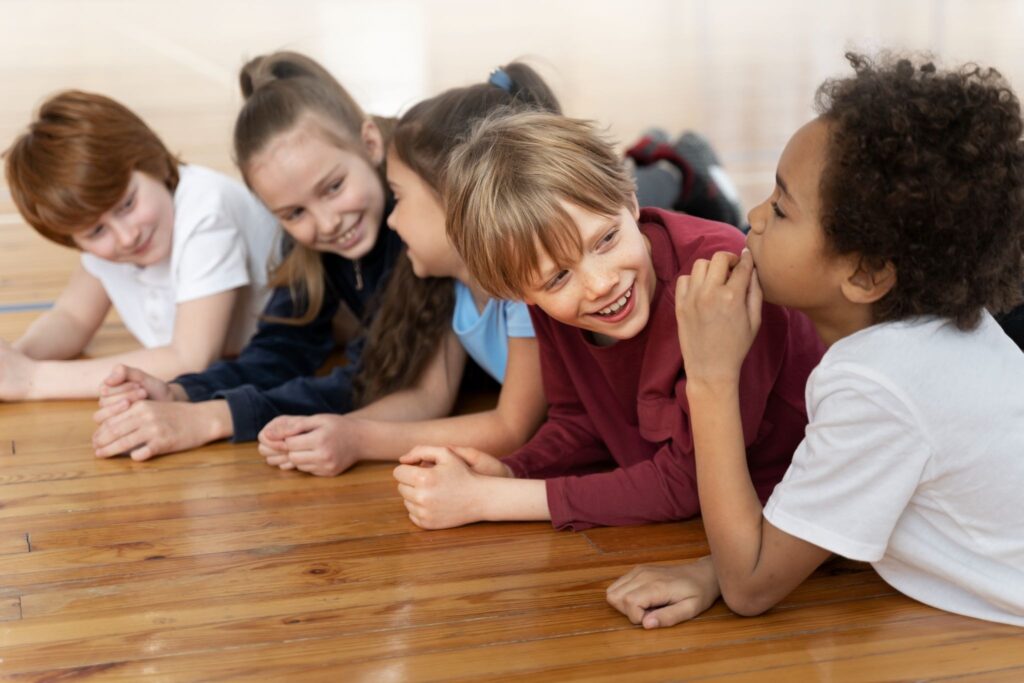
Let's consider the topic of food and preferences. In a traditional program, this might be text, a list of words, and «fill-in-the-blank» exercises. In the format of teaching Russian as a foreign language, a lesson is built around an action:
- children «open a restaurant», invent a menu, explain to each other what's in each dish, discuss who will order what;
- It seems they naturally use the correct cases and constructions, and the teacher gently corrects their speech as it happens, without red pens and the feeling that any mistake will be punished.
Another example is related to descriptions. Instead of «describe the picture,» the child is given a clear situation: they lost their backpack at the airport and are explaining to an employee what it looks like. They need adjectives, colors, sizes, and all of this in the context of a problem, not just «for the sake of it.».
With cartoons and videos, the approach is the same: children watch a segment, retell it, argue about who is right, and come up with a different ending. This is live communication in Russian, not mechanical text reproduction.
If a child already speaks Russian well, is Russian as a foreign language (RKI) necessary?

Parents often say: «He speaks great with us and grandma, why does he need „Russian as a Foreign Language“?» In such situations, it's useful to look deeper than everyday conversations.
In many families, «speaks well» means the child confidently handles familiar everyday topics: what they ate, where they went, what they did. But if you ask them to talk about a movie, an argument with a friend, or their thoughts on an abstract topic, it becomes apparent that they sometimes lack the words and sentence structures, resorting to English insertions or simplified phrases.
The RKI methodology helps precisely here: it gives the child a language for more complex conversations about feelings, relationships, studies, and plans. At the same time, it doesn't devalue the already existing «home» Russian, but gently builds a new level on top of it.
How do RKI classes differ from regular school program classes?

Sometimes parents hire a tutor who uses Russian textbooks. This can help maintain their level if the child has recently moved and it's important for them not to lose their school-level Russian. However, if the child was born or has lived abroad since early childhood, assignments for native speakers often turn out to be too far removed from their real-life experiences.
When a child is constantly faced with texts and exercises «for Moscow second-graders,» they don't see themselves in these tasks, often don't know the expected vocabulary, and don't feel like they are succeeding. As a result, they develop a feeling that the Russian language is difficult and unpleasant.
The RCT approach is initially built differently: the task is selected based on the child's actual level, not on age expectations. The child understands what they can do, sees progress, and resists lessons less.
How does this work at Palme School

At Palme School, classes for bilingual children and children learning Russian as a foreign language are built precisely on the principles of teaching Russian as a foreign language (RKI). Our teachers are specially trained to work with bilingual children and children for whom Russian is not their primary language, so the classes take into account real-life experiences in the USA and Canada, not just school standards.
In our lessons, we don't start with dry rules but with conversation and a clear situation. The teacher observes what the child already knows and builds upon that. Grammar is introduced when it truly helps the child express their thoughts better. Mistakes are handled gently, and lesson topics are connected to the family's real life: trips, communicating with relatives, school, and hobbies.
Children learn in small groups where everyone has a similar experience: several languages in their lives, switching between them, and varying levels of Russian. This reduces anxiety: the child realizes there are many «like them,» and it becomes easier for them to speak.
If you find that «regular» Russian lessons are not yielding the desired results or your child has started to avoid Russian, you can confidently try a different format. Sign up for a free trial lesson at Palme School, and you'll see how the RKI approach works in practice and be able to determine if it's comfortable for your child.