

Imagine: you come to Russia and want to speak Russian. They put you at a desk and give you a thick textbook. Pages full of incomprehensible rules. Case tables that mess up your head. Boring? No wonder many foreigners quit learning Russian in the second week.
But one day everything changed. There was a scientist who looked at linguistics in a completely different way. He realized that language is not about grammar. Language is about people and their traditions. It's about how they live and think. Russian language study must be as alive as life itself.
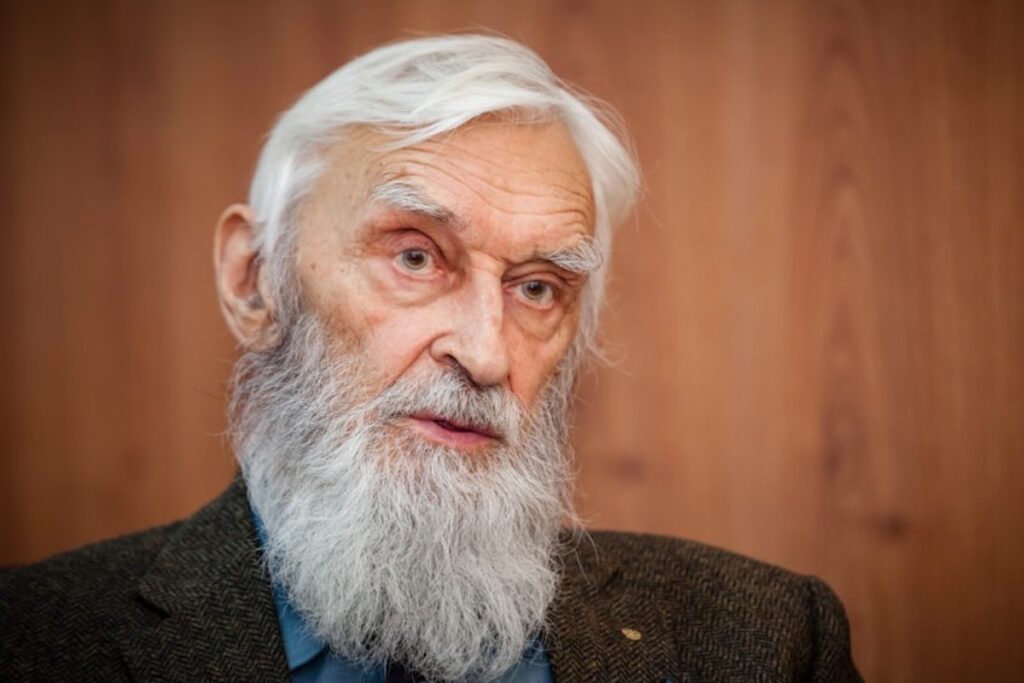
The name of this man was Vitaly Grigorievich Kostomarov.
Who is Vitaly Kostomarov
Vitaly Kostomarov is not just a scholar, but a real revolutionary in the world of linguistics. Before him, teaching Russian abroad was like torture: rote learning, boring exercises, lack of live communication. Kostomarov was the first to approach this task seriously and scientifically.
In 1973, he founded the Pushkin State Institute of Russian Language. And this place became the heart of popularization of the Russian language all over the world.
His ideas formed the basis of modern teaching methods, and today almost all textbooks for Russian language learners are based on his principles.
How a scientist popularized the Russian language

Kostomarov linked language and culture into an inseparable whole. Students used to learn the word «pancakes» as just a feminine noun. But Kostomarov suggested: let's find out why Russians bake pancakes on Maslenitsa, what the round shape symbolizes, why it is a holiday to see off winter.
This idea has given rise to a whole field - linguocountry studies.
Kostomarov's unique methods
Kostomarov has created teaching methods that work simply, clearly, and effectively.
The first is to teach through life. From the first lessons, students learn to say what they need here and now. For example, to ask for directions, to order coffee, to meet a new person. Language becomes a tool for communication, not a subject for rote learning.
The second is to explain through culture. Why does the Russian language have «you» and «you»? Not because «this is the rule», but because in Russian culture it is important to respect elders and strangers. Why do we say «to your health»? Because for Russians, health is the main value.
The third is the courage to speak up. Kostomarov taught: mistakes are not a failure, but a step towards success. The main thing is not to keep silent. Even with mistakes. Because only through live communication does a language become one's own, native language.
These teaching methods have revolutionized the way languages are taught. Today they are used not only for Russian, but also for teaching many other languages around the world.
How parents can utilize Kostomarov's expertise

Kostomarov's ideas work well not only with foreigners, but also with children at home. Do you want your child to love the Russian language? Take his approaches to heart.
First, turn learning into a game. Don't make them memorize words in a list. Play «store»: one sells apples, the other buys apples. Play «guess by description.» «It's round, red, crisp» - an apple! This way the words will be memorized easily and for a long time.
Second, tell stories. Why do we color eggs on Easter? Why is there a Christmas tree on New Year's Eve? Why do Russians like tea with baranki so much? When a child understands why words and traditions are needed, language becomes alive and important to him.
Third, praise for every attempt. Say it wrong? That's okay! The main thing is that he tried. Your task is to create an atmosphere where the child is not ashamed to make mistakes, where he feels: «Mom and Dad are happy that I am speaking.
Simple ideas for activities:
- «Name Five»: name five blue-colored objects around you in one minute.
- «Tell a story»: make up a short story with three new words.
- «A holiday every week»: celebrate small occasions - «pancake day», «fairy tale day» - and talk about it in Russian.
Learning Russian is especially valuable for children from multilingual families. Such children develop memory, attention faster and the ability to see the world from different sides. The Russian language becomes for them not just words, but a whole world of feelings and images.