
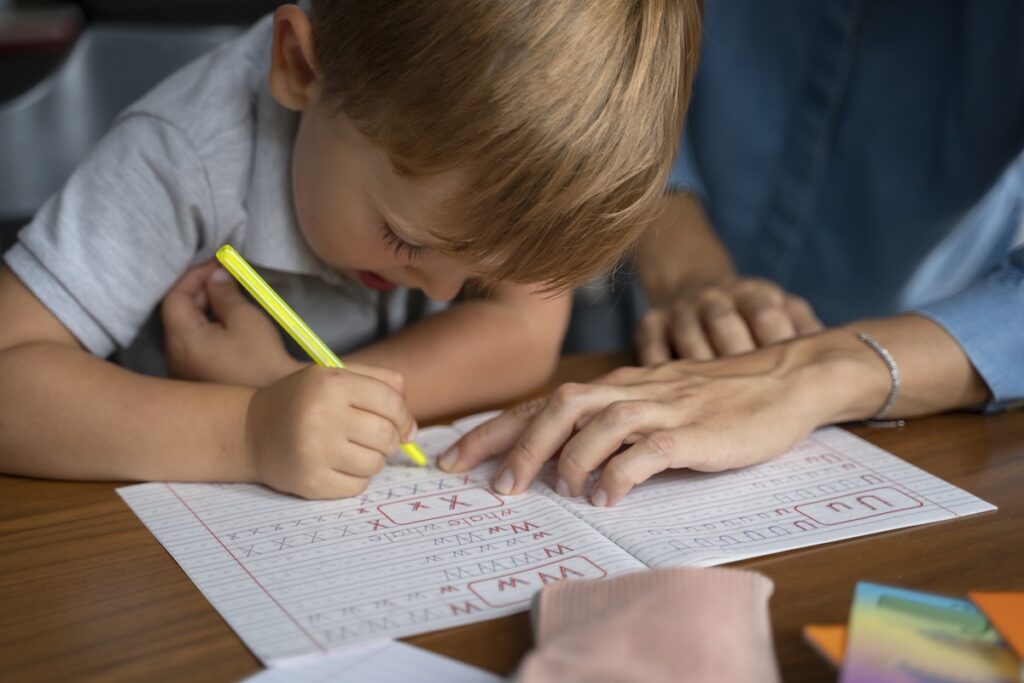

Many parents are faced with the situation: the rule is explained, but the child still writes «zhy» or confuses «ie» and «tsya». The problem is not laziness or unwillingness to learn, but the way the rules are explained to the child.
The main causes of difficulties:
- Abstract formulations: «Imperfect verbs denote a procedural action» - even an adult would think about it. But for a child, it's just noise.
- Long and complex explanations: children 6-10 years old can hold their attention for 10-15 minutes. If the explanation takes half a page, the point is lost.
- Age peculiarities of perception: up to 9-10 years thinking is predominantly visual and figurative. Grammar is a logical, abstract structure.
This is especially acute for bilingual families. The child can speak two languages fluently, but makes mistakes in Russian that are typical for native speakers: omission of soft signs, confusion in endings. The reason is the lack of intuitive sense of language, which is formed through regular communication and play.
Fewer terms, more meaning
Instead of, «It's an unstressed tested vowel in the root.»
Say: «Listen to the sound of the word: if in one word we hear river and in another - rivers, it means that where the e is heard clearly, we memorize the letter».
Replace terms with images:
- «Root» is «the main part of a word, like the trunk of a tree.»;
- «Ending» is «the clothing of a word that changes.»;
- «Preposition» is «a little bridge word: in, on, under - they don't stand alone, they always hold on to another word.».
This approach is the foundation of how to talk to your child in simple words. It reduces anxiety and engages natural curiosity.
Explain grammar using examples from life

Children memorize what is related to their experiences. Therefore, grammar for children should live in real-life situations. Examples:
Declension: «Mommy gave an apple. To whom? Mom. From whom? - Mom. You see: mama - mame - mamas - the word «dressed» in different ways, like we put on a hat, scarf, or jacket.».
Unstressed vowels: «Writing grIbs. How to check? Let's find a word where this sound will shout: grIb - so we write and».
«B» after a hiss: if we hear a soft sound, put an "A" (night, mouse).
For bilinguals, it's especially important - linking the rule to the emotion rather than the translation.
Games and visual cues
Visual and tactile perception enhances memorization. Effective techniques:
Color schemes: root - green, prefix - blue, suffix - yellow, ending - red dot.
Puzzle cards: cut out parts of words and assemble new ones.
«Rule-tale»: «Once upon a time there was a letter »b". It did not sing (did not signify a sound), but it could do magic: it made the previous letter as soft as a pillow".
Games for teaching Russian language:
- «Spelling bingo» - pictures + words with missing letters;
- «Find the twin» - find the correct word;
- «Wordsmith» - correct «swallowed» letters in sentences.
For older students - quests: decipher the message, where every mistake is a clue.
Russian language for bilingual children

In a bilingual environment, teaching Russian to a child requires a special approach:
- Don't compare it to another language («in English it's like this, but in Russian it's different»);
- Emphasize phonetics: pronounce syllables clearly, with intonation;
- Use books for bilingual children - with pictures, simple sentences, repetitive structures.
Best Practices bilingual education:
- One parent, one language;
- «Russian» days or hours - without switching to another language;
- Regular reading aloud - even 10 minutes a day builds language intuition;
- Video content in Russian (cartoons, YouTube channels like «Umnitsa», «Malyshariki»).
Helping your child with Russian language: 5 rules
- Don't scold me for making mistakes. They're part of learning.
- Praise the process, not the result.
- 10 minutes of exercise a day is more effective than 1 hour once a week.
- Connect learning with joy. After the exercise, have tea and pancakes, go for a walk or draw.
- Lead by example. Read it yourself, write notes, comment aloud.
The goal of Russian language teaching for children is not perfect knowledge of Russian language rules for schoolchildren, but confidence in speech and love for words.