
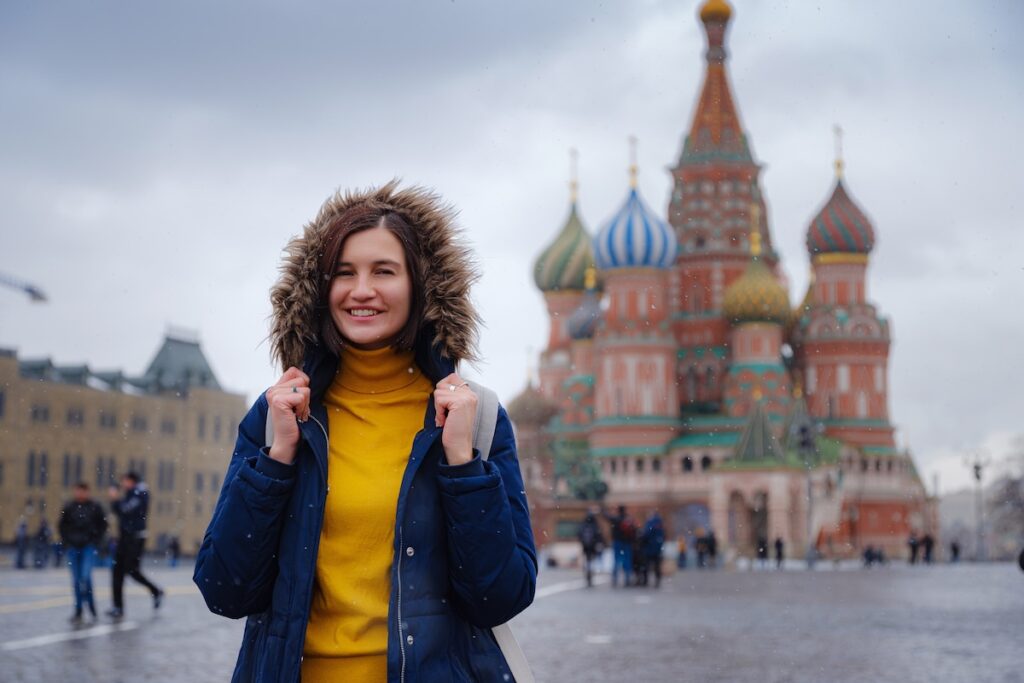

Planning a trip to Moscow, St. Petersburg or any other Russian city? Even in major cities, knowing English does not guarantee trouble-free communication. Especially outside the tourist areas: in small hotels, at train stations, in local markets or in cabs. To feel confident and show respect for the local culture, it is worth learning Russian phrases for tourists in advance.
Why learn Russian phrases before traveling
You should not expect that everyone in Russia speaks perfect English. They don't. Especially in the hinterland.
Knowing a few simple phrases is politeness. Russians appreciate the efforts of foreigners trying to speak Russian. Even a less than perfect pronunciation evokes sympathy and favor.
Basic phrases for a tourist in Russia

Basic courtesy phrases
- Hello
- Thank you/thank you very much
- You're welcome.
- Uh, excuse me.
- Goodbye
- Yes/No
Phrases at the airport and train station
- Where's the front desk?
- Where's the landing gate?
- When does train number...?
- I need a ticket to Moscow.
- One ticket, please.
Transportation and getting around the city
- How to get to Red Square?
- How much is the fare?
- Stop, please!
- Is that the bus to downtown?
- Can I pay by card?
At the hotel
- I have a reservation in my name...
- Can you put me in?
- Where's the elevator?
- Do you have wi-fi?
- Is the parking lot on?
- What time is breakfast?
In cafes and restaurants
- Can I have the menu?
- What do you recommend?
- I'll have borscht and vodka.
- No onions, please.
- The bill, please.
- Can I pay separately?
- How much do I owe you?
Emergency and important phrases
- Help!
- Call an ambulance, please!
- Where's the nearest pharmacy?
- I have allergies.
- Is it edible?
- I lost my passport.
Useful conversational phrases
- Do you speak English?
- I speak a little Russian.
- Say again, please.
- Slowly, please.
About how to speak Russian easily outside of everyday topics, we wrote in previous article.
Tourists' mistakes in Russian phrases

Even knowing Russian for a tourist, it's easy to get into an awkward situation. Here are three common traps:
Formal / informal
Using «you» instead of «you» is rude, even if the person you are talking to is younger than you. Always use «you» with strangers. The same goes for names.
Intonation and context
The phrase «Yes no» is «no.» «Now» can mean «in five minutes» or «never». «Fine» is not always a compliment: «the food is fine» = «edible, but not a delight». It is better to specify: «Did you like it?».
False friends of the interpreter
Not always Russian words mean exactly what foreigners are used to seeing.
- A store is only a store (not a «mall» - it's a shopping center or shopping mall).
- A brand is a postage stamp or an automobile stamp, but not a commodity brand (they say brand or trademark about them).
- Cute is «handsome,» not «a person who is pleasant to me.».
Memorize phrases in Russian for traveling as single blocks - this way you will avoid mistakes and misunderstandings. And most importantly, don't be afraid to speak. Even the phrase «I'm learning» with a smile will elicit a warm reaction. Russia is a hospitable country, and Russian phrases for tourists are your key to a real, non-tourist experience.