



What is early development in its healthy manifestation?
Early development does not mean «early childhood education» in the academic sense. Until the age of three, a child's brain is organized differently than an adult's. He learns not through memorization, but through emotional connections and repetition of actions in a playful way.
True early development is beneficial precisely when it respects the natural rhythms of nervous system maturation and does not force the achievement of «adult» results.
What areas include early development

True early development encompasses five interrelated strands:
Motor development
Mastering movements from rolling over and crawling to confident walking and first self-care skills.
Sensory Play
Getting to know the world through the senses: distinguishing shapes, colors, textures, sounds and smells in play situations.
Speech development
From humming and babbling to first words and simple phrases. Special attention is paid to the development of speech in babies through lively communication, reading books and song accompaniment to everyday rituals.
Cognitive development
Formation of the first ideas about cause-and-effect relations, object permanence and spatial relations.
Social-emotional development
Mastering basic emotions, attachment to loved ones, first forms of interaction with peers.
When is the best time to start early development

You can start from the first days of life. But in the form of care and communication, not «lessons».
Even a newborn baby learns through eye contact with mom, the sounds of a mother's voice, and the tactile sensations of touch.
The developmental period of children up to the age of 3 is critical: it is during these years that the basic neural connections on which future learning ability depends are formed.
However, the key principle is to follow your baby. If your baby is actively crawling, offer him a safe space to explore. If he is interested in objects, give him the opportunity to touch and explore them. Healthy early development looks like cooperative play, where the adult follows the child's initiative and gently expands the child's capabilities.
Effective activities for early development are simple and organic:
- Sorting items by color or size while cleaning toys
- Dough molding in the kitchen (development of fine motor skills)
- Reading short poems with gestures
- Walking around describing what we see around us
Myths about early development
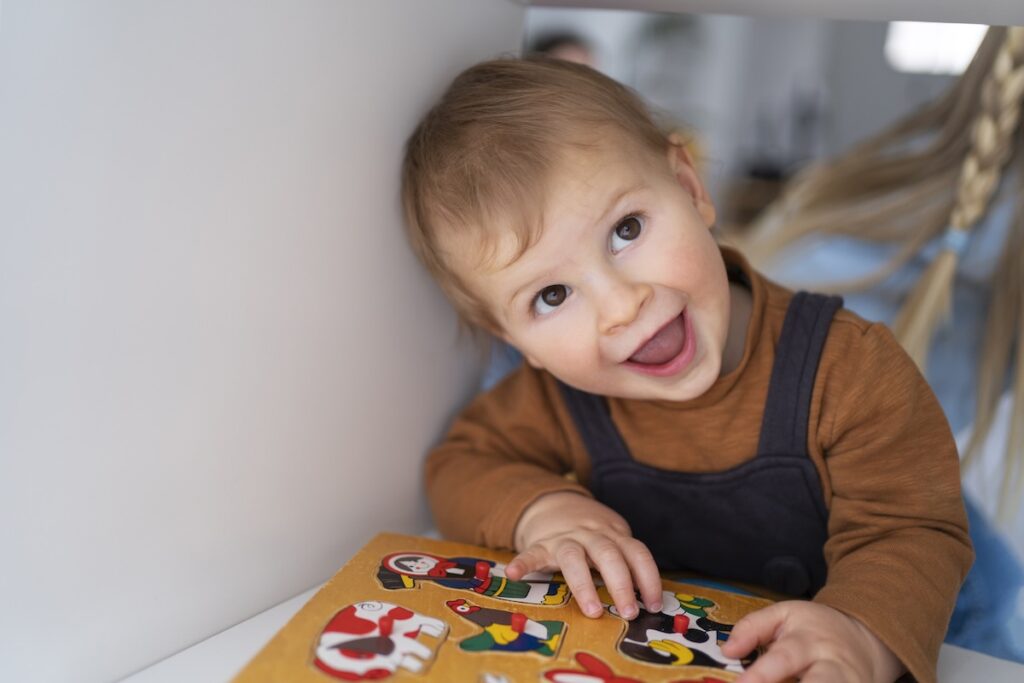
Myth 1: «The earlier a child learns to read, the smarter he or she will be.».
Reality: early stress can cause learning rejection. The brain is not physiologically ready for systematic reading until age 5-6.
Myth 2: «Developmental toys are a substitute for socializing.».
Reality: a child develops through interaction with people, not gadgets. Even the smartest toy is no substitute for live dialog.
Myth 3: «All children should develop on the same schedule.».
Reality: developmental norms have a wide range. One child will walk at 10 months, another at 14 months, and both can be healthy.
True early childhood development is not about chasing results, but about creating an environment where your baby feels safe, loved, and free to explore the world at his or her own pace.