


It seems obvious to adults: a week consists of seven days, they go strictly in order, and each day has its own name. But for a child it is a real puzzle.
Toddlers think concretely. They see a toy, feel hunger, are happy to go for a walk. But «Tuesday» or «Friday» is not an object, not an action, not an emotion. It is a time stamp that cannot be touched or seen.
This is why children often confuse «yesterday», «today» and «tomorrow». For them, «yesterday» can mean any event that has already happened. Even a week ago. And vice versa. «Tomorrow» is anything that hasn't happened yet.
Such confusion is a normal part of children's speech development. It is just that the brain is not yet ready to operate complex temporal constructions.
At what age to teach the days of the week and how to do it

There is no single «right» age. But there are age milestones that help you understand what to expect.
At 2-3 years old, the child is just beginning to distinguish the sequence of events: «first dinner, then sleep».
At this age, you can simply name the days out loud: «It's Monday - that means we have music class!». It's just familiarizing yourself with the time.
By the age of 4-5, children are already able to notice cycles: «We go to the pool on Wednesdays», «There is always pizza on Friday». This is the time when it is useful to start teaching the days of the week in a more focused way. You can use a calendar, songs, cards.
At 6-7 years of age, conscious understanding comes. The child begins to connect the days of the week in order with real events: school schedule, clubs, weekends. He can already answer: «And in two days we have a test!» This is an important stage of preparation for school.
And for schoolchildren, the days of the week become a planning tool. They learn to navigate the school schedule, prepare for lessons in advance and understand that «tomorrow is math and the day after tomorrow is physical education.
How to explain the days of the week without rote learning
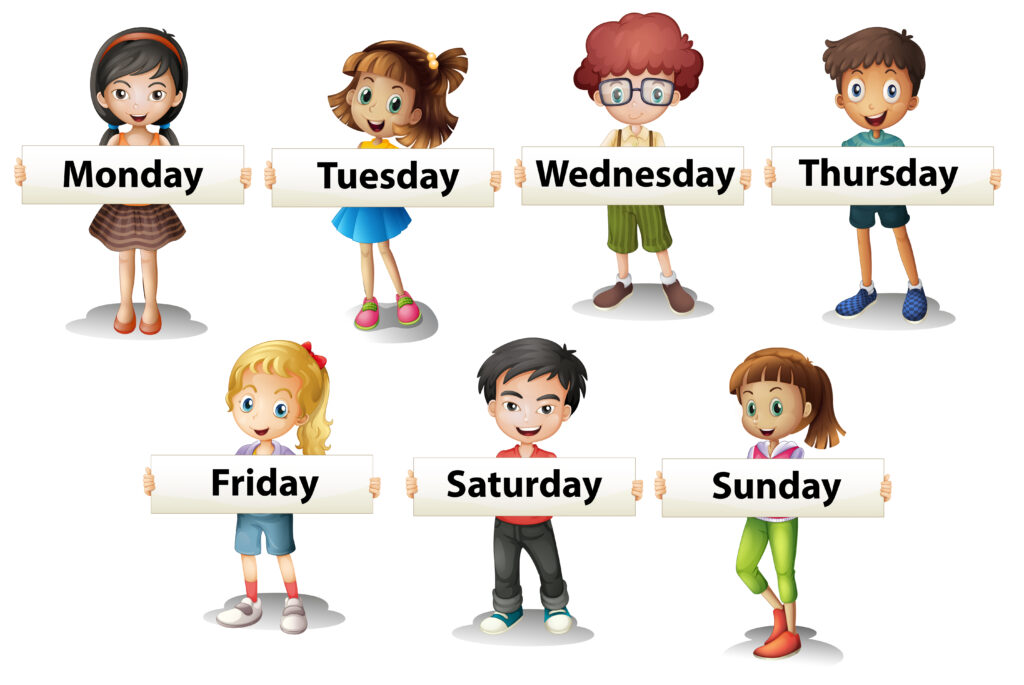
The main rule: no rote learning! Children learn best what is relevant to their lives. Here are some tried and tested methods:
Calendar with pictures
Each day is a different icon:
- Monday - sun
- Tuesday is a book
- Wednesday is a ball, etc.
In the morning, celebrate the current day with your child.
Songs and rhythms
Such short rhyming lines are easy to memorize.
Games
Play «store»: «Today we have discounts on Thursdays!» Or «mail»: «The letter arrived on Wednesday, but we'll send a reply on Friday».
Daily phrases
Talk about the days in context, «Saturday we will go to Grandma's», «Sunday is a rest day».
It is a typical mistake for parents to ask, «What day is today?» like an exam. It's better to say, «Oh, it's Thursday! That means we'll watch a cartoon tonight!» That way the child will make the connection himself.
If your child confuses days, don't correct abruptly. Say, «Do you think today is Tuesday? Do you remember yesterday we made pancakes? And we bake pancakes on Mondays. So today is Tuesday!» That way you're not just giving the right answer, you're showing logic.
Days of the week and a baby's speech development
When a child begins to use the phrases «last week,» «in three days,» and «every Friday,» he or she is learning to construct complex sentences, express cause-and-effect relationships, and plan for the future.
Such skills are critical for successful learning in school. Especially in Russian language lessons for children where retelling, composing or working with text is required.
In addition, saying the days develops phonemic hearing (especially difficult sounds like the «ch» in «Thursday») and expands vocabulary. When teaching children at home, parents can use the days of the week as a theme for conversations, drawings, and crafts - all of which make learning lively and meaningful.
Days of the week for children is not just a list of words. It is a key to understanding time, order and their role in the world. Approach it with patience, humor and play - and soon your baby will remind himself: «Mommy, tomorrow is Friday!».